The morning your foundation feels like a stranger
Have you ever come home from a week at the beach, started applying your usual foundation on Monday morning, and stopped mid-stroke? That odd, chalky float of a shade that no longer belongs to your face. The closet does the same thing: the soft pastel shirt that carried you through spring suddenly looks flat, and a deep color you rarely wear starts working strangely well.
That is when the classic summer question arrives: 'I was a spring warm — did the tan turn me into an autumn warm?' Today we take that question seriously for fun, walking through the science of how skin tans and the answer color practitioners give. The usual premise holds here too: personal color is a styling reference to enjoy, not a rulebook.
Skin tans not once, but twice
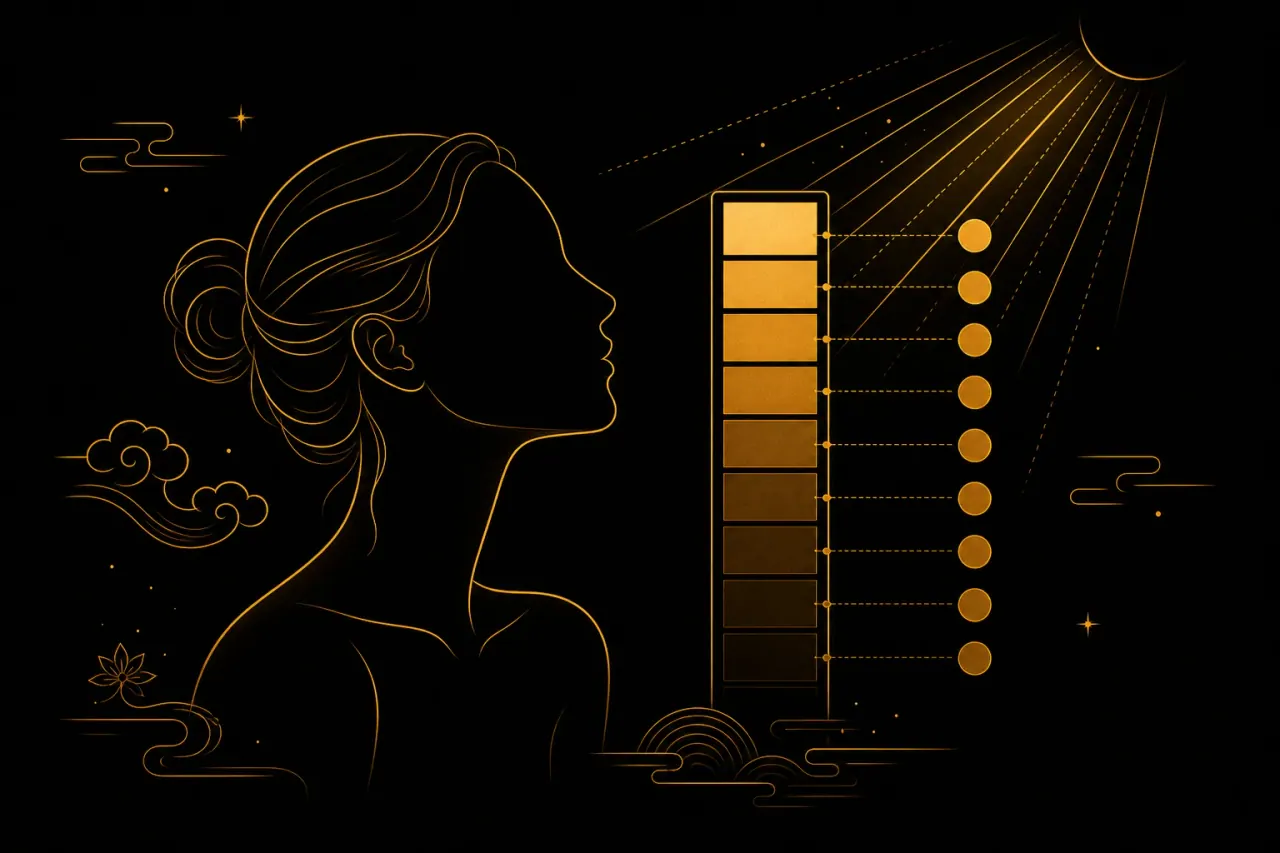
Photobiology references describe skin darkening in two main stages. The first is called immediate pigment darkening: within minutes of sun exposure the skin looks slightly darker, but this comes from existing melanin oxidizing rather than any new melanin being made, so it often fades within minutes to days.
The second stage is the tan we actually mean: delayed tanning. Melanocytes respond to UV by producing new melanin and sending it up into the skin's outer layers, and that takes time. It typically becomes visible three to four days after exposure, peaks somewhere between ten days and a few weeks, then fades gradually over the following weeks. There is a reason you look most tanned the week after the vacation — it was on the schedule all along.
One thing to make explicit: tanning and UV sit right next to skin health, so questions like how to use sunscreen belong to dermatologists and official health guidance, not to this article. We borrow only the timetable of color change here — please enjoy the rest as styling talk.
The color-practice answer: depth shifts, undertone stays
So do you need a whole new color analysis for tanned skin? Here comes the distinction color practitioners lean on: splitting skin color into two axes called depth and undertone. Depth is how light or dark the surface of the skin currently is; undertone is the cast underneath — the warm yellow-golden or cool pink-blue direction.
Many consultants explain that what a tan changes is mainly depth, while undertone is an inborn base that rarely moves. More melanin makes the surface darker and shifts your contrast, but the warm-versus-cool direction itself seldom flips. So rather than 'a spring warm becomes an autumn warm,' the common practice view is closer to 'a season arrives when the deeper, calmer colors within your own palette suit you best.'
That said, this distinction is a working rule accumulated in practice, not a law established in a lab. People tan to different degrees in different ways, and any analysis is itself a reference that wobbles with lighting and condition. It is enough to take it lightly: the summer you and the winter you naturally reach for slightly different clothes.
How to play with a tan
Now that the theory is done, the fun begins. The few weeks after a tan are the best time of year to run color experiments you would normally skip.
Base, clothes, then accessories
For base makeup, compare against the jaw-neck boundary rather than the face alone, and try adjusting by half a shade to a full shade. Keeping one darker summer shade to mix with your usual one wastes nothing. With clothes, rather than replacing your palette wholesale, test colors one step deeper and more saturated within your usual family — safer, and more fun. The many reports that white shirts and vivid primaries look especially good in this period come down to contrast with deepened skin.
As for accessories, this is the season with the most 'gold suddenly glows on me' testimonials. But this too is play, not law: hold gold and silver side by side against your wrist and choose whichever looks brighter on that day's skin. That comparison is the most honest method there is.
| Item | Before the tan | Post-tan reference point |
|---|---|---|
| Base makeup | Your usual shade | Compare at the jaw-neck line; adjust by half to one shade, mix a summer shade |
| Clothing colors | Your usual palette | Test one step deeper and more saturated within the same family |
| Contrast | Your usual contrast | White and vivid primaries pop against deepened skin |
| Accessories | Your usual metal | Gold often glows this season — but the wrist test decides |
| Photos | Your usual setup | Lighting and white balance exaggerate or flatten a tan — compare in natural light |
The tan in your photos is a separate question
The final variable is the camera. The same tan can photograph far darker or flatter depending on lighting and white balance. Under yellow indoor light, tanned skin easily sinks into dullness; under harsh midday sun it gets exaggerated along with shine. Soft window light is, once again, the safest answer.
So if you want to see what the tan really changed, shoot before and after in the same place, at the same time of day, with the same camera. That 'wow, I got so dark' verdict from two selfies days apart is often an illusion built by lighting more than by skin. Color is always a collaboration between skin and light — if you take one sentence from this article, let it be that one.
Frequently asked questions
Should I get a new color analysis after tanning?
The common view among practitioners is that undertone stays while depth shifts temporarily. So rather than re-testing, most suggest exploring the deeper, calmer colors within your existing palette. If you do want to check, do it in natural light in a season when your skin is back to baseline — and either way, treat it as a fun reference.
Why do I look most tanned the week after vacation?
Because delayed tanning — the production of new melanin — starts becoming visible around three to four days after exposure and peaks between ten days and a few weeks. It is a slow second wave, separate from the immediate darkening you noticed on the beach.
Does tanned skin always call for gold accessories?
This is the season with the most gold success stories, but it is not a rule. Holding gold and silver side by side against your inner wrist and picking whichever brightens that day's skin is always the most reliable method. Plenty of cool-undertone people still feel most at home in silver after a tan.
Why do photos show me more or less tanned than the mirror?
Camera white balance and lighting color. Yellow indoor light tends to dull a tan, while harsh direct sun exaggerates it. For a fair before-and-after comparison, shoot in the same place, at the same time of day, with the same camera.
Article info & references
Published July 4, 2026 · Last updated July 4, 2026
- Photobiology literature on skin pigmentation responses to solar-simulated radiation — the time course of immediate pigment darkening (IPD) and delayed tanning (e.g., Miller et al., Pigmentation effects of solar simulated radiation, open-access on PMC)
- Consultant references on the depth-versus-undertone distinction used in personal color practice and tanning (yourcolorguru.com, yourcolorstyle.com, and similar)
- For UV and skin health, dermatologists and official health guidance are the authority — this article covers styling reference only