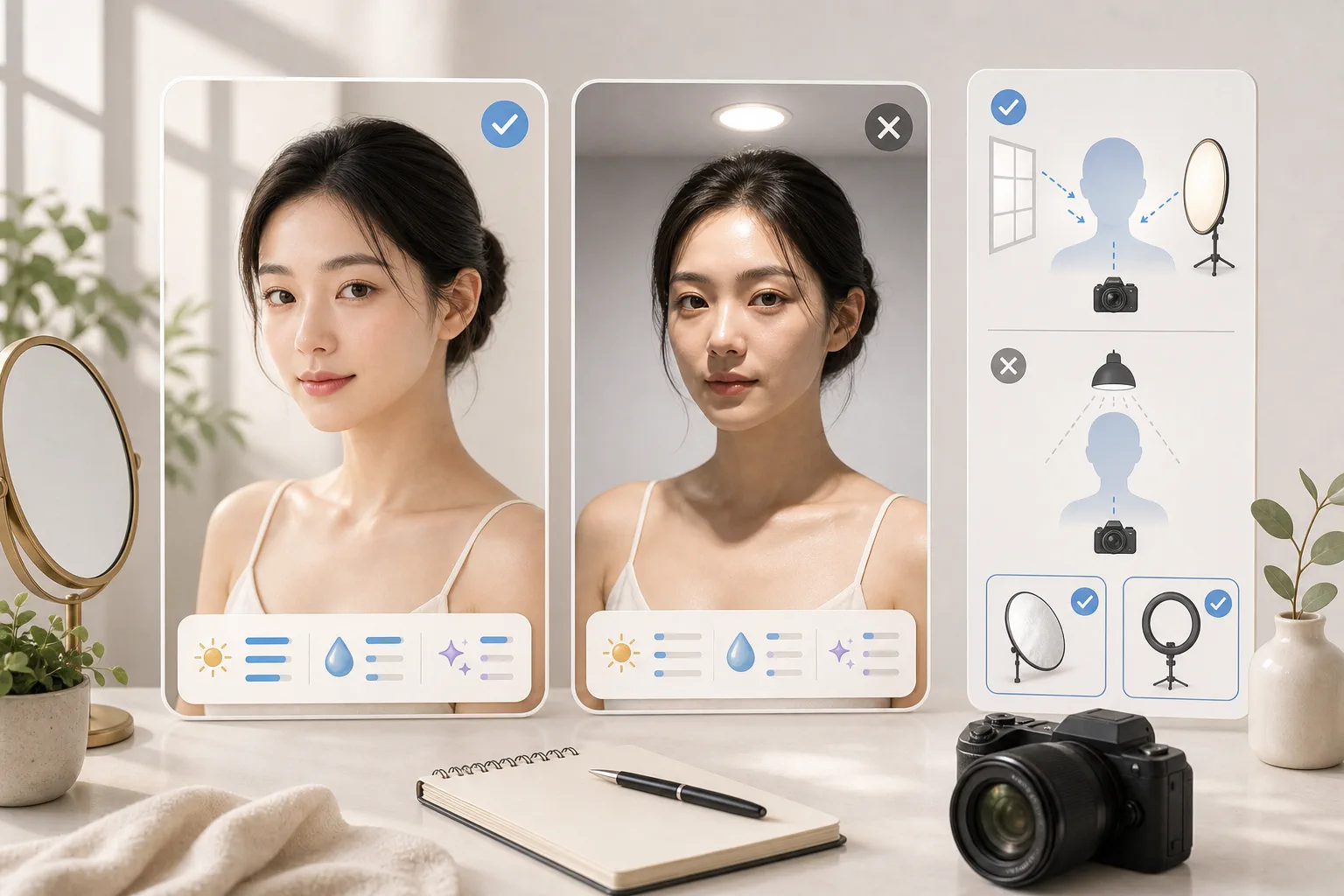
Why Summer Light Reshapes Your Impression
The same person in the same outfit can look noticeably different in vacation photos than in everyday selfies. A face that looked soft in front of the mirror can read as sharp, even a little hard, at the beach — then suddenly relax the moment you step into the shade. What changed isn't the face; it's the light falling on it.
Summer light is the strongest and steepest of the year. At midday the sun pours almost straight down from overhead, casting deep shadows under the brows, the nose, and the chin. The bigger the gap between light and shadow, the more a face's contours get exaggerated, which can make an impression look harsher or more tired than usual.
One promise first. The impressions in this article are only about visual mood in a photo — they have nothing to do with anyone's personality or ability. Handling light a little differently is just the fun of getting a frame you like more, so read this as light play rather than a search for the right answer.
Midday Sun — the Hardest Light to Handle
The light you meet most often on a trip is also the trickiest: direct midday sun. Between roughly 11 a.m. and 3 p.m. there is plenty of brightness, but the direction comes from so high above that it's surprisingly unflattering for portraits.
The trap of light pouring from above
When light drops from straight overhead, the forehead and nose bridge blow out bright while the eyes sink into shadow — the classic raccoon-eye look. On top of that, the glare makes you squint, so the expression stiffens and the impression turns even sterner.
Instead of forcing your eyes wide open, drop your gaze slightly or shoot on the beat right after a blink — it reads far more relaxed. Simply not facing the sun head-on already cuts the squinting.
Why a moment of shade is the answer
The simplest fix is a few steps into the shade. Under a parasol, a tree, or a building's eaves, the harsh vertical light turns into soft, scattered light. The shadows under your eyes fade and your skin tone evens out.
Shade doesn't mean a dark photo. In summer the ground and walls around you are so bright that reflected light fills your face even in the shade. It often gives more natural dimension and a gentler impression than direct sun.
Sea, Sand, Pool — Make Reflected Light Your Ally
Summer destinations come with giant reflectors you rarely see other seasons. White sand, sparkling sea, pool water, and bright decking all bounce light back up as natural fill. Used well, this reflected light fills the shadows under your face and brightens your impression without any gear.
The method is simple. Stand with bright sand or water below your face and the light rising from underneath softly fills the shadows under your chin and eyes. The heavy midday shadow lifts, and your expression looks clear yet relaxed. If a too-strong reflection makes you squint, just pick a moderately bright surface instead.
The table below sums up, at a glance, how your impression shifts under the light situations you meet most on a trip, and how to handle each. Treat it as a reference for a frame you like more, not a rule.
| Light situation | Effect on impression | Quick fix |
|---|---|---|
| Midday direct sun | Under-eye shadow and squinting; strong, tired look | Move to shade, drop your gaze a little |
| Sea / sand reflection | Light fills from below; bright, clear look | Put a bright surface below your face |
| Tree / parasol shade | Scattered light; soft, relaxed look | Use front light in overhead shade |
| Golden-hour side light | Warm color and natural dimension | Sun to the side, a few quick frames |
| Backlight | Dreamy if right, dark silhouette if wrong | Add reflected fill or raise exposure |
Shade and Golden Hour — Using Soft Light
If you had to name the time of day portraits look best, it's golden hour near sunset. As the sun drops low and light comes in from the side at an angle, faces gain natural dimension and colors warm up. The same spot gives a completely different mood at noon versus golden hour.
Early-morning light is similarly soft. In the thick of a heat wave, shifting your photo time to morning and evening cools you off and flatters your impression at once. Overcast days, with their weak light and faint shadows, are also surprisingly kind to portraits.
Golden hour changes fast, though, so don't be greedy — grab just a few quick frames. Keep the sun to your side or behind you while positioning your face to catch reflected light, and you get both soft contours and a bright tone.
Backlit Selfies — the Small Difference Between Hit and Miss
Shooting with the sun behind you can create a dreamy frame with a rim of light around your hair — or, done wrong, a silhouette with your face lost in black. The difference is surprisingly small.
The key is to give your face its own light. A bright wall or sand in front bounces fill onto your face, and nudging your phone's exposure up to meter for your face keeps the expression clear even if the background blows out a little. Even a light touch of portrait mode or exposure compensation changes the result completely.
If the light is still so strong your face comes out dark, don't insist on backlight — just turn your body slightly into side light for a quick fix. Rather than cramming everything into one shot, it's easier to shift position a bit and take several frames.
A Lighter Mindset for Vacation Photos
For all these light tips, the most important thing in a vacation photo is really the mood of the moment. Reshooting endlessly for one good frame while missing the scenery and the time gets it backwards. Know your feel for light, but don't cling to the perfect photo.
And if you don't love your impression in a shot, don't worry too much. Strong summer light makes anyone's face look different from usual, and that's just a momentary mood the light created. It never defines who you are.
FaceOracle, too, only reflects the visual mood of a photo for fun — it doesn't rate which photo is better or judge anyone's personality. Remember that the photos you bring home aren't something to be scored, but a record of a moment you enjoyed.
Frequently asked questions
What if I have to shoot outdoors at midday?
The easiest move is a few steps into shade under a parasol, tree, or eaves. The light that was pouring down softens and scatters, the shadows under your eyes fade, and your expression relaxes. Even in shade, reflected light from nearby sand or water brightens your face plenty, so you don't need to worry about it being too dark.
Don't sunglasses hide my impression?
They do cover your eyes, but in strong sun, wearing them often reads as more relaxed than squinting. Take them off for frames where the expression matters, and keep them on when you want a cool, breezy vacation mood — choose by the situation. There's no single right answer.
Does FaceOracle pick my best vacation photo?
FaceOracle only reflects the visual mood of a photo for fun; it doesn't score or pick which photo is better, and it isn't a tool for judging looks or personality. Use the table's tips as a starting point, and in the end, trust your own eye to choose the shot you like.
Article info & references
Published June 27, 2026 · Last updated June 27, 2026
- General photography and lighting concepts on how a light source's direction, intensity, and color temperature affect a subject's impression
- General principles of natural-light shooting such as backlight and reflected fill
- General photography principles such as the rule of thirds in composition
- General social-psychology concepts such as the primacy and halo effects on first impressions