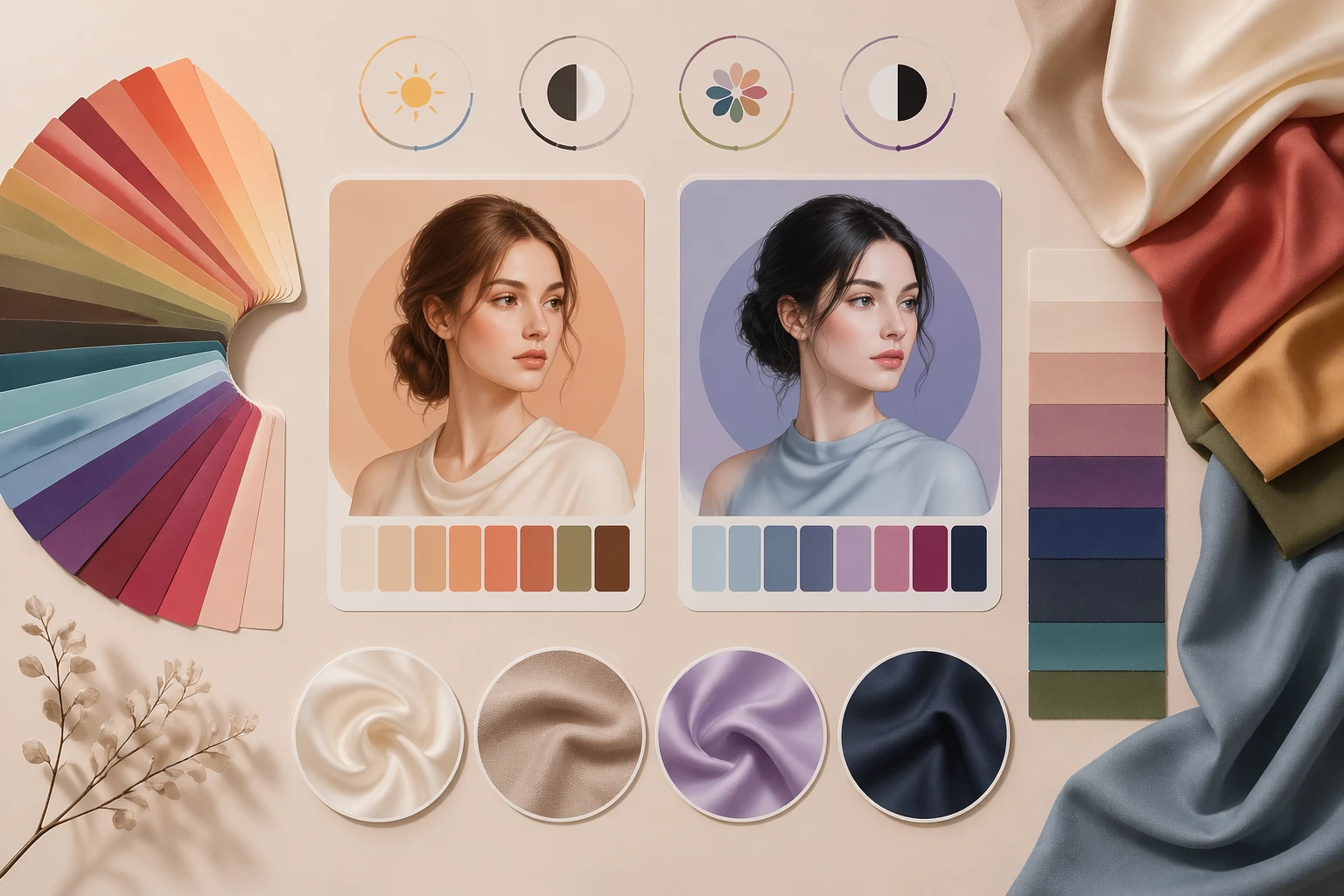
The Palette Is Done, but the Closet Feels Stuck
After finding your personal color, you walk away with a pretty palette card. Yet standing in front of the closet each morning, that card and your actual clothes do not connect, so you reach for the same safe outfit again. A palette is only a set of colors — it does not tell you the order or the rules for wearing them. This guide builds the bridge between the card and the closet.
The point is not to memorize colors but to build a system. Once you decide which colors sit near your face, how few colors run your wardrobe, and how to mix without misses, morning decisions shrink fast. We will not re-explain the self-check process. Assuming you already know your season, we focus only on actually wearing the result.
Anchor the Colors Near Your Face First
The most important rule is that the closer a color is to your face, the more it should match your tone. Tops, shirt collars, knits, scarves, and mufflers catch light and reflect it onto your skin. A flattering color makes your face read clearer and brings back a healthy glow, while a wrong one deepens under-eye shadows and looks dull.
That makes your spending priority clear. Concentrate your season colors on the items that come near your face, and do not compromise there. Far-from-face pieces like trousers, skirts, and shoes can drift a little off-tone with little effect on your overall look, so choose them more freely. Just grasping this idea of distance cuts a lot of shopping mistakes. A wide collar or a high-neck knit carries a large area of color, so it is worth picking with extra care.
Run the Wardrobe on a Small Core Palette
The reason a full closet still has nothing to wear is usually that the colors clash and refuse to mix. The fix is a small core palette. Within your season, pick two or three flattering neutrals as your base, then add only two or three accent colors. Narrowing to about five or six colors lets nearly every combination fall into place.
Put neutrals on the staples you buy often and wear long — coats, trousers, basic tops, the pieces in heavy rotation. Use accents in small areas like a scarf, a knit, or a bag to shift the daily mood. Cutting colors feels like a loss, but it actually multiplies the outfits you can build. For dividing color, the 60-30-10 rule is an easy memory aid: use the base widest, the secondary next, and the accent narrowest for a put-together look.
The Capsule Wardrobe, a Smaller Closet
Translate the core palette into a count of garments and you get a capsule wardrobe — a small set of pieces that freely mix to make many outfits. If a few tops, a few bottoms, one or two coats, and a couple of pairs of shoes all share one core palette, any top over any bottom keeps the colors in agreement.
Set up this way, choosing clothes becomes almost automatic. With no matching to puzzle over you save time and curb impulse buys. The test for a new piece gets simple too: does it mix with at least three items already in the closet? If not, however pretty, it stays unworn. When seasons turn, keep the base and swap only a few accent colors to refresh the whole feel.
Safe Combinations That Do Not Miss
If mixing feels hard, start from proven safe combos. The first is shades of one color: pairing a lighter and a darker tone of the same family top and bottom looks calm and polished. The second is one neutral plus one accent: over a beige or gray base, lay exactly one point color and it never goes overboard.
Matching temperature matters too. Group warm with warm and cool with cool for a steadier blend. Pair yellow-leaning colors with other warm tones and blue-leaning colors with cool ones. As a starter exercise, cap each outfit at three colors or fewer. Once that feels easy, widen your range by mixing only chroma within the same temperature.
Quick Wardrobe Keys by Season
If you are a Spring type, clear and fresh colors suit you. Build on warm ivory or camel, then add lively accents like coral or light green to brighten the face. If you are a Summer type, soft and cool colors feel easy. Base on soft gray or light navy, with slightly blue-leaning points like lavender or rose pink.
If you are an Autumn type, deep and calm colors give weight: use khaki, brown, and mustard as a base with a warm accent like terracotta. If you are a Winter type, crisp high-contrast colors come alive: build on charcoal, deep navy, or pure white with a vivid red or cool blue point. Whatever the season, the rule stays the same — base wide, accent narrow.
Start Small Today
You do not need a perfect closet all at once. Today, lay out only the tops that come near your face and pick five that match your season well. Those five are the starting point of your core palette. Add one matching bottom and one accent and an outfit for today is ready.
All the colors and combinations here are for-fun styling references. Flattering ranges shift with hair color, makeup, and the light of the day, so use the rules only as a starting point and trust your own eye while comparing in the mirror.