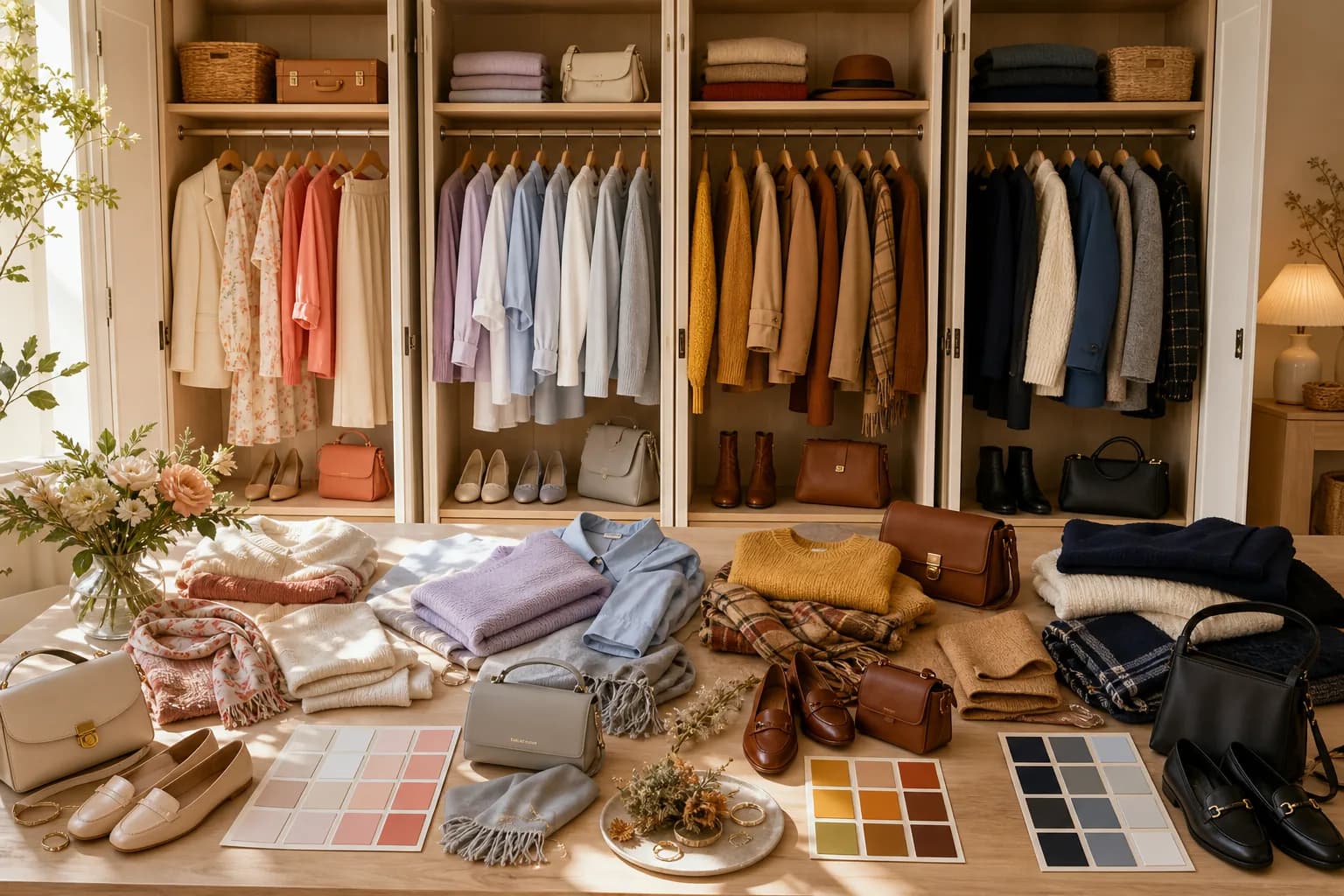
Capsule Wardrobes: Why Start With Color?
You know that morning where you stand in front of the closet, hesitate forever, and end up grabbing the same outfit again? Often it isn't a lack of clothes but a lack of pieces that actually work together. That's why capsule wardrobes are so popular now: a small set of clothes that mix into many outfits. The trick isn't cutting the number of items, it's unifying the colors so everything pairs.
A palette is the set of colors that runs through your whole closet. When you decide a few colors in advance and only buy within them, anything you pull out simply fits. It's a bit like a painter limiting their colors to keep a single canvas cohesive. The fewer colors you allow, the more freedom you actually gain in combining them.
In this guide we'll walk through the three-color base, accent, and neutral structure, then season-by-season palettes for spring, summer, autumn, and winter, and finally the 7:2:1 area rule. It may sound technical, but once the principle clicks you'll have a steady standard that keeps you grounded while shopping. By the end you'll be able to picture organizing your closet by color.
The Three-Color Structure: Base, Accent, Neutral
The easiest way to start a palette is to give each color a role. Think in three groups, base, accent, and neutral, and the closet suddenly feels simpler. Because each color does a different job, nailing these three lets the rest fall into place. Below we'll break down base and accent one at a time.
Base Colors — The Large Surfaces
The base is the core color that covers the most surface area in your closet. It lives on bulky pieces like coats, trousers, and knitwear, and its strength is mixing easily with almost anything. Narrowing it to one or two colors slashes morning decisions. A stable base means any color you layer on top won't clash.
When choosing a base, picture the situations you dress for most. If you commute a lot, calm tones suit you; if your days are casual, softer tones feel right. One handy tip: simply accept the color you already own most of as your base. Working with what you have is far more practical than buying everything new.
Accent Colors — The Eye-Catching Touch
The accent is the color that shifts the whole mood with very little surface. Used on small items like scarves, bags, socks, or a lip tone, it makes the same outfit feel new. Because the area is small, you can take a chance on a bold shade you'd normally avoid. One accent gives a flat outfit a bit of expression.
It's best to limit accents to one or two colors. Too many scatter the eye and end up looking less tidy, not more. A color that contrasts slightly with the base draws a natural glance, while a similar tone reads calm and refined. Decide which mood you want first and the choice gets easy.
Season-by-Season Palettes for Spring, Summer, Autumn, Winter
As seasons change, the color temperature of daylight and the fabrics you wear shift, so the same clothes look different. Rather than forcing all four seasons into one palette, it's practical to swap the main colors a little each season. Spring leans bright, summer cool, autumn deep, and winter into crisp contrast. The table below lays out base, accent, and capsule item picks per season, so compare it against your own closet.
Treat the table as a starting point, not a shopping list. Instead of buying exact matches, find the closest colors among the clothes you already have and pair from there. Swapping just one or two items at the turn of a season can change the whole impression of a wardrobe. Above all, remember that color is a matter of taste, not a right answer.
| Season | Base color | Accent color | Capsule item picks |
|---|---|---|---|
| Spring | Ivory, light beige | Coral, light green | Light trench, pastel cardigan |
| Summer | White, soft gray | Sky blue, lavender | Linen shirt, cool-tone scarf |
| Autumn | Camel, brown | Mustard, burgundy | Knit vest, leather tote |
| Winter | Charcoal, black | Icy white, deep red | Wool coat, crisp-color muffler |
Connecting It to Your Personal Color
Referencing your personal color makes choosing palette shades much easier. Personal color is a styling concept for the set of colors that harmonize with the tones of your skin, hair, and eyes. That said, it isn't a tool that pins a person down to one fixed type; it's just a reference frame for finding shades that tend to look good on you. Since the same color can read differently under various lighting, makeup, and fabrics, there's no need to box yourself in too strictly.
To start simply, stand in front of a mirror and compare whether warm or cool shades make your face look brighter. Many find that if gold accessories suit you, you lean warm, and if silver looks cleaner, you lean cool. Use a self-check to get a rough direction, then pick base and accent colors to match it. It's fine if you're unsure; you narrow color down by trying things on anyway.
One thing worth noting here: the colors that suit you don't reveal your personality or character. A first impression or the feeling a color gives is just an impression, and it isn't the same as the actual person. So enjoy color lightly, not as a label that defines you, but as a tool for choosing the mood you want to show that day.
Setting Proportions With the 7:2:1 Area Rule
Once your colors are set, it's time to decide how much of each to use. The 7:2:1 rule, used across interiors and fashion, shines here. Roughly 70 percent goes to the base, 20 percent to a secondary color, and 10 percent to the accent. Keeping this ratio alone makes outfits look balanced rather than uneven.
For example, matching top and bottom in a calm base fills the 70 percent, a light outer layer or knit adds the 20 percent, and a bag or scarf supplies the 10 percent accent. Since the accent is small, even bold colors slip in without feeling heavy. Conversely, expanding the accent area feels lively and shrinking it feels calm, so adjust to your mood that day.
The nice thing about this rule is that it guides new purchases too. Asking yourself 'is this a 70 piece or a 10 piece?' cuts down on impulse buys. Run color within the ratio and your closet stays orderly even as it grows. The numbers aren't there to memorize but to build the instinct of safe colors for large areas and bold colors for small ones.
A Pre-Shopping Checklist
Finally, here are a few things worth checking before you head out to shop. First, save your palette's base, accent, and neutral colors as a phone note or photo. When you waver in a store, that one note becomes a reassuring standard. Then mentally picture whether a new piece pairs with at least three clothes you already own.
Check the lighting too. Store lights, yellowish or white, can make colors look slightly off, so confirm the color near natural light when you can. In front of the mirror, see whether your face looks dull or whether the garment's color comes through crisply. For online buys, allow for the screen color differing from the real thing.
Most of all, build the habit of buying not because it's pretty but because it fits your palette, and the closet gradually tidies itself. Reducing colors isn't giving up style; it's making daily choices easier. Open your closet today and decide just one base color to start. One small standard can make tomorrow morning feel a lot lighter.
Article info & references
Published June 7, 2026 · Last updated June 7, 2026
- General color-theory concepts such as the Munsell system — distinguishing hue, value, and chroma
- The 60-30-10 (7:2:1) color-distribution principle widely used in interiors and fashion
- Capsule wardrobe — a common styling concept of building outfits from a small set of clothes
- General social-psychology concepts such as the primacy effect and halo effect in first impressions