Why four seasons aren't enough
Most people first learn personal color as Spring, Summer, Autumn, and Winter. But while shopping you hit fuzzy moments — "I'm Cool Summer, so why do pastels flatter me while vivid colors feel like too much?" That happens because each season splits further. Pro analysis divides the four seasons into four again, for sixteen types total — a finer map for narrowing down "your" colors.
The second axis behind 16 types
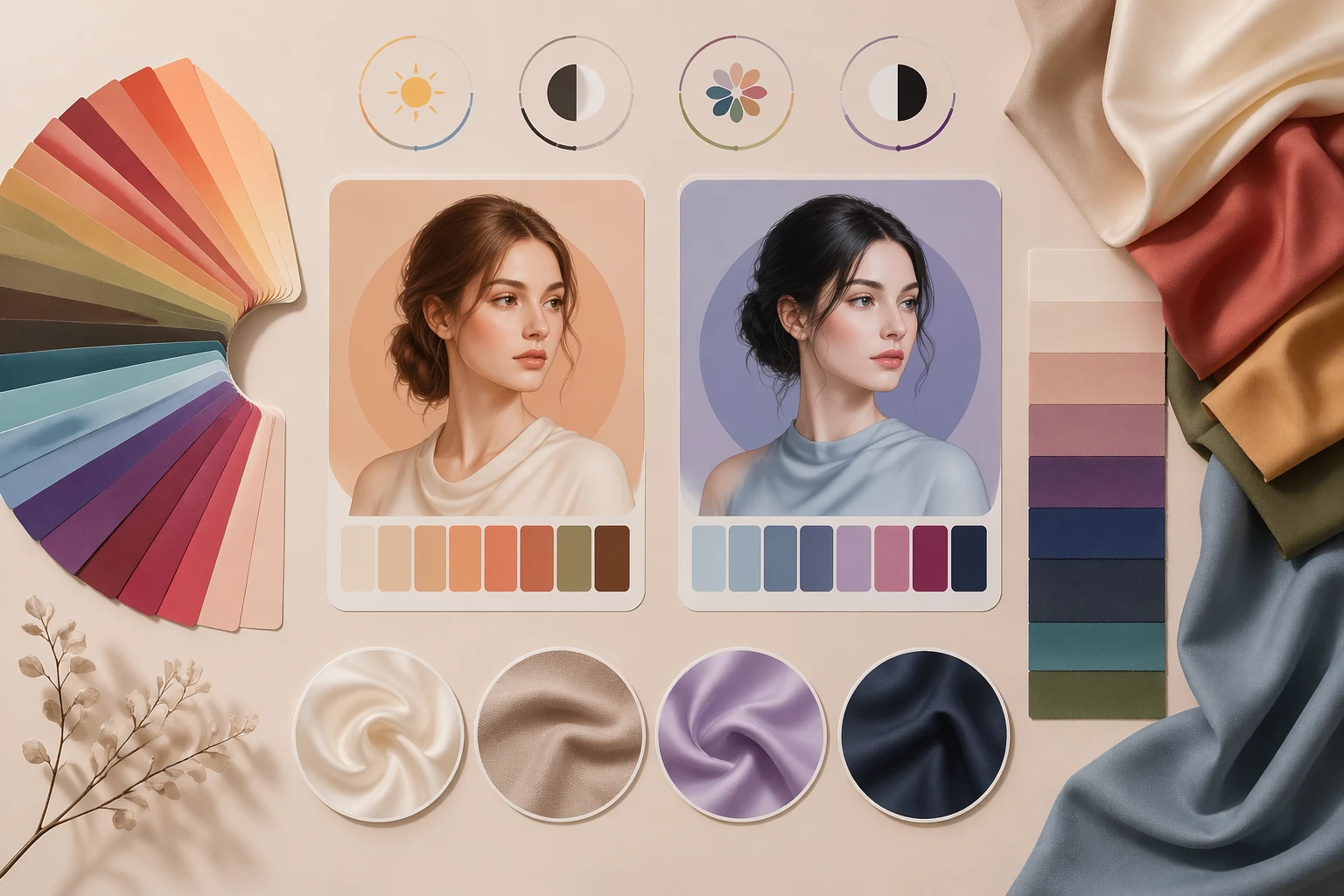
If the four seasons split by temperature (warm/cool), the 16 types add value, chroma, and contrast. Each season usually breaks into Light, Bright/True, Muted/Deep, and a temperature-leaning variant — e.g. Light Spring, Bright Spring, Warm Spring, True Spring; Light Summer, Muted Summer, Cool Summer, True Summer, and so on for Autumn and Winter.
Three questions to narrow your sub-type
You don't need to memorize all sixteen. First: do light or dark colors make your face read clearer? Light points to the Light family, dark to Deep. Second: do clear or mutedcolors bring life to your skin? Clear means Bright/True, muted means the Muted family. Third: does soft or strong contrast look natural on you? Big differences between hair, eyes, and skin suit high-contrast Winter/Bright palettes.
A one-line style key per family
Light types live in soft, airy pastels; tone down any high-chroma color. Bright types light up from a single clear accent color. Muted types are most at ease in beige and greige mid-tones, using vivid colors only in small areas. Deep types find their center in rich, dark colors, while very pale colors wash them out.
16 types are a starting point, not a cage
One caution: the 16 types are coordinates that reduce shopping mistakes, not boxes that define you. Most people sit on a border between two types, and the coordinate drifts when you change hair color or get a tan. So instead of "I'm strictly Cool Winter," remember something like "I read clearest in clear, high-contrast colors" — and you'll stay steady in front of any wardrobe.
A mini experiment to try today
Drape a white cloth over your shoulders, take a selfie in natural light, then swap in a bright pastel, a clear primary, and a deep dark cloth in the same spot. Compare the photos: where do the shadows under your eyes fade and your face read clearer? That tells you which of the sixteen groups you sit closest to. Treat it all as a for-fun styling reference.