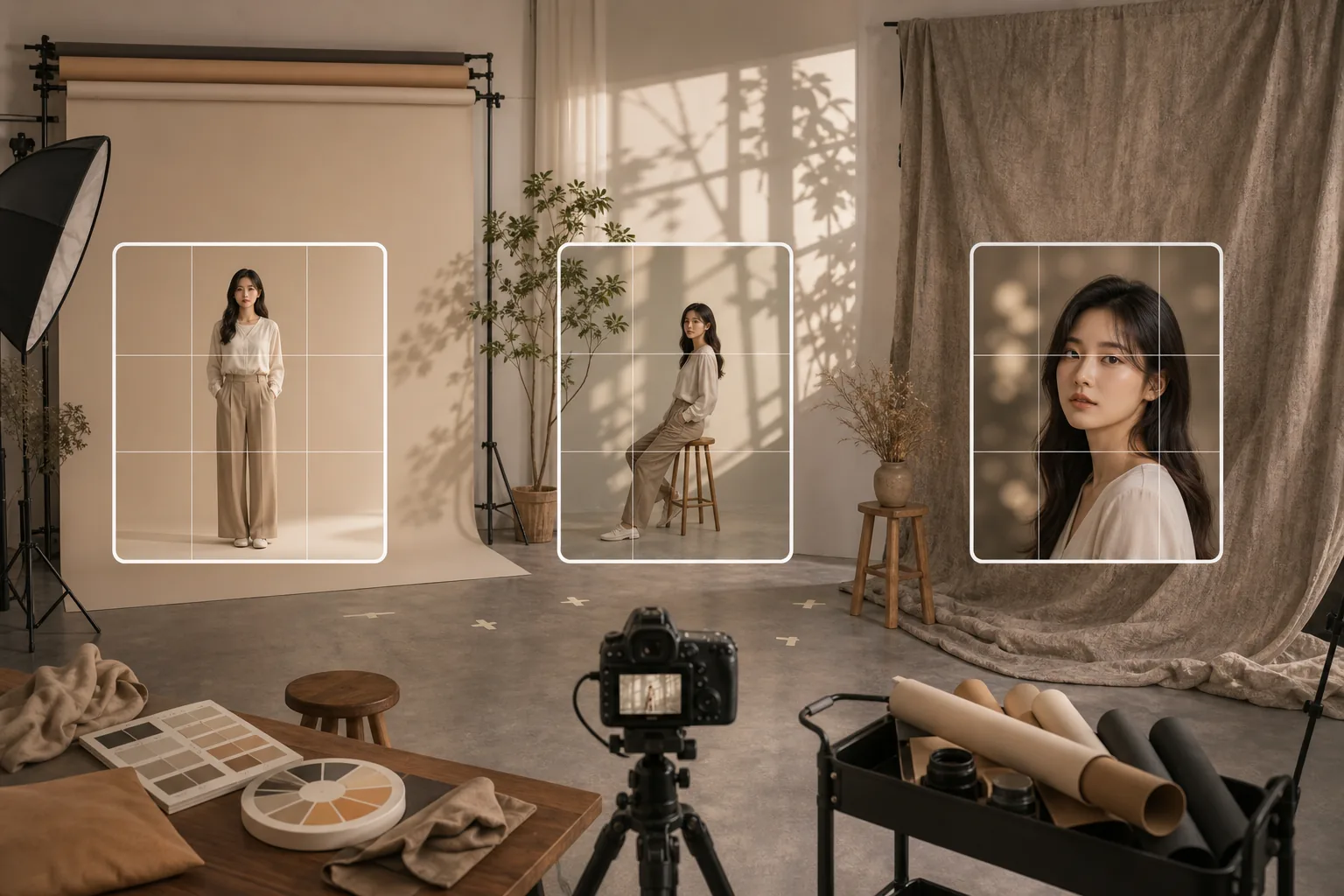
Why Background and Composition Set the Mood
Sometimes the same face, the same outfit, and the same expression read completely differently from one photo to the next. A lot of that difference doesn't come from the face at all, but from the background behind it and the way the frame is divided. Our eyes don't read a person in isolation; they tie the subject and the surroundings together into one scene. So a messy background makes a person look cluttered too, while a tidy one lets the very same person come across as calm and composed.
Composition builds the path your eye travels across the frame. Where you place the subject, where you leave empty, and where you fill all change where a viewer's gaze settles. When that path feels natural, the photo reads comfortably; when it tangles, something feels off. In that sense composition is less about what you show and more about the order in which you let people see it.
One thing is worth saying up front. The mood or impression a photo gives off is purely a visual feeling created by the light, background, and composition of that moment. It is not the same as a person's real personality or ability. With the mindset that an impression is just an impression, let's focus today only on how to capture the mood you actually want.
Composition Basics: Thirds and Negative Space
You don't need grand theory; just two instincts will transform your photos. One is the sense of dividing the frame and deciding where the subject goes, and the other is the sense of deliberately leaving space empty. Both work the same whether it's a selfie or a shot a friend takes for you. Let's unpack each in the two sections below.
Using Thirds to Place the Gaze
The rule of thirds means imagining your frame split into a three-by-three grid, like a tic-tac-toe board. That creates four points where the lines cross, and placing the subject's eyes or face near one of those points looks far more grounded than pinning them dead center. A centered placement gives a crisp, ID-photo feel, while shifting slightly to the side adds a lingering, story-like quality. Most camera apps can turn on a grid overlay, so use those lines as your guide.
At first it can feel odd to push the subject off to the side, but try it once and you'll notice the gaze flows naturally toward the face. Leaving a bit more room on the side the person is looking toward gives the sense that they're gazing in that direction, which adds breathing room to the shot. Block the space in front of the gaze, on the other hand, and the frame can feel stuffy. This is a starting point more than a rule, so once it feels natural, it's fun to break it on purpose.
Leaving Room to Breathe with Negative Space
Negative space isn't just an empty area; it's an active element that gives a photo room to breathe. Leave a little generosity around the subject and the frame opens up, letting the viewer relax too. Pack the top, bottom, and sides tightly instead and you create tension or a sense of confinement, which can be its own mood when used on purpose. So negative space isn't a question of more or less, but of what feeling you're after.
A common slip is leaving too much, or almost none, of the space above the head. A bare expanse above makes the subject sink toward the bottom, while a head pressed against the top edge feels awkwardly cropped. For an upper-body shot framed to the chest, leaving about a fingertip of headroom is a safe bet. Want a calm mood, give it generous space; want a crisp, open feel, frame the subject a touch larger.
Choosing a Background: Plain and Tidy
The background is the stage that shapes a photo's mood second only to the subject. Shoot the same person against a single wall versus a desk piled with clutter and the results are worlds apart. If you want a crisp, orderly mood, clearing the background is the fastest route. Look first for a wall in one simple color, a curtain with an even tone, or a clean patch of outdoor shade.
The Crispness of a Plain Background
A plain background is the easiest way to gather attention on the subject. Stand in front of a single-tone backdrop, like a white, gray, or dark wall, and the viewer's eye goes straight to the face and expression. The color shifts the feeling too: a bright single tone reads light and airy, while a dark one feels calm and deep. If the outfit color is too close to the background, the subject can blend in, so keeping a slight tonal gap between clothing and backdrop makes them stand out.
If a plain background is hard to set up at home, one large piece of fabric or a single tidy wall is plenty. A spot where soft light comes in from one window is even better. Just stepping over a pace so an outlet, switch, or picture-frame corner doesn't clip into the frame makes the photo far cleaner. These small tidy-ups add up to a photo that looks considered, even if it isn't quite studio level.
Adding a Story with a Tidy Background
An empty background isn't the only good one. A background with atmosphere, like a cafe window, a bookshelf, or an alley, adds a story to the photo. The key word is tidy. Even with elements in the background, if they share one consistent grain they don't look busy and instead look richer. A shelf of similarly colored books, for example, looks complex but reads as a stable backdrop because the tones are unified.
Here it helps to keep some distance between subject and background. Pressing your back flat against a wall casts messy shadows and flattens the scene, but stepping a pace or two away lets the subject float slightly off the background for a sense of depth. Frame it with the idea of keeping just one element as an accent and tidying the rest. That gives you a background that isn't empty yet isn't cluttered, which is just right.
| Technique | Effect | Best Situations | Tip |
|---|---|---|---|
| Rule of thirds | Gaze flows naturally, feels grounded | Portraits and scenes with a story | Eyes on a crossing point, leave gaze-side space |
| Plain background | Sharp focus on the subject | ID, profile, and tidy moods | Keep a tonal gap between clothes and wall |
| Shallow focus | Background melts, adds depth | Busy places, night-scene backdrops | Get close, keep blur moderate |
| Symmetrical framing | Neat, balanced impression | Hallways, doorframes, windows | Level the horizon, vary the expression |
Adding Depth with Shallow Focus
Shallow focus means locking focus on the subject and letting the background go softly blurred. Cameras call this a shallow depth of field, where the in-focus range is narrow so everything in front and behind eases out naturally. When the background blurs, busy elements turn into soft fields of color, and the subject stays sharp even in a crowded place. That makes it an especially reassuring trick when the background is hard to tidy perfectly.
On a smartphone, turning on portrait mode gives a similar feel easily. Because it blurs automatically, though, hair strands or glasses edges sometimes get cut awkwardly, so check the result and dial the blur down if it looks unnatural. With a regular camera or telephoto lens, leave generous distance between subject and background, and the closer you move to the subject the more the background melts. Shoot in front of a night scene full of light points and you'll get round bokeh that softens the mood even more.
One caveat is that shallow focus isn't a cure-all. For a photo where a lovely view or a meaningful place matters, don't blur it all away; let it show in moderation instead. Too strong a blur can also leave the subject feeling oddly suspended, so easing it only until a hint of the place remains is easier on the eye. In the end, shallow focus is another tool where you decide how much to blur.
Bringing Stability with Symmetry and Framing
Symmetry and framing are compositions that bring order to the frame. Both give the viewer a settled, tidy feeling, yet their moods differ a little. Symmetry creates a calm, neat impression, while framing creates a focused pull that gathers the gaze. Knowing both lets you choose your mood even in the same location.
Creating Neatness with Symmetry
A symmetrical composition balances the left and right, or top and bottom, like a mirror. Place the subject dead center with similar elements on either side and the result feels stable and neat at a glance. Spaces that repeat side to side, like hallways, doorframes, windows, or stairs, are great for symmetry. Just getting the horizon level when you raise the camera does half the work.
That said, perfect symmetry can come off stiff or like an ID photo. So softening the expression, tilting the head ever so slightly, or varying the hand position keeps the neatness while adding a human touch. Because symmetry has such a clear rule, a small break in it can become the charm. Give it a try on a day when you want a calm, clean mood.
Gathering the Gaze with Framing
Framing means building another frame within the frame to wrap the subject. Shooting through a window, placing the subject between a doorframe, or capturing them under a branch or arch lets that frame pull the gaze naturally inward. Even with the same person, a composition surrounded by something feels cozy and focused. Everyday spaces offer more frame-worthy elements than you'd think.
When you use a frame, adjusting distance and angle so it doesn't cover the subject is important. Blurring a near frame slightly makes the subject pop more, and a light difference between frame and subject gathers the gaze inward naturally. Practice first with clear frames like a window, then widen to subtle ones like the edge of a shadow or light once it feels familiar. Framing is a tool that lifts the mood a notch even where the background is plain.
Common Mistakes and a Quick Check
What blocks a good-mood photo is often not a lack of fancy gear but a small mistake. The two most common are a cluttered background and a tilted horizon. When laundry, a trash bin, a lettered sign, or a stranger clips into the background, the gaze scatters and the subject reads weaker. Simply building the habit of scanning the edges of the frame before you press the shutter heads off half of it.
A tilted horizon dents the mood more than you'd expect. When a floor line, window frame, or horizon goes crooked, the viewer feels an unconscious unease. Turn on the level guide or grid in your camera app and use a straight horizontal line in the frame as your reference. Unless you're going for a deliberately diagonal composition, just getting the horizon level makes the photo look far more stable.
Finally, let's settle the mindset once more. Background, composition, and light are all tools for capturing the mood you want. Remembering that the impression a photo gives off is not the same as a person's personality or worth lets you handle photos more lightly and joyfully. Pick just one idea you liked from today and apply it to your next photo. One small change can shift the mood quite a lot.
Article info & references
Published June 7, 2026 · Last updated June 7, 2026
- General composition principles such as the rule of thirds and negative space
- General photographic optics on depth of field and shallow focus (out-of-focus backgrounds)
- General design and composition concepts on visual balance such as symmetry and framing
- General lighting knowledge on how light direction and shadow affect impression