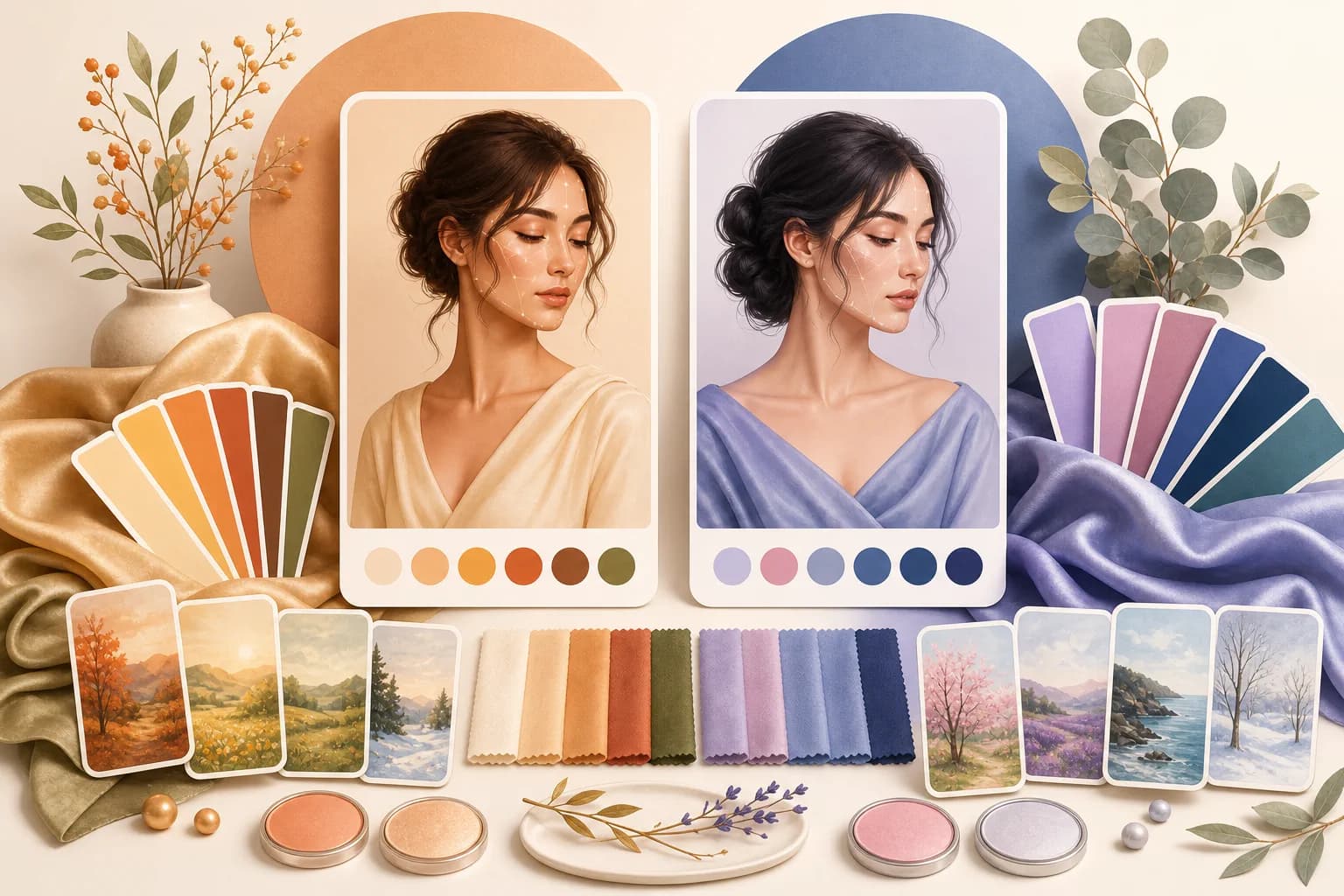
More people than you'd think don't land on warm or cool
Talk about personal color long enough and the same worry keeps coming up: "I honestly can't tell if I'm warm or cool." These are the people for whom gold jewelry looks good, silver isn't bad either, a coral lip works but a rose lip is pretty too. When their results keep flip-flopping between spring one day and summer the next, they sometimes feel like something's wrong with them. But really, this is completely natural.
Temperature isn't split cleanly down the middle like a knife cut; it's more like a long ribbon stretching from a warm end to a cool end. Right around the center of that ribbon sits a spot where yellow and blue undertones are roughly balanced and nothing tips strongly either way. That spot is usually called neutral. Add a faint greenish-gray cast to it and we call that olive. Both are 'blurry-boundary' tones, and they're the main reason warm-cool tests keep confusing people.
One promise up front: all this talk of tones is about the impression a color gives and a styling reference, nothing more. Being a certain tone never speaks to anyone's personality or ability; it's just the small joy of noticing which colors make a face look a little brighter. So read it as 'a hint for picking today's outfit,' not 'a box that sorts you.'
A quick refresher on temperature, value, and chroma
Before we dive in, let's lightly recall three axes. Temperature is whether a color leans yellow (warm) or blue (cool); value is how light or dark it is; chroma is how crisp it is versus how softly muted. People who struggle with warm versus cool are often standing right in the middle of that temperature axis. If your value and chroma feel clear but temperature alone stays fuzzy, that's a strong sign you might be neutral.
Signs you might be neutral
Neutral folks tend to share a few endearing little signs. The most telling is that both gold and silver look perfectly fine. Usually warm faces glow against gold and cool faces brighten against silver, but neutrals look at either one and think 'not bad,' with no dramatic difference. Having that wide a range is actually a real gift — your choices in both jewelry and clothing open way up.
The second sign is that you can pull off both warm and cool colors to a reasonable degree. Coral works, rose works, a camel coat suits you, a gray coat suits you too. The catch is that the extreme ends of the saturation scale start to feel like 'hmm, that's a lot.' If near-fluorescent primaries or jet black make your face feel slightly swallowed up, that's a very neutral kind of reaction.
The third sign is that your results keep changing. If some days you read as spring and others as summer, and different people give you different seasons, it isn't a mistake — it may mean you genuinely sit close to the center. Standing on the boundary means you can look like either side depending on the angle.
Olive — the secret of a soft, greenish middle
Olive is a slightly special texture within neutral. There's a very faint greenish-gray cast resting on the skin, which makes it different from the radiant yellow of warm skin and also from the flushed pink of cool skin. That subtle green softens both the yellow and the blue at once, so when you run warm-cool tests, neither side ever feels like a perfect match. That's exactly why olive skin is especially confusing, even among middle tones.
The trap with olive is that the wrong color can make the complexion look dull and washed out. A too-cold blue pink or, on the flip side, a too-yellow beige placed near the face can clash with the green cast and leave the skin looking muddy. But meet a deep, rich color and olive's signature calm, refined mood suddenly comes alive. A closet that felt like 'I have nothing to wear' often starts to click the moment you shift the texture of the colors.
Olive has a reputation for being difficult, but you can flip that entirely. It's a tone that can embrace the deep, rich colors from both the warm and cool sides. Not being locked into one palette simply means more freedom in how you style.
Why olive confuses warm-cool tests
Think of the popular wrist-vein test. Because of the green cast, olive skin often shows veins that look neither clearly blue nor clearly green but somewhere ambiguous in between. So applying the simple 'green veins mean warm' formula straight up is an easy way to get lost. The vein test is only a reference hint; if it comes out ambiguous, take that ambiguity itself as one more gentle clue that you're somewhere in the middle.
A light at-home self-check for middle tones
You can sense the direction at home without any fancy gear. The one essential is midday daylight by a window. Incandescent bulbs tint everything yellow and fluorescent lights tint it blue, making the same face read as a totally different tone. Start bare-faced, against a white background, with beauty filters off. Repeat the steps below not once but several times and the pattern gets clearer.
If both sides feel about the same, that's nothing to be disappointed about. You've actually landed the most important answer of all: 'ah, I'm close to the center.' This is a fun self-check, so take the results lightly, like play.
Gold vs silver drape
This is the easiest one. Hold a gold cloth (or gold-tone jewelry) and a silver cloth next to your face in turns. If gold clearly brightens your face, you lean warm; if silver looks cleaner, you lean cool. But if you think 'both look about equally fine,' that's the neutral signal itself. In that case there's no need to force a choice — you can happily mix and match the two.
White vs cream, and how you tan
Comparing a pure-white cloth against a warm cream-ivory one is another good move. If pure white sharpens your face you lean cool; if cream gently flatters it you lean warm; if both are fine, you're toward the middle. How you tan is a hint too. If you redden easily and recover fast, you're closer to cool; if you brown smoothly without much flush, you're often warm or olive. These are just tendencies, so read them as 'I'm kind of like that,' nothing more.
| Type | Temperature feel | Colors that fit | Colors to ease off | One-line mood |
|---|---|---|---|---|
| Neutral warm | Slightly warm | Camel, soft coral, taupe | Loud fluorescent primaries | Quietly warm |
| Neutral cool | Slightly cool | Dusty rose, mauve, soft gray | Stark jet-black contrast | Clear and calm |
| Neutral center | Neither side | Sage, beige, muted tones overall | Extreme light-dark contrast | Flexible and balanced |
| Olive | Greenish-gray cast | Emerald, mustard, wine jewel tones | Cold pink, yellow beige | Deep and mellow |
Styling for middle tones — deep and soft
The most dependable friend of neutral and olive is the 'muted, soft color' — shades dropped a notch in chroma. Sage green, dusty rose, taupe, camel, mauve, calm terracotta — colors that strike a balance somewhere between yellow and blue melt naturally into the face. Because they're hard to pin as warm or cool themselves, they elegantly wrap up a middle tone's ambiguity.
If you're olive, add a spoonful of jewel tones on top. Deep, rich colors like emerald, teal, mustard, wine, and deep purple meet olive's green cast and, far from dulling the complexion, make it look glossy and alive. Rather than thin, washed-out pastels, colors with firm saturation behind them are a far stronger weapon for olive skin.
The last tip is to avoid extreme contrast. Slamming jet black against pure white looks striking on a crisp winter-cool type, but for a soft middle tone it can make the face lose out to the outfit. Swap black for charcoal or deep navy, and pure white for ivory or off-white, and the contrast softens while your face floats up comfortably. It sounds like a small change, but in front of the mirror the mood shifts quite a bit.
Tone is a spectrum, not a box
If you've read this far, please take away one most important thing: warm, cool, and neutral aren't compartments that cage people, but a single long spectrum stretching from a warm end to a cool end. Some people stand clearly on one side; others roam freely from the center. Being in the middle isn't being half-baked — it means you're holding a wider palette in your hands.
And even for the same person, the weight of flattering colors shifts a little with hair color, how tanned you are, and the day's lighting. So rather than nailing down 'I'm definitely this,' it's most practical to grab the broad direction — warm-ish or cool-ish — and play freely within it. Remember too that while a flattering color can help the mood of the day, it doesn't speak to anyone's personality or ability.
In the end, personal color isn't a label that defines you but a tool for dressing yourself up more joyfully. If you've spent time feeling confused for being a middle tone, turn it now into the pleasure of enjoying that breadth. Sage green today, wine tomorrow, drifting lightly between them — that freedom is the middle tone's greatest privilege.
Frequently asked questions
How do I do the gold vs silver drape test at home?
In natural light by a window with a bare face, hold gold fabric then silver fabric under your chin and watch which one makes your face look fresher and softens shadows. Gold lifting you means a warm lean, silver means cool, and if both look equally fine you're likely a neutral middle tone. It's just a light, fun look at how colors read on you, not a judgment of your personality or abilities, so enjoy it casually.
Can I tell my undertone by whether pure white or cream looks better on me?
Yes, the white comparison is an easy at-home self-check. If crisp pure white makes your face look sharp and clear you lean cool, if soft cream or ivory warms you up you lean warm, and if both feel fine that can be a neutral signal. Lighting and your daily condition can shift the result, so compare gently over a few different days rather than just once.
I have olive skin and warm-cool tests keep giving different answers, why?
Olive skin carries a faint greenish-gray cast that gently mutes both yellow and blue at the same time. That's why neither gold nor silver feels like a perfect match, and tests may swing between spring and summer from day to day. It doesn't mean you got it wrong; it likely means you sit near the middle, and styling with deep, calm colors brings out olive's elegant, refined mood beautifully.
Article info & references
Published June 13, 2026 · Last updated June 13, 2026
- The three attributes of color (temperature, value, chroma), as in the Munsell color system and general color theory
- General makeup and styling knowledge on classifying skin undertones (warm, cool, neutral, olive)
- How light changes color (color temperature and color rendering), as general lighting knowledge
- Primacy and halo effects, as general social-psychology concepts about first impressions
- Using natural light and white balance in photography, as general photo principles