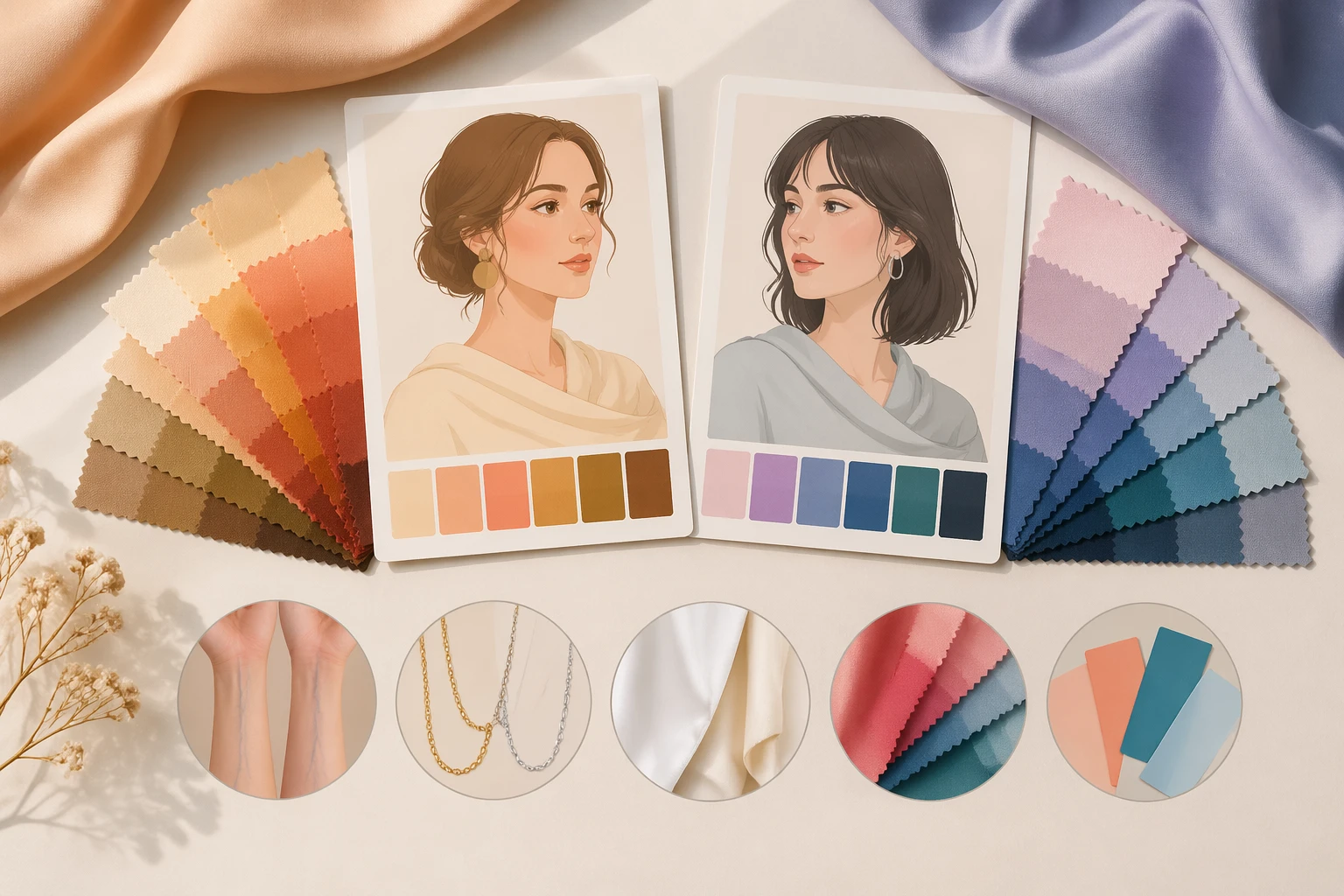
When the result keeps changing, blame the setup
A personal color self-check is a fun thing to try at home. But the moment you hold a cloth up to the mirror, the result often comes out different every time, which is confusing. This is not because something is off about your face. It is because the testing conditions are making the result wobble.
Even for the same person, when the light and the conditions change, the cloth color reflects in a completely different way. That is why you can look like a warm spring one day and a cool winter the next. So if you want a more trustworthy read, the first step is to fix the environment before you ever look at your face.
In this guide we will walk through the mistakes people make at home, why each one makes the result harder to trust, and a repeatable method that gives you a result that fits better.
Mistake 1 - lighting hijacks the whole result
The biggest source of wobble is lighting. Under a yellow incandescent bulb almost everyone looks good in warm tones, and under a bluish fluorescent tube cool tones suddenly seem to win. Mixed light, where a ceiling lamp meets window light, is even trickier. One cheek goes yellow and the other goes blue, so the comparison itself falls apart. The color of the light coats the color of the cloth, which means you are really looking at the bulb, not the fabric.
So the most reliable light is soft midday daylight, especially the indirect light near a window rather than direct sun. Turn off the lamps, and let only thin filtered light through the curtain so the cloth color looks close to its true self. The even light of an overcast afternoon works surprisingly well too. Move one color around a few spots and you will feel just how much the light pushes the result.
Mistake 2 - makeup decides the answer in advance
The second mistake is testing with makeup on. Foundation has already evened out your skin tone one step, so it creates the illusion that any color suits you well enough. Lip and blush color also pull the mood of the whole face and hide what the cloth is actually doing.
So always run the self-check bare faced, with your hair pushed back or wrapped in a white cloth to keep the area around your face neutral, then begin. It also helps to take off accessories, because metal tones or a collar color can quietly interfere with the comparison. If you are wearing a colored top, cover your shoulders with a white cloth so only the swatch in your hand reaches your face.
Mistake 3 - trusting the phone screen and filters
The third is judging from a phone screen. Selfie apps often brighten skin and push up saturation by default, so the color on the screen and the real cloth color do not match. With a filter on, the result drifts even further. Screen brightness, night mode, and a blue-light filter all nudge the colors as well.
If you want to keep a photo, turn off every enhancement before you shoot, but make the final call from your real reflection in the mirror. It is easy to remember it this way - the screen is a reference, the mirror is the standard. If you do glance at photos, shoot several swatches under the same light and line them up side by side.
Mistakes 4 and 5 - season drift and testing only two colors
The fourth is missing seasonal change, that is, tone drift. When you tan over summer, your skin goes darker than usual and a warmer cast appears, so the result differs from the one you got in spring. Your color also shifts with sleep, condition, and a glass of wine. So do not stamp a single result on yourself as a lifelong label. When the season turns, check again, lightly. It is natural for the result to move a little.
The fifth mistake is drawing a conclusion after holding up only two colors. If you compare just one warm and one cool, one of them always wins, and it is easy to mistake that for your tone. To see it properly you have to drape several steps within one family. Hold up a light pastel, a clear vivid, and a deep dark tone in turn, and watch which brightness and saturation make your face the most clear and luminous. The wider your range, the smaller the wobble.
A clean method you can repeat at home
Here is the repeatable home method. Stand by a window during the day with the lamps off, bare faced, hair wrapped in a white cloth. Place a white cloth below your shoulders to set a reference point, then hold the colored cloths up one by one. Within one color family compare three steps - pastel, vivid, deep - and each time you drape one, look at two things - whether the shadow under your eyes gets darker or lighter, and whether the overall clarity and glow of your face come alive.
A color that fits softens the shadow and tidies up your contours. A color that does not fit dulls the face and makes it look tired. If you can, repeat over several days, and check whether the same color gives the same impression when you drape it again. Keep watching those two signals and you slowly narrow toward a result that fits better.
The result is a styling coordinate, not a label
One last request. Do not take the result as a fixed identity - use it lightly, as a styling coordinate. If you commit too hard to one label, telling yourself you are absolutely this season, you actually narrow the clothes and colors that suit you. Plenty of people sit right on a border, and even the same person finds a color that fits better shifting with makeup and lighting.
A self-check is just a guideline that points you in a direction when you pick clothes. And everything in this guide is a for-fun styling reference, so use it as a relaxed tool for exploring color and enjoy the play of it.