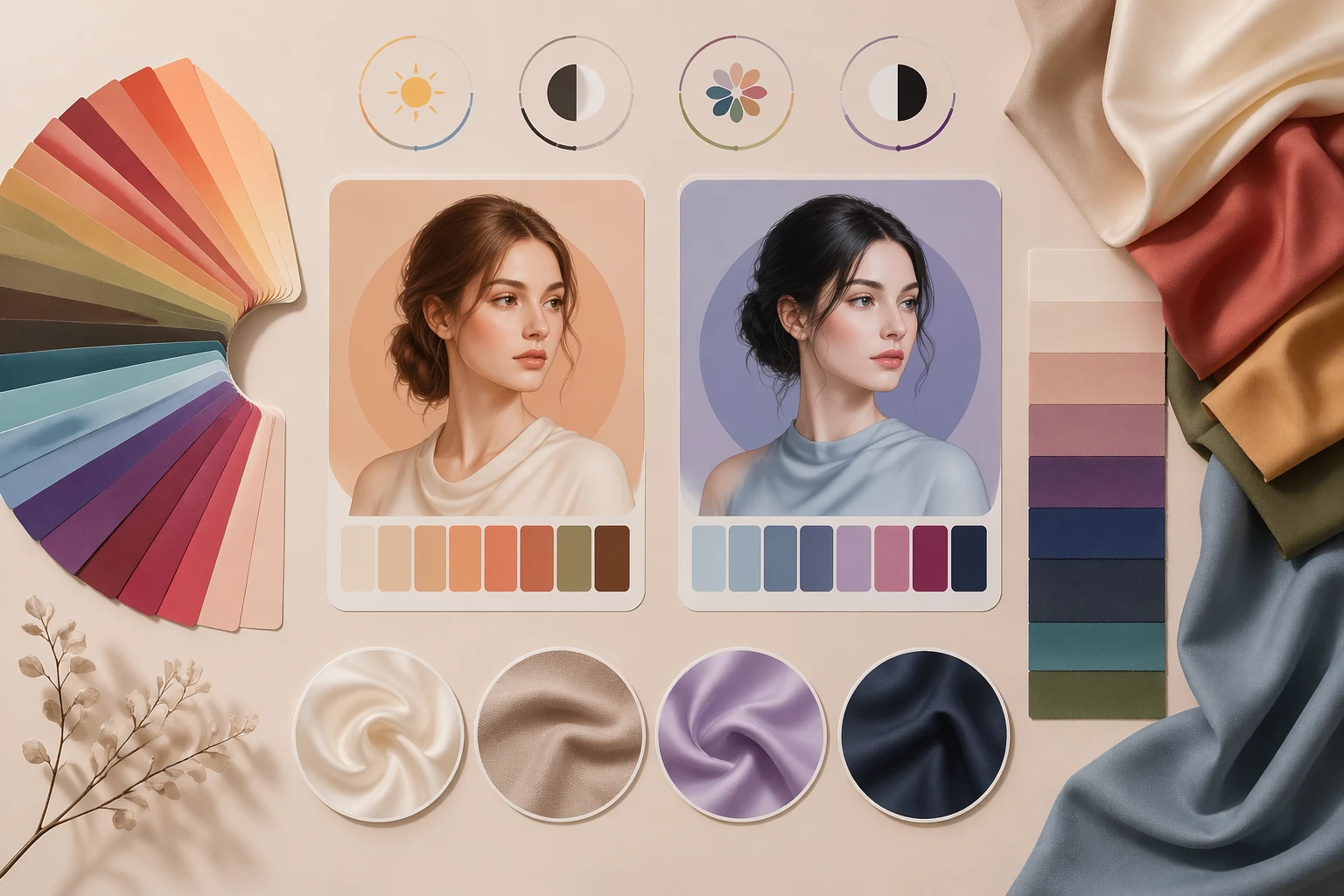
Personal color is a styling frame for finding palettes that flatter your skin, eyes, and hair. It is not a scientific category; it is an experience-based guiderefined by color theory and fashion consulting over decades. This is a true beginner's introduction.
Four axes of personal color
It looks complicated, but four axes cover almost everything.
- Temperature: overall warm or cool.
- Value: overall light or dark.
- Chroma: clear and vivid colors suit you, or muted and soft ones.
- Contrast: gap between skin, eyes, hair is big or small.
Season labels — "Spring Warm," "Summer Cool" — are just convenient nicknames for combinations of those axes. Spring Warm is roughly warm + light + clear; Winter Cool is cool + dark + high-contrast.
Very rough at-home diagnosis
Note: none of this replaces a professional consultation. Light changes everything, so do it near a window.
- Wrist veins: greenish = tentatively warm, bluish = tentatively cool.
- Gold vs silver: hold metallic fabric under your chin and pick the metal that brightens the face.
- Ivory vs pure white: if ivory flatters more you likely lean warm; pure white better means cool.
The detailed five-test version is in personal color self-diagnosis.
Season palette keywords
- Spring Warm: apricot, coral, ivory, soft khaki — bright and alive.
- Summer Cool: lavender, rose pink, sky blue, pigeon gray — soft pastels.
- Autumn Warm: mustard, terracotta, olive, chocolate — deep and muted.
- Winter Cool: black, pure white, burgundy, royal blue — high contrast.
How to actually use personal color
Clothes near the face
Tops and lip colors matter most. A Spring Warm in Winter Cool colors can read slightly dull, and vice versa. If you only buy in-season knits, shirts, and lipsticks, you already get most of the benefit.
Clothes far from the face
Pants and shoes matter less. Use that real estate for colors you simply love.
Metal accessories
Gold usually leans warm, silver leans cool. If both look good, try rose gold as a middle ground.
Common misconceptions
- "Never wear off-season colors." False. Keep the focus near the face.
- "Your personal color is forever." It shifts with hair color, tan, and age.
- "You need an official diagnosis." It's a helpful tool, not mandatory. The point is confidence when shopping.
What about FaceOracle's AI personal color?
The AI personal color card takes the overall color of your uploaded photo, skin, eyes, and hair, and suggests a season. It is a reference, not a verdict — lighting changes the output, and it does not replace a professional consultation. It is, however, a useful starting point when reorganizing a wardrobe.