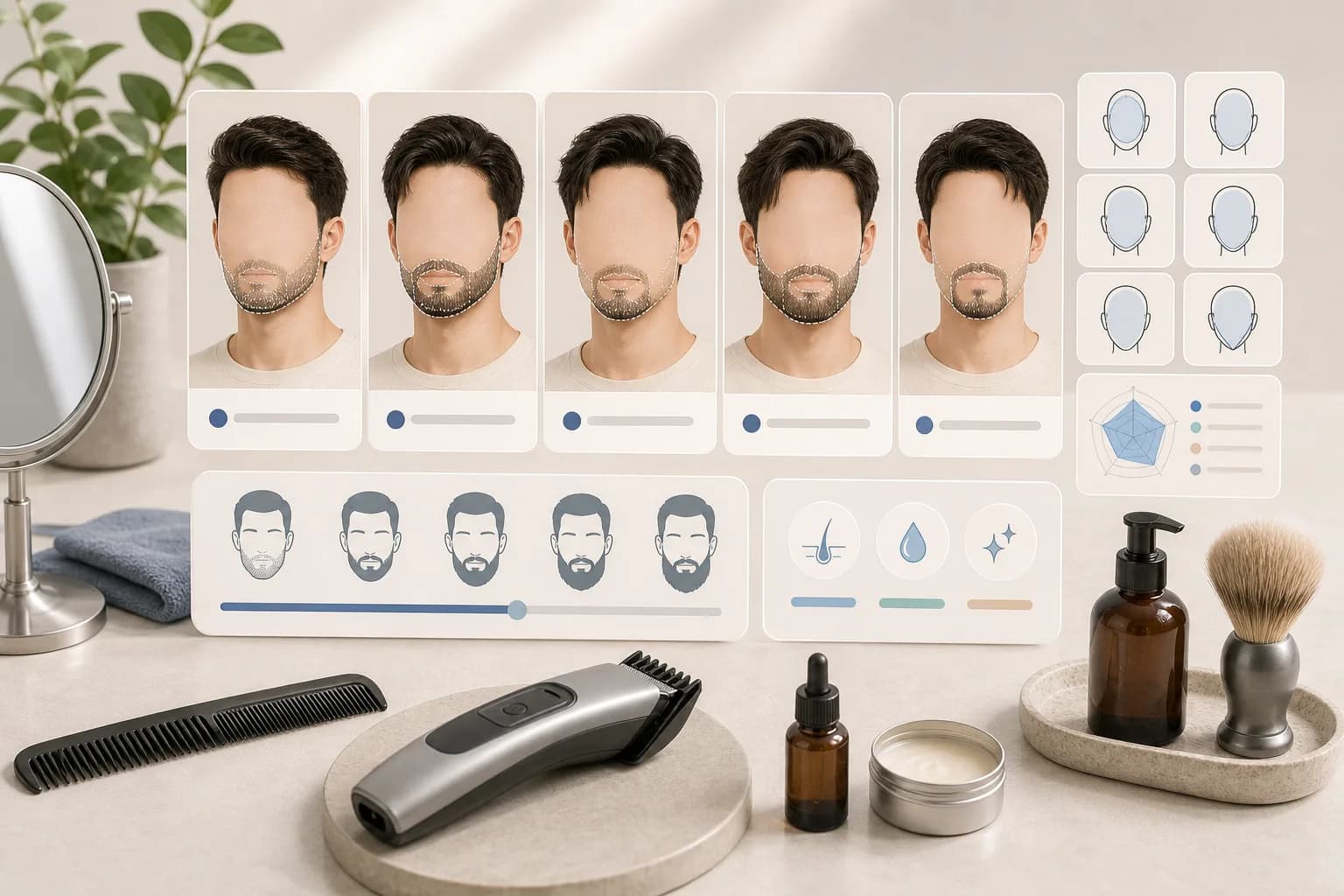
Your Hair and Face Shape Are One Set
When men pick a haircut, the first thought is usually whatever is trending or the cut that one celebrity happens to have. But the same cut reads quite differently from person to person, because hair sits right above your facial outline and redraws the vertical and horizontal balance of your face. So if you keep your own face shape in mind and nudge the cut just slightly in the opposite direction, your overall impression settles down nicely.
The logic is simpler than it sounds. If a face is long top-to-bottom, take some length away with side volume and a horizontal accent; if it is round or wide, add length with crown volume and a vertical line. Just four dials — fade height (how short the sides and back go), length on top, parting position, and whether the fringe goes up or down — can make the same face look noticeably different.
One thing worth saying clearly. The impression here is only the visual mood a viewer feels; it does not describe anyone's actual personality or ability. A round face looking softer or an angular face looking firmer is just a first impression, and no face shape is wrong. Read this not as an answer key, but as a fun reference for nudging your look toward the mood you want.
Start by Roughly Placing Your Face Shape
Before choosing a cut, having a rough sense of your face shape makes the chart below far easier to read. In front of a mirror, push your hair back and visually compare the width at three spots — forehead, cheekbones, jaw — along with the overall length. You do not need exact measurements; sorting yourself into whichever of the five shapes looks closest is enough.
A Quick Split Into Five Shapes
Similar width and length with a rounded jaw means round; noticeably long top-to-bottom means long. Even width across forehead, cheeks, and jaw with a defined jawline means square; a balanced shape that tapers gently from forehead to jaw is oval. A wide forehead and cheekbones narrowing to a slim chin reads as inverted triangle (close to the heart family). If you sit between two shapes, do not force a single box — reference both.
Things to Watch When You Self-Check
Photos make a face shape look different depending on angle and lighting. Shooting from above narrows the jaw, while shooting from below widens it. So for a self-check, a photo taken straight on at eye level in something close to natural light is the most useful. Face shapes are a small mix in most people, so treat the chart's picks as a starting point and confirm in the mirror that a look feels comfortable to you.
Cut, Fade, and Beard at a Glance
The chart below sums up, for each of the five shapes, a suggested direction for the top, fade height, parting, and a beard pairing in one line. Get the big picture from the table, and the next section unpacks why each one works, shape by shape. The table is a fun reference of general styling tendencies, so please do not take it as rules you must follow.
Read the suggestion as the opposite of your face shape and it clicks fast. Long calls for horizontal, wide calls for vertical — and the basic of balance is not letting the beard repeat a direction the hair already emphasized.
The Five Shapes, in Detail
Now let us unpack each row of the table. Grouping similar shapes together makes the differences clearer. Read just your section, or reference both if you sit between two shapes.
Round and Square
A round face reads as generously wide, so adding a little vertical length suits it well. Build volume on top and lift it up (a pomp-style or upswept top), and keep the sides short with a high-to-medium fade so the face looks longer top to bottom. Part slightly to the side but keep the top line standing. A beard left a touch longer at the chin adds length and pairs nicely. Leaving volume at the sides while flattening the top can echo the round feel one more time.
A square face reads sharp thanks to a defined jawline, and a little curve softens the mood. Go with a naturally flowing textured crop or a slight wave on top, with a low-to-medium fade blended softly at the sides. A slightly tousled grain suits it better than a crisp straight part. A beard kept even and short along the jaw wraps the corners gently. Pairing a razor-sharp line with a blunt straight cut can stack too many straight lines.
Long and Inverted Triangle
A long face reads stretched vertically, so adding a horizontal accent helps. Rather than lifting the top high, a fringe worn down or a cut that flows to the side visually shortens the length. Keep the fade low to leave some weight at the sides, and part to the side to create a horizontal flow. A fuller beard with body at the cheeks adds width and balances things out. Shaving the sides tight while lifting only the top can make the face look even longer.
An inverted triangle has a wide forehead and cheekbones tapering to a narrow chin, so taking weight off the top and adding it lower brings balance. Keep the top textured rather than heavily volumized, and use a medium fade that is not too high, leaving a little body at the sides. Let the parting drift slightly to soften the wide forehead. A full beard or chin-focused growth that fills the narrow jaw suits this beautifully and balances the lower face. Lifting the top high and shaving everything clean can make the upper face look even wider, so leave one side relaxed.
| Face shape | Top direction | Fade height | Beard pairing |
|---|---|---|---|
| Round | Volume up, vertical | High to medium | A touch longer at chin |
| Long | Fringe down, horizontal | Low | Fuller beard at cheeks |
| Square | Texture, slight wave | Low to medium | Even, short along jaw |
| Oval | Mostly easygoing, your call | Medium | Any shape you like |
| Inverted triangle | Moderate texture, ease off volume | Medium | Full beard to fill the chin |
How to Say It at the Barber
Even with a clear picture in mind, the words can stall once you are in the chair. The surest move is a photo or two plus length in concrete units — finger-widths or centimeters. For example: fade the sides but keep it low, only up to above the ear; leave about two finger-widths on top and bring it forward; or a natural part on the left. Adding your intent — leave some volume at the sides so my face does not look long — makes it easier for the barber to match the details.
Fade height communicates well as low (below the ear), medium (mid-ear), or high (above the temple). If you want grain, add keep it textured; if you want it to fall clean, say leave some weight. And if you are tidying a beard at the same time, name the range clearly — short, just along the jawline. For beard shape specifics, the beard guide by face shape is a helpful companion read.
Product Basics and Looking Good in Photos
You really only need two product families. Matte clay has little shine and shapes grain naturally, so it suits a textured crop or a fringe worn down; pomade slicks with shine and fits cuts you sweep back (upswept tops, side parts). Scoop out a pea-sized amount, rub it well into your palms, then work it through dry or slightly damp hair from the roots. A little applied in several passes looks more natural than a lot at once.
In photos a cut reads slightly sharper than in person. A gentle three-quarter angle shows off crown volume and the fade line better than dead-on, and shooting at eye level in natural light renders your face shape without exaggeration. A little volume on top makes the face look longer in a photo, while weight at the sides makes it look horizontally settled. Results looking different from shot to shot usually comes down to angle and lighting.
Finally, all of this is a fun reference built on the premise that no face shape is wrong. Rather than copying a trend or a cut that suited someone else, the best measure is whether you feel comfortable and good in the mirror. Style is less a test than a kind of play that makes you feel good.
Frequently asked questions
My face is on the rounder side, which men's hairstyle works best?
For a round face, adding height on top while keeping the sides short brings out a vertical line that makes your face look a bit longer. A side part with a fade and a slightly lifted fringe works well, and the key is not letting the sides puff out too much.
How do I get my barber to understand the cut I want?
Split it into length and volume placement, like "leave length on top for volume, fade the sides and back short." Mentioning your usual part direction and whether you style with just your hands or use wax helps them leave a length that's easy to manage.
Does pairing a beard with my face shape really change the overall look?
Yes, a beard that fills the sides adds horizontal balance for a long face, while a short, chin-focused beard sharpens the line on a round face. That said, this is purely a styling reference for fun and does not say anything about your personality or ability.
Article info & references
Published June 13, 2026 · Last updated June 13, 2026
- General visual-design concepts of contrast and balance in shape perception
- General first-impression ideas in social psychology, such as primacy and halo effects
- Common styling knowledge on how hair texture and volume affect silhouette
- General photography principles on how angle and lighting render facial proportion