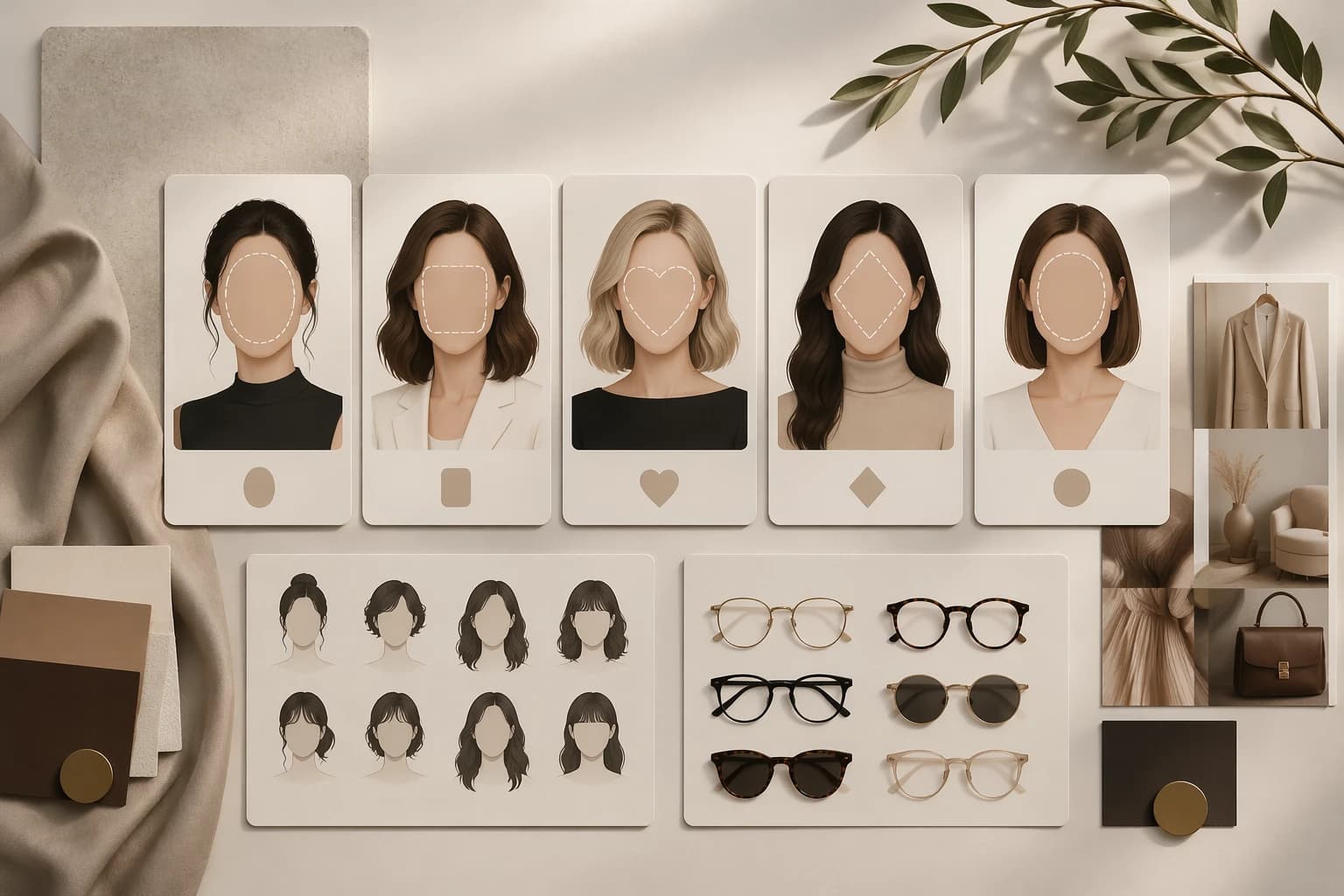
"What face shape am I?" is less of an aesthetic question than a framing question. Where the hairline sits, where the jaw ends, where the cheekbone is widest — all of those change how a photo reads. This article uses face shape as a starting point for styling and framing decisions, not as a ranking system.
Why face shape is useful to know
Face shape is not a leaderboard. It is a small map that tells you which features to lean into and which to soften. A strong jaw produces sharp definition, but an extreme low-angle camera can push it past flattering. A round face has a naturally soft mood, but flat-on front lighting can read as slightly two-dimensional. Knowing your face shape is really about knowing those tradeoffs up front.
The seven labels people use
No single classification is correct, but styling books and photography guides usually talk about seven. Don't stress if you fall between two — almost everyone does.
- Oval: length roughly 1.4× width; most styles work.
- Round: similar length and width, soft jaw curve.
- Square: strong jawline, similar forehead and jaw width.
- Oblong: forehead, cheek, and jaw similar in width but face looks long.
- Heart: wide forehead, narrow V-shaped jaw.
- Diamond: cheekbones widest, forehead and jaw narrower.
- Pear: jaw wider than forehead.
Measuring is easy
A mirror and a lip pencil are enough. Looking straight on, note the widest points at forehead, cheekbones, and jaw, plus the length from hairline to chin. The ratios between those four numbers get you in the right ballpark. Full step-by-step here: how to find your face shape.
Framing-first styling tips
Hairline and face shape
Hair is the easiest way to redraw the outline of a face. Curved layers soften a square jaw; top volume adds length to round faces; heart-shaped faces often balance better with a little more weight below the jawline. The question is not "does it suit me?" but "which framing am I choosing?"
Cheekbones and shadow
Diamond-shaped faces already have strong cheekbone structure, so heavy contour can push into harsh territory. Round faces benefit from gentle shadow along the jaw and temples to add dimension. Oblong faces often balance better with horizontal volume — bangs or side hair — because heavy top volume can lengthen the face further.
Glasses and face shape
Glasses create a second face-line. Round or oval frames soften square faces; rectangular or wellington frames add structure to round faces. More pairings in best glasses for your face shape.
Camera angle and face shape
One angle can change the apparent face shape entirely. A camera just above eye level usually softens the jaw and enlarges the eyes. Square and oblong faces tend to photograph better from this angle; heart-shaped faces often balance better shot closer to dead-on so the forehead does not dominate. Details: how camera angle affects first impressions.
Common misconception
"Oval is the prettiest" is a styling-book cliché, but in practice face shape changes with photo, light, and angle. It's more useful to ask "which face shape is this particular photo closest to?" than to pick a permanent label. A FaceOracle result that lands on a face shape is describing this photo, not assigning you a lifelong identity.
Summary
- Face shape is about framing, not aesthetics.
- Use hair, glasses, and makeup to enhance, not to "fix".
- One angle change can shift the apparent face shape.
- Don't use a face-shape label to judge yourself or anyone else.