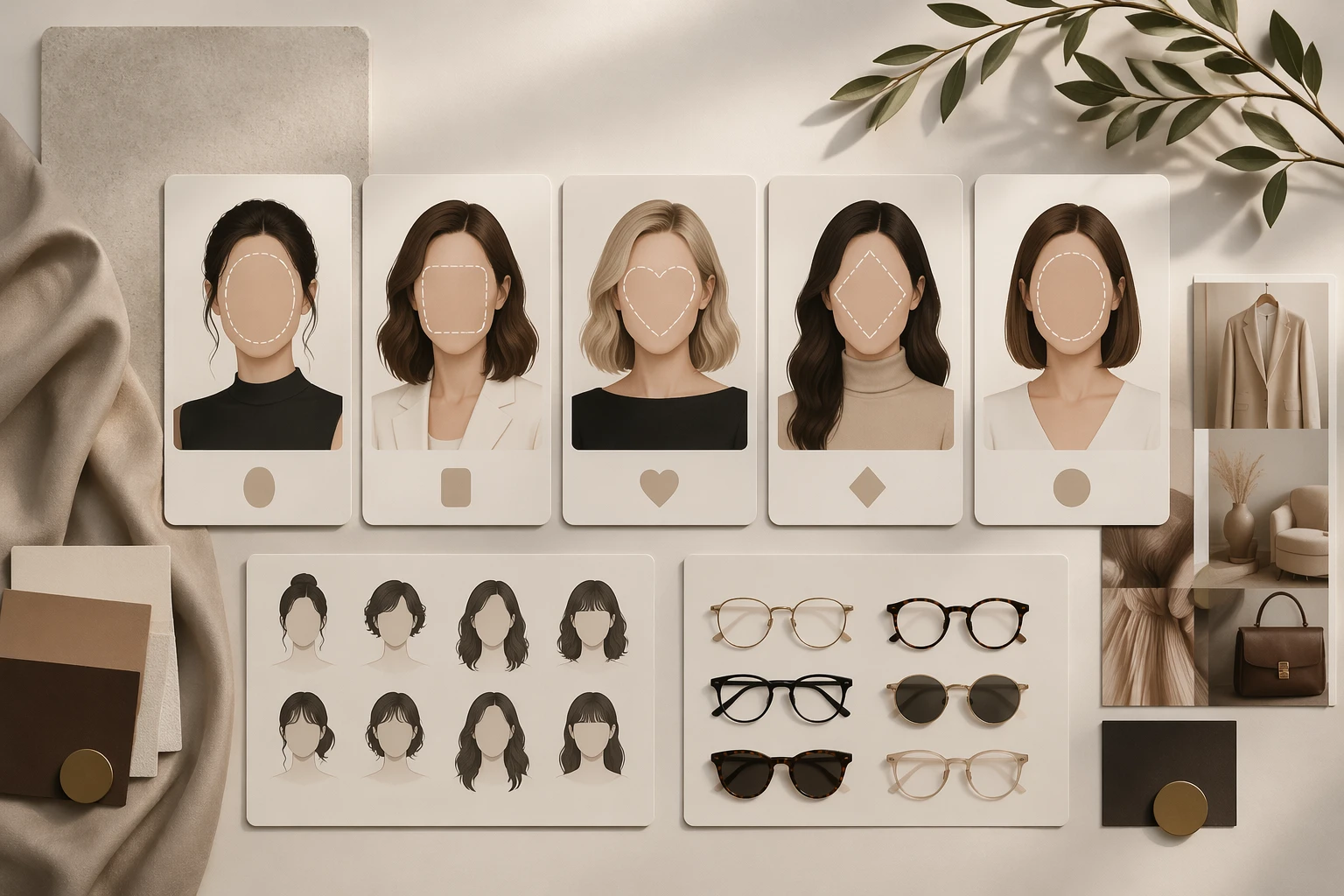
A Beard Redraws Your Face Outline
The first thing to remember is that a beard is not just a look. It is a tool for redrawing the outer line of your face. At the same length, what you keep and what you shave can make a face look longer or softer. So before chasing a trending shape, it helps to read the proportions of your own face first.
The core idea is simple. Shave clean where you want things to look narrower so the line pulls inward, and leave length where you want to add balance. Bringing length down below the chin makes a face read longer vertically, while filling the cheeks and sides makes it read wider and more grounded. Just these two axes make most choices easy.
Everything below is framing for proportion based on face shape. It is not about reading character or impression from a face. Treat it as a styling reference for tidying your line in the mirror and in photos. Your front view in the mirror and your side view in a photo can differ quite a bit, so it helps to check both.
Round Face: Length at the Chin, Short on the Sides
A round face has similar width and height with a soft outline, so adding a vertical line with a beard creates a more defined look. The best direction is to keep length at the center of the chin while trimming the cheeks and sides short. A slightly longer beard under the chin draws the eye up and down so the face reads longer.
In practice, keep the center of the chin longest and let it fade shorter toward the sides for a gradient. Do not set the upper cheek line too high. Keeping it clean just below the cheekbone avoids emphasizing width. Keep the moustache just inside the corners of the mouth and avoid letting it spread sideways, since a wider spread makes a round look stronger.
The same idea works for stubble alone. Set the trimmer one step shorter on the sides and one step longer around the chin and mouth, and you get a vertical line without shaving. For a round face, a slightly angular tidy line suits better than a fully rounded one, so defining the chin tip a touch makes the look clearer.
Long or Oblong: Fill the Sides, Keep the Chin Short
A long or oblong face is already tall, so you do the opposite of the round approach. Adding more length below the chin can make the face look overly long, so keep the chin tip short and put the weight on the cheeks and sides. Filling the sides brings back width and steadies the proportion.
You can carry the cheek line a little higher than for a round face, leaving it fuller toward the cheekbone. Meanwhile, trim the chin tip short so it does not stretch further down. Picture a balanced box that is full on the sides and rounded at the bottom. A moustache with a touch more horizontal width works well here too.
One thing to avoid is tapering the bottom to a sharp point. Pulling the chin into a long V emphasizes length, so a long face is better finished round and flat at the bottom. For stubble, keep the sides slightly longer and the under-chin shorter for the same effect. Build up the sides slowly rather than leaving a lot of length at once.
Square Face: Soften the Corners or Define a Rounded Line
A square face has a clear jawline and a sharp outline, so it already reads tidy. You can pick one of two directions. To keep the strong jaw, use short stubble or a neat short beard to emphasize the line. To soften a look that feels too strong, wrap the corners gently.
To soften, add a little length and a rounded line at the corners of the jaw. When the beard sits in a curve over the angular corner, the straight edge turns into a curve and the look feels more relaxed. To do the opposite and emphasize the line, keep the cheek line and neckline close to straight and crisp for a defined feel. The same length reads very differently depending on how you set the edges.
Either way, very long length that spreads out can make a square shape look wider, so keep the sides close and gather the weight lower down. For a square face, one crisp tidy line alone raises the finish a lot, so start with clean edges rather than extra length.
Heart and Oval: Fill the Lower Beard or Hold the Balance
A heart face is wider at the forehead and cheekbones and narrows toward the chin, so the lower area can look a little empty. Filling the chin and the beard below it a touch fuller adds weight to the narrow chin and balances top and bottom. Keep the upper cheek light and let it grow fuller toward the bottom. Keep the sides clean so the cheekbone width is not emphasized further.
An oval face has balanced width and height, so most beard styles suit it easily. That makes it the shape with the most freedom to try different lengths and lines. Just avoid piling all the length on one side, which can disturb the balance you already have. Keep top and bottom proportions similar and you are set.
For both shapes, rather than going long from the start, it helps to set the line at a short length first and add length gradually. A length you cut is hard to take back, so reduce in steps over a few days for fewer mistakes. Checking front and side photos, not just the mirror, makes the balance much easier to see.
Neckline, Cheek Line, Sideburns: Three Lines That Make It Clean
More than the beard shape, three boundary lines decide the finish. First is the neckline. Set too low it looks messy, set too high it looks tight. A natural choice is a soft curve around where the chin meets the neck, roughly two fingers above that point. A gentle U curve reads easier on the neck than a straight line.
Second is the cheek line. Too high looks artificial, too low looks unkempt. Follow the natural boundary that runs from the nostril toward the sideburn and just clean up the stray hairs above it. Letting the natural growth pattern lead looks more natural than drawing a hard straight line.
Third is the blend with the sideburns. Adjust trimmer lengths so the hair steps down gradually from hair to sideburn and sideburn to beard rather than cutting off sharply. When just these three lines are clean, the look reads tidy whether the length is short or long, so set the edges before you fuss over the shape.
Upkeep, Finishing, and Keeping It Light
Maintenance matters more than growing it out. For stubble, tidy the whole beard at the same length every few days and separately clean up only the neckline and cheek line with a razor to keep a groomed feel. When growing longer, trim stray parts once or twice a week with scissors or a trimmer and comb the grain so the shape holds.
Look after the skin and hair too. Dry skin under the beard leads to flaking and itch, so a light moisturizer after washing helps. A beard with some length looks neater and softer when you comb the grain and tidy it gently. Early on, push through a few awkward days while the shape settles and do not give up too soon.
All of the face shape matching here is a for-fun styling reference. It is a starting point for proportion, not a fixed rule, so grow it out, compare with photos, and find the line that suits you at your own pace.