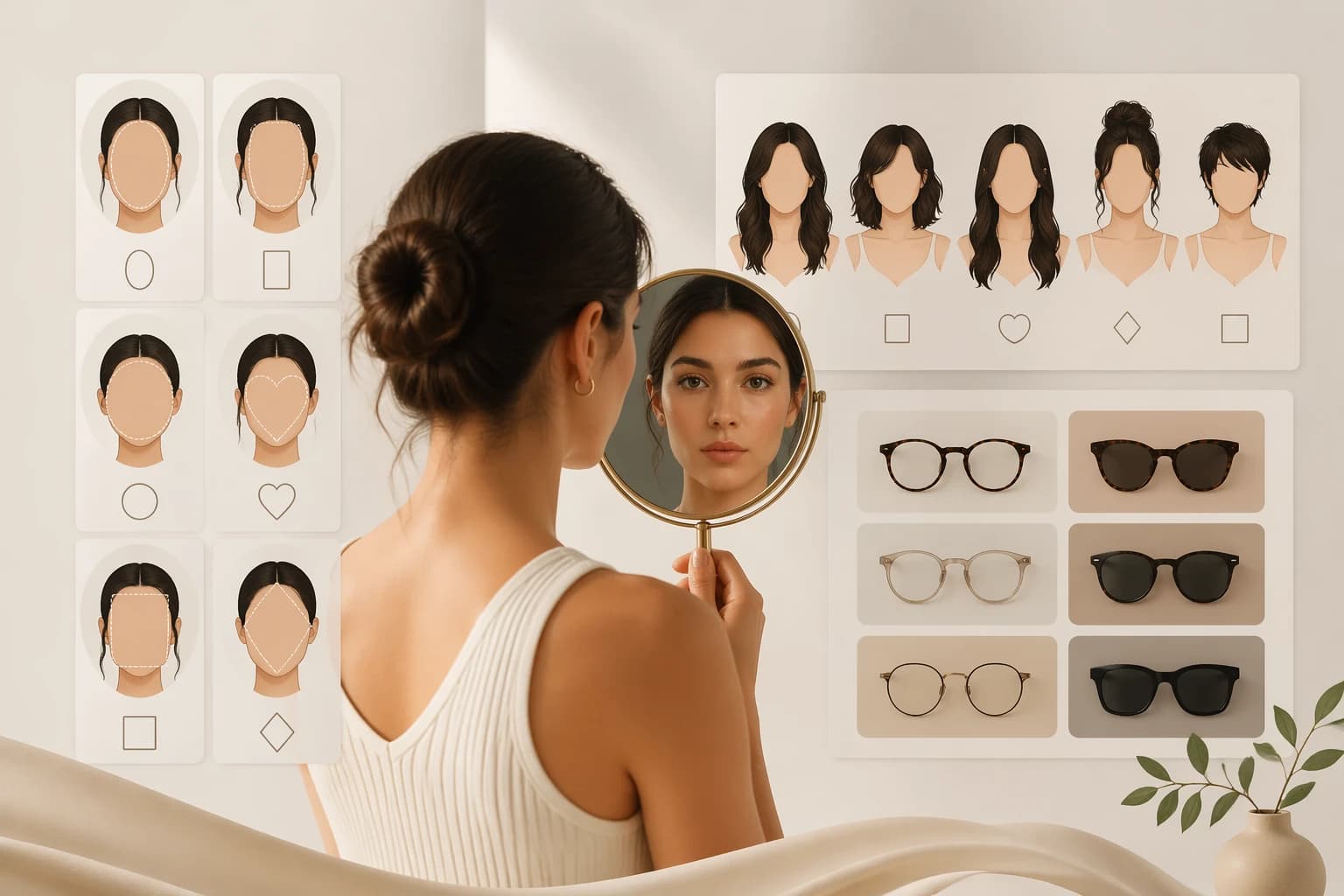
"What's my face shape?" — have you ever wondered? When changing your hairstyle or choosing glasses, knowing your exact face shape helps you make much better choices. You don't need fancy tools — just a mirror and a pencil are enough to measure at home! Today, we'll walk you through a self-measurement method and share the best hairstyles for each face shape.
What You Need and Basic Measurement
What to Prepare
All you need is a large mirror, a pencil or marker pen, and a headband. Before measuring, push all your hair back so your face outline from forehead to jawline is clearly visible. After washing your face and drying off, look straight ahead for the most accurate results.
4 Key Measurement Points
To determine your face shape, you need to compare 4 measurements. Even rough estimates while looking in the mirror can give you a good idea!
1) Forehead width: The distance from one eyebrow end to the other. Hold a pencil at one eyebrow tip while looking in the mirror and estimate the distance to the other side.
2) Cheekbone width: The distance between the most protruding points of your cheekbones. This is usually slightly below and outside your eyes. Check whether this is the widest part of your face, or similar to your forehead and jaw.
3) Jaw width: The distance across the widest part of your jawbone. Trace from below your ears toward your chin to feel the jawbone. Compare this width with your forehead and cheekbones.
4) Face length: The distance from the center of your hairline to the tip of your chin. Check whether this length is longer than, or similar to, the widest part of your face (usually the cheekbones).
Determining Your Face Shape by Proportions
Proportion Characteristics of Each Face Shape
Round: Face length and cheekbone width are nearly equal, with a smoothly curved jawline. If your forehead, cheekbones, and jaw are similar in width with an overall round feel, you have a round face.
Oval (Egg-shaped): Face length is slightly longer than cheekbone width, and the forehead is wider than the jaw. If your face tapers naturally toward the chin, you have an oval face.
Square: Forehead, cheekbone, and jaw widths are all similar, with an almost right-angled jawline. Face length and width tend to be similar.
Heart: The forehead is widest and the chin is pointed. Cheekbones are slightly narrower than or similar to the forehead, and the face narrows significantly toward the chin.
Diamond: Cheekbones are widest while both forehead and chin are narrow. If the middle of your face appears to spread wider, you have a diamond face.
Rectangular: Similar to square but with a longer face. Forehead, cheekbone, and jaw widths are similar but the face is elongated vertically.
Best Hairstyles for Each Face Shape
Styles for Round Faces
Round faces benefit from styles that emphasize vertical lines. A ponytail with volume on top or side-swept bangs can make your face appear longer. On the other hand, a bob with lots of side volume may make your face look even rounder.
Styles for Square Faces
Square faces look great with layered cuts that softly frame the jawline. Wavy or S-curl styles help soften angular features. A side part or curtain bangs tend to look more natural than straight-across bangs.
Styles for Heart Faces
Heart faces benefit from styles that add volume around the chin. A chin-length bob or outward C-curls can complement a narrow chin. Since the forehead tends to be wider, adding bangs to reduce apparent forehead width is also a great strategy.
Styles for Oval Faces
The oval face is the most versatile — almost any style works! Long hair, bob, bangs — feel free to experiment with whatever style you like. Just maintain some volume to prevent your face from looking too long.
Disclaimer: This content is for entertainment purposes and provides general guidelines. Since individual facial features vary widely, consider consulting a professional stylist for personalized advice!