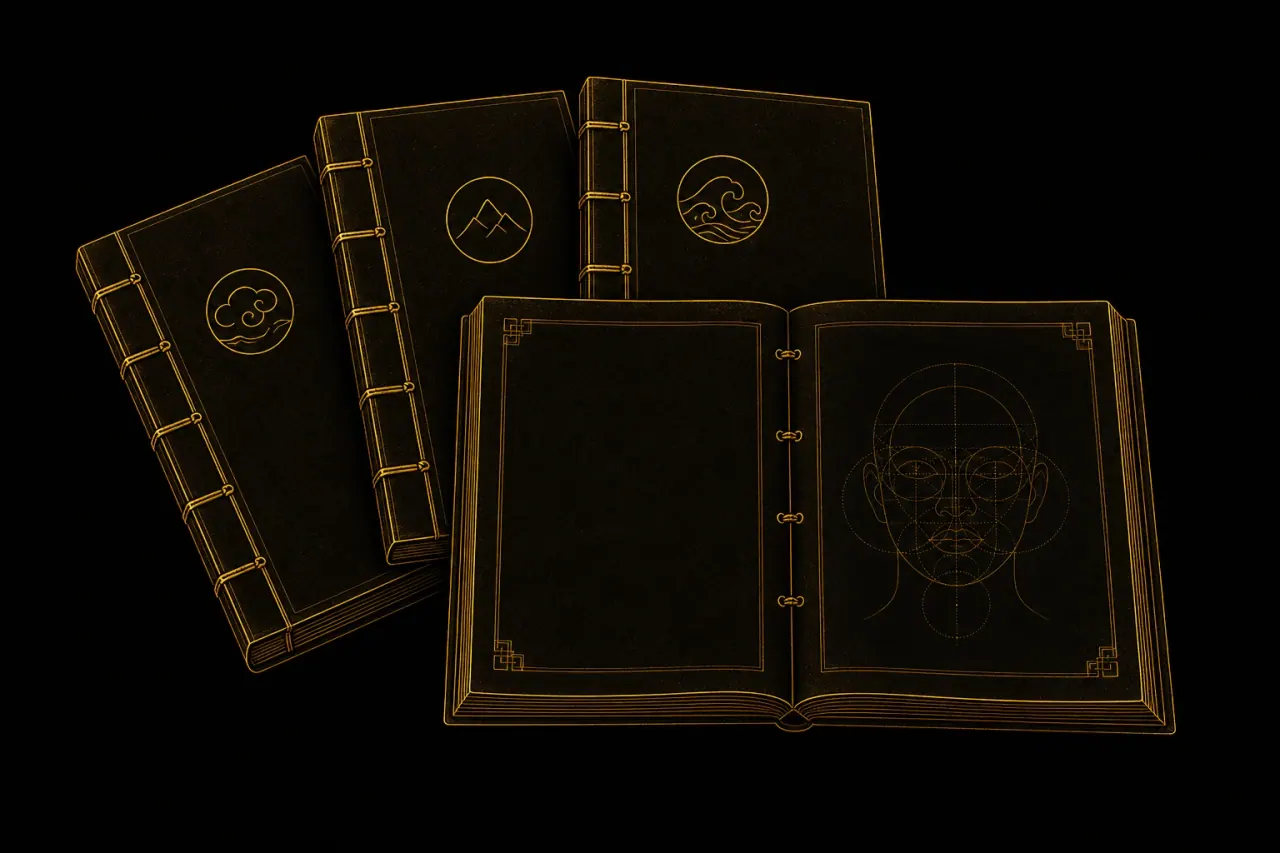
Face Reading Has Its Own 'Classics'
Dig into old physiognomy material and a handful of book titles keep coming back: Mayi Xiangfa, Liuzhuang Xiangfa, Shenxiang Quanbian, and Damo Xiangfa. These are the works usually grouped as the physiognomy classics, the 'four great books' of face reading. Today we'll walk slowly through when each was compiled, through which lineage, and what it holds — as history.
The word 'classic' needs a caveat here. These aren't books one author finished in a given year so much as compilations that passed down for centuries by word of mouth and hand-copying before being edited and printed by later hands. So the name on the cover is often the symbolic founder of a lineage rather than a literal author, and the contents mix verse mnemonics (gejue), position diagrams, and case notes.
Let me be clear up front. This article introduces the four classics as cultural and historical texts, not to pass along their individual fortune claims as fact. Old books claimed a face could reveal personality or destiny, but today we don't use them as a basis for judging anyone. Read them the way you'd read a Renaissance medical text — as a window onto how a period saw the world.
Mayi Xiangfa (麻衣相法) — the Oldest Root
The deepest-rooted and most widely spread of the four is Mayi Xiangfa. The 'Mayi' (hemp robe) in the title points to a recluse in coarse hemp clothing — the Hemp-Robed Master, Mayi Daozhe. By tradition he was a Daoist hermit of the late Tang and Five Dynasties era, a half-legendary figure whose name and deeds are barely recorded.
The lineage: from the Hemp-Robed Master to Chen Tuan
The person usually credited with transmitting Mayi Xiangfa is the Song Daoist Chen Tuan (d. 989). Known as Xiyi Xiansheng and famed for Yijing studies and Daoist cultivation, he is said in the tradition to have inherited the Hemp-Robed Master's teaching and organized physiognomy into a system. Still, the printed Mayi Xiangfa we read was collated much later, in the Ming and Qing, so 'Song transmission' marks the starting point of a lineage, not a date of authorship.
What it holds
Mayi Xiangfa lays out, in dense verse, frameworks like the three courts (san ting) that split the face into upper, middle, and lower, the five peaks (wu yue) that liken the forehead, nose, and chin to mountains, the twelve palaces (shi'er gong) that map facial areas to life domains, and the age-position scheme (liunian) that reads areas by age. Notably it prized the shen — the spirit or vitality a face gives off — over mere shape, but such writing reflects that era's view and isn't a basis for fixing anyone's personality or ability today.
Liuzhuang Xiangfa (柳莊相法) — Field Notes from the Ming Court
If Mayi Xiangfa is poetic and principle-first, Liuzhuang Xiangfa is far more practical and case-driven. 'Liuzhuang' comes from the studio name of an early-Ming family of physiognomists. The book is transmitted through the lineage of Yuan Gong, renowned for face reading, and his son Yuan Zhongche.
Yuan Zhongche (1376–1458) is recorded as an actual official at the Ming court, so this lineage's book carries the flavor of watching people in palace and government service. Much of Liuzhuang Xiangfa reads less like abstract principle than an observation notebook — 'in this sort of case it looked like this.' Of course, using that observation to pin down someone's destiny or identity was an old habit; we don't read it that way now.
Later readers often paired Mayi Xiangfa and Liuzhuang Xiangfa as the two pillars of physiognomy. One speaks the language of principle and metaphor, the other the language of field observation, so people read them layered together, each filling the other's gaps.
Shenxiang Quanbian and Damo Xiangfa — the Encyclopedia and the 'Face of the Mind'
The remaining two classics have quite a different grain. One is an encyclopedia-like book that gathers scattered physiognomy knowledge in one place; the other is steeped in Buddhist color.
Shenxiang Quanbian (神相全編) — a comprehensive compilation
True to its name, Shenxiang Quanbian is a 'complete compilation' (quanbian) of many writings on physiognomy (shenxiang). Assembled in the Ming, it collates earlier physiognomy texts, position diagrams, and verse formulas into one reference; tradition traces its backbone to Chen Tuan and credits later editing to the Yuan Zhongche lineage. It overlaps considerably with Mayi Xiangfa, nicely showing how texts in this field grew by quoting and copying one another.
Damo Xiangfa (達摩相法) — the mind shapes the face
Damo Xiangfa is ascribed to Bodhidharma (Damo), traditionally the first patriarch of Chan Buddhism. That doesn't mean he wrote it; the name borrows the authority of a Buddhist lineage. The book emphasizes complexion (qise) and shen, and above all pushes the idea of the 'face of the mind' — that appearance arises from the mind (xiang you xin sheng). Rather than the face fixing destiny, the notion that one's heart reshapes one's impression reads today as a reason not to judge people by their faces.
| Classic text | Attributed era / lineage | Style & focus | Reading it today |
|---|---|---|---|
| Mayi Xiangfa (麻衣相法) | Song, via Chen Tuan (ascribed to the Hemp-Robed Master) | Principle- and verse-based; prizes shen (spirit) | Root source of the whole system |
| Liuzhuang Xiangfa (柳莊相法) | Ming, the Yuan Gong / Yuan Zhongche family | Court field notes and case observation | A practical, case-driven notebook |
| Shenxiang Quanbian (神相全編) | Ming compilation on Chen Tuan's transmission (edited by Yuan Zhongche) | Encyclopedic anthology of many texts | The genre's grand collation |
| Damo Xiangfa (達摩相法) | Buddhist transmission (ascribed to Bodhidharma) | Stresses complexion and 'the face follows the mind' | A lens of mind and cultivation |
The Shared Language Running Through All Four
Though they come from different eras and lineages, the four classics share a strikingly similar vocabulary. The three courts that stack the face in layers, the five peaks and four rivers (wu yue si du), the twelve palaces that attach a life domain to each area, and the age-position map (liunian) recur across nearly every book — as if several dialects shared one grammar.
What many of them stressed, again and again, was less measurement than shen and qise — the vitality and the flow of complexion a face gives off. It's intriguing that they tried to read overall energy rather than tally the sizes of features. That said, these old lines are not a basis for reading off anyone's health or ability, and real health must always be checked with a medical professional.
Another thread running through all four is the line 'appearance arises from the mind' (xiang you xin sheng). Repeated especially in Damo Xiangfa and the Mayi lineage, this notion actually stands opposite the fatalism that nails destiny to a face. Because it says a changed heart and conduct change the impression too, it can be read as an ethic of self-cultivation that tells us not to judge anyone's future by a face.
How Should We Read These Books Today?
So how best to approach these classics now? The healthiest way is to read them not as prediction manuals but as sources for cultural history — a kind of anthropological record of how people in East Asia classified and imagined the world and human beings through the familiar object of the face.
These texts are woven through with their era's cosmology — the five elements and yin-yang, metaphors linking body and society. Read with that context, the history of physiognomy starts to look less like divination and more like an intellectual tradition, the same way we read Western phrenology or bloodletting medicine as history rather than science.
In short, from Mayi Xiangfa to Damo Xiangfa, these four are cultural heritage well worth reading. But using their face readings as a basis for judging real personality or destiny was only that era's way, so we enjoy them best at a distance that sees both their wisdom and their limits.
Frequently asked questions
Which books exactly are the four physiognomy classics?
They're usually named as Mayi Xiangfa, Liuzhuang Xiangfa, Shenxiang Quanbian, and Damo Xiangfa. Mayi Xiangfa is the oldest root and lays out the principles, Liuzhuang Xiangfa is the practical record of the Ming Yuan Zhongche lineage, Shenxiang Quanbian is a comprehensive compilation of many texts, and Damo Xiangfa is steeped in Buddhist transmission. All four are best read as cultural and historical texts, not as tools for guessing anyone's personal fortune.
Did a man named Mayi Daozhe really write Mayi Xiangfa?
That's hard to claim. The Hemp-Robed Master is a half-legendary hermit whose name and deeds are unclear, and the printed edition we have was collated much later. The name on the cover is better understood as the symbolic founder of a lineage than a literal author. It's best not to read old author attributions like a modern copyright notice.
Is Damo Xiangfa a Buddhist scripture written by Bodhidharma?
It isn't a scripture. It's a physiognomy text that borrows (is ascribed to) the name of Bodhidharma, traditionally the first patriarch of Chan, with no evidence he wrote it himself. Still, the Buddhist idea that 'the mind shapes the face' runs deep in it, so it can also be read as a message not to judge people carelessly by their faces.
Can I actually use these classics for real face-reading judgments today?
I wouldn't recommend it. These books aren't scientifically validated prediction manuals but cultural-history sources holding their era's worldview. Judging personality, health, or destiny from a face alone has no basis, and such important matters must be checked with a professional in that field. The classics are best enjoyed as history and general culture.
Do Shenxiang Quanbian and Mayi Xiangfa overlap?
Yes, quite a lot. Shenxiang Quanbian is a comprehensive compilation that gathers earlier physiognomy texts, position diagrams, and verse formulas, so it absorbed much of the Mayi material. Growing by quoting and re-copying one another is a hallmark of this field, so it's often hard to cleanly separate original from copy.
Article info & references
Published July 4, 2026 · Last updated July 4, 2026
- Mayi Xiangfa (麻衣相法): a physiognomy classic transmitted via the Song Daoist Chen Tuan (Xiyi Xiansheng) and ascribed to the legendary Hemp-Robed Master (Mayi Daozhe)
- Liuzhuang Xiangfa (柳莊相法): a physiognomy text passed down through the early-Ming Yuan family lineage of Yuan Gong and Yuan Zhongche
- Shenxiang Quanbian (神相全編): a Ming-era comprehensive compilation gathering earlier physiognomy texts on the transmission ascribed to Chen Tuan (edited in the Yuan Zhongche lineage)
- Damo Xiangfa (達摩相法): a physiognomy text of Buddhist transmission ascribed to Bodhidharma (Damo), traditionally the first patriarch of Chan
- General note that all four are transmitted, later-compiled texts best read as East Asian cultural-history sources