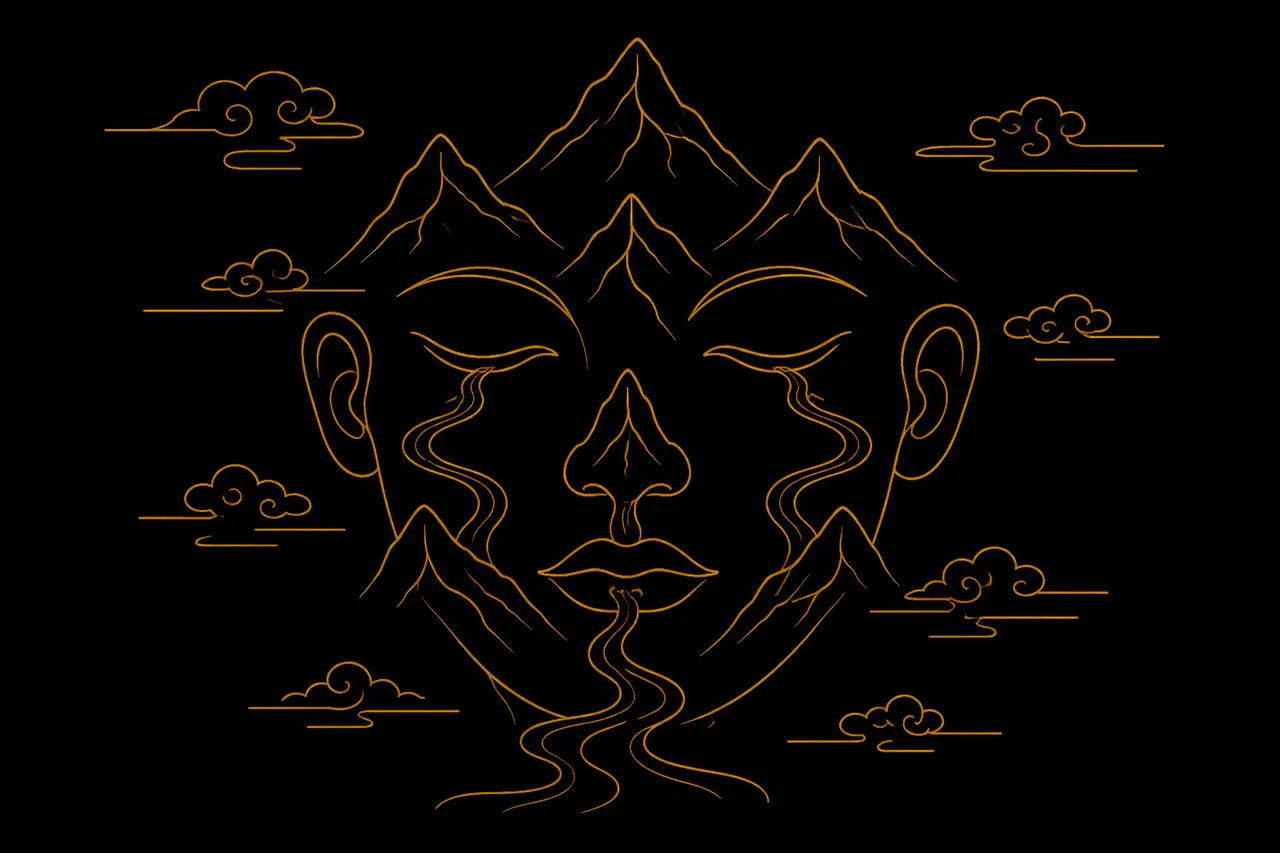
People who read the face as mountains and rivers
East Asians long looked at the face as a kind of landscape. The forehead was a high peak; the eyes and mouth were winding waterways. The phrase that compresses this old imagination into a single term is 五嶽四瀆 (obak-sadok) — the Five Peaks and Four Rivers. It maps the forehead, chin, nose, and two cheekbones onto five mountains, and the eyes, ears, nose, and mouth onto four rivers, a landscape metaphor handed down in Ma Yi (麻衣相法)-lineage physiognomy texts.
What is fascinating is that the Five Peaks and Four Rivers were not originally facial terms at all. Both were real geographic names honored in Chinese state sacrifice — the Five Peaks being famous mountains like Tai, Hua, Heng, Heng, and Song, and the Four Rivers being four great rivers that each reach the sea on their own. Physiognomy simply laid this ready-made cosmic map over the human face, turning a single face into a small country of mountains and streams.
So this article is not putting the Five Peaks and Four Rivers forward as scientific fact; it is a place to look, as culture, at how people once imagined the face. The mountains and rivers drawn onto a face do not tell you anyone's personality or destiny. Please follow along lightly, as one story built on an old landscape metaphor.
The Five Peaks (五嶽) — five mountains on the face
The Five Peaks are the famous mountains guarding the four directions and the center. In physiognomy, these mountains were each seated on the five spots that rise most fully on the face. Because all of them are held up by bone and keep their shape even under soft tissue, to older eyes they looked like a mountain range crossing the land of the face.
Where the five mountains sit
The most widely handed-down arrangement goes like this: the forehead is the southern peak (Mt. Heng 衡山), the chin is the northern peak (Mt. Heng 恒山), the nose is the central peak (Mt. Song 嵩山), the left cheekbone is the eastern peak (Mt. Tai 泰山), and the right cheekbone is the western peak (Mt. Hua 華山). Calling the upper forehead 'south' and the lower chin 'north' may feel odd, but it echoes the old convention of placing south at the top of a map. The nose at the very center becomes Mt. Song, the central mountain that presides over the other four.
Obak-jogong — peaks leaning on one another
What traditional physiognomy watched for in the Five Peaks was less the size of any single summit than how well the five suited one another. When the four peaks seem to gather and curve toward the central nose, it was called 五嶽朝拱 (obak-jogong) — the mountains bowing toward the center — and prized as a harmonious composition. A steadiness in which no peak collapses or juts out alone, but each supports the rest, was seen as pleasing. Of course this is only an old aesthetic taste for looking at faces, not a yardstick for judging anyone's ability or destiny.
The Four Rivers (四瀆) — four waters flowing across the face
The Four Rivers are the four great waters that carve their own way to the sea — the Jiang (江), He (河), Huai (淮), and Ji (濟). If the Five Peaks are where the land rises, the rivers were assigned to the places that open and flow on the face: the eyes, ears, mouth, and the nostrils through which breath passes. In common transmission, the eyes were likened to the He (Yellow River), the ears to the Jiang (Yangtze), the mouth to the Huai, and the nose to the Ji.
Here is a detail worth noticing. The nose appears both as the central peak (Mt. Song) of the Five Peaks and, through the nostrils, as the Ji among the Four Rivers. It plays two roles at once — a rising mountain and a flowing channel — which hints at how deeply older readers treated the nose as the center of the face. That said, exactly which river pairs with which feature shifts a little from edition to edition, so it is better enjoyed as a flow than memorized as one fixed answer.
The aesthetic of 'flowing clear'
The heart of the river stories is the image of water that runs clear, deep, and unobstructed. Water valued as pleasing was neither muddy nor dried up but open and free. So clear eyes, well-defined ears, and a composed, closed mouth were all talked about in terms of flowing water. This too is just an appreciation of the face as a landscape painting, not a basis for checking anyone's health or identity.
| Traditional class | Face part | Landscape (mountain/river) | Story attached |
|---|---|---|---|
| Five Peaks · South | Forehead | Mt. Heng (衡山) | High and even, read as an open, clear look |
| Five Peaks · North | Chin | Mt. Heng (恒山) | A generous chin, described as steady and grounded |
| Five Peaks · Center | Nose | Mt. Song (嵩山) | Likened to the central pillar of the face |
| Five Peaks · East | Left cheekbone | Mt. Tai (泰山) | Curving toward center, seen as harmonious |
| Five Peaks · West | Right cheekbone | Mt. Hua (華山) | Left and right in accord, called balanced |
| Four Rivers | Eyes | He / Yellow River (河) | Compared to clear, deep-flowing water |
| Four Rivers | Ears | Jiang / Yangtze (江) | A distinct channel, valued when well-defined |
| Four Rivers | Mouth | Huai (淮) | Likened to a tidy, composed waterside |
Why mountains and rivers, of all things
There was a whole worldview behind likening the face to terrain. In East Asia, the idea of 天人合一 (heaven-human unity) — that the human body is a miniature of heaven and earth — had long been settled in place. If the great world has its Five Peaks and Four Rivers, then the small world of the face was imagined to have its own corresponding mountains and rivers. It is a wish to read body and nature along the same grain.
On top of that, the Five Peaks and Four Rivers were not just any terrain but sacred geography where sacrifices were offered for the peace of the realm. By transplanting this already-dignified map onto the face, a single human face was poetically elevated into a small landscape, a world of its own. Just as landscape painting held the scenery of nature, physiognomy read the scenery of the face.
The Five Peaks and the Five Elements
The Five Peaks were never merely five mountains. In East Asian cosmology the five directions paired with the Five Elements (五行): eastern Mt. Tai with Wood, western Mt. Hua with Metal, southern Mt. Heng with Fire, northern Mt. Heng with Water, and central Mt. Song with Earth. So seating the Five Peaks on a face meant laying the symbols of direction and element onto the forehead, chin, and cheekbones as well. It springs from the same root as the old habit of sorting face shapes by the five elements, so the two read more clearly side by side. Yet this is only a symbolic system old thinkers used to order the world; it does not decide anyone's personality or destiny.
How to see this old map today
The most enjoyable way to look at the Five Peaks and Four Rivers is to appreciate it as a landscape painting rather than a scorecard. Picturing peaks and waterways on your own face makes your gaze in the mirror a little more generous and curious. Instead of ranking what is better or worse, you end up wondering which mountains and rivers run through this particular view.
Interestingly, we still describe faces in the language of space. Saying features look 'open' or 'balanced' is not far from the sensibility of the Five Peaks and Four Rivers. But such impressions are subjective feelings that shift with the viewer and the mood of the day. Psychology research on how easily first impressions wobble — the primacy effect and the halo effect — backs that up.
One last thing to keep in mind: the Five Peaks and Four Rivers is only a beautiful old map for imagining the face, not a basis for judging anyone's personality or destiny. The moment you appraise a person because a mountain is high or a river bends, the metaphor curdles into prejudice. This map is at its most beautiful when it stays a lens for seeing the face as a poem, not a ruler for measuring people. If you are curious about the history of face reading or other facial maps, follow the pieces below.
Frequently asked questions
What does 五嶽四瀆 (Five Peaks, Four Rivers) mean?
The Five Peaks liken the five rising spots of the face (forehead, chin, nose, and both cheekbones) to China's five famous mountains, and the Four Rivers liken the four open, flowing spots (eyes, ears, nose, and mouth) to four great rivers. It is a traditional physiognomy metaphor for reading the face as a single landscape of mountains and water. It is an old cultural and historical story, not a scientifically verified theory, and not a framework for pinning down anyone's personality or destiny.
Which parts of the face are the Five Peaks?
In the most widely handed-down arrangement, the forehead is the southern peak, the chin the northern peak, the nose the central peak, the left cheekbone the eastern peak, and the right cheekbone the western peak — paired with the real mountains Heng, Heng, Song, Tai, and Hua. But this is just an old metaphor likening the face to terrain, not a standard for judging a person by their face.
How are the Four Rivers divided?
The Four Rivers are assigned to the sensory openings that seem to flow across the face. In common transmission, the eyes are likened to the He (Yellow River), the ears to the Jiang (Yangtze), the mouth to the Huai, and the nose to the Ji. The aesthetic behind it prizes water that runs clear, deep, and unobstructed. The pairings shift a little between editions, so it is best enjoyed as a flow rather than memorized as one fixed answer.
What does it mean that the nose is both a peak and a river?
Yes — the nose is the central peak (Mt. Song) of the Five Peaks and, through the nostrils, also appears as the Ji among the Four Rivers, holding two roles at once as a rising mountain and a flowing channel. It shows how central traditional physiognomy considered the nose to be, but this too is only a cultural symbol; the shape of a nose does not tell anyone's ability or luck.
Can the Five Peaks and Four Rivers tell my personality or fortune?
No. It is only an old culture of appreciating the face as a landscape, and it is not a basis for revealing or pinning down anyone's personality or destiny. The same face reads completely differently depending on the viewer and the mood of the day, and appraising a person by their face is closer to the trap of first impressions. Please enjoy it lightly, purely as an interesting piece of cultural storytelling.
Article info & references
Published July 4, 2026 · Last updated July 4, 2026
- The 五嶽四瀆 (Five Peaks, Four Rivers) classification handed down in Ma Yi (麻衣相法)-lineage physiognomy texts — a landscape metaphor mapping forehead, chin, nose, and cheekbones to five mountains and eyes, ears, nose, and mouth to four rivers
- The Five Sacred Mountains (五嶽) and Four Waterways (四瀆) of Chinese state ritual geography — general cultural/historical background on Mt. Tai, Hua, Heng, Heng, and Song and the Jiang, He, Huai, and Ji rivers
- General cultural-history background on the East Asian 天人合一 (heaven-human unity) and correspondence cosmology that viewed the body as a microcosm of heaven and earth
- Classic first-impression research: Solomon Asch, 'Forming Impressions of Personality' (1946) — primacy effect / Edward L. Thorndike, 'A Constant Error in Psychological Ratings' (1920) — halo effect