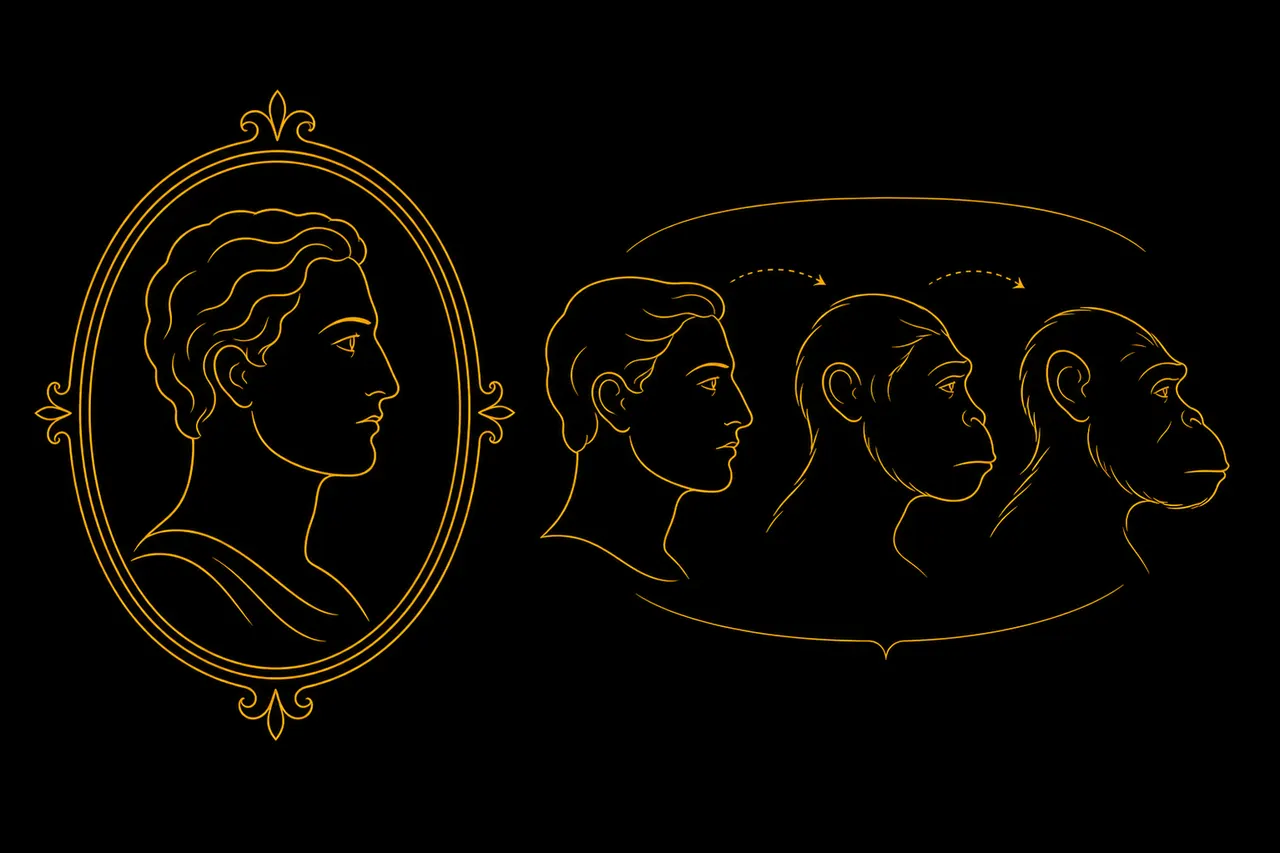
The urge to read character from a face is shared East and West
When people hear the word physiognomy, they usually picture an East Asian tradition. Yet the urge to read a person's character from the face runs deep in the West as well. From classical Greece to Renaissance Italy to Enlightenment-era Switzerland, Western physiognomy left behind its own texts and images. This article looks at that story as cultural history — it does not claim that a face actually tells us anyone's character or destiny.
Western physiognomy has three great landmarks: the Physiognomonics attributed to Pseudo-Aristotle, often called the first textbook of face-reading; Giambattista della Porta's 1586 plates that set human and animal faces side by side; and Johann Kaspar Lavater's 1775–78 work that made profile silhouettes a craze. Following these three scenes, we will also compare Western physiognomy with its East Asian cousin.
To be clear up front, these old physiognomy books are not modern science but cultural artifacts carrying the worldview of their times. They are records of what people once believed; they are not a basis for judging anyone's character or ability. If anything, the refusal to size people up by their faces is the real lesson this history leaves us.
Pseudo-Aristotle's Physiognomonics — the first Western textbook
The oldest surviving Western text to treat the face systematically is a short treatise called Physiognomonics. It has come down to us under Aristotle's name, but scholars today attribute it to his followers — the Peripatetic school, around the third century BCE — which is why it is usually credited to 'Pseudo-Aristotle.' Its founding assumption is that body and soul act upon each other, a kind of sympathy between the physical frame and the inner self.
Three ways of looking
The treatise proposed three routes for reading the face and body. The first was analogy to animals: a person who looked like a lion was thought brave, one who resembled a fox, cunning. The second read a lasting temperament from the expressions of passing emotions. The third compared people to regional or 'ethnic' types — and that last method, sorting people by group, is plain prejudice that is not a basis for judging anyone today.
The weight of Aristotle's name
Much of the book's staying power came from the authority of Aristotle's name. Medieval Arab and European scholars copied and annotated it as trusted knowledge, and it was read avidly again in the Renaissance. But the authority of a name does not make its contents true. It is worth remembering that the premise — that you can read character off a face — was never a proven fact, only a belief of its era.
Della Porta's human-animal analogy plates (1586)
In sixteenth-century Naples, the polymath Giambattista della Porta published De humana physiognomonia in 1586. A man equally at home in natural magic and optics, he revived the ancient animal-analogy method with woodcut plates that carved a human face and an animal's head onto the same page.
Setting human and animal side by side
A man like an ox, a face like a ram, features like a lion or an owl — della Porta's illustrations placed a human face beside the animal it supposedly resembled, hinting that the person shared the beast's temperament. Because a picture lands harder than a paragraph, these plates spread widely and turned physiognomy into an intriguing spectacle. Of course, looking like some animal does not determine anyone's character.
Curiosity that clashed with the Church
Della Porta's restless curiosity often courted danger. The private society he founded to probe nature was suspected of dabbling in magic and forced to close, and several of his works fell under Church censorship. Physiognomy too drew suspicion for seeming to second-guess a person's fate — a sign that reading the future off a face was risky even then. Foretelling destiny from a face is not a sound judgment, then or now.
Lavater's silhouette physiognomy (1775–78)
The man who turned Western physiognomy into a popular craze was Johann Kaspar Lavater, a pastor from Zürich. Between 1775 and 1778 he published his four-volume Physiognomische Fragmente, and the lavish book, packed with fine engravings, drew the interest of contemporaries like Goethe and Herder, was translated across Europe, and became a runaway bestseller.
The vogue for profile shadows
Lavater's favorite instrument was the profile silhouette. He would seat a person before a candle, trace the shadow cast on the wall, and treat that stripped-down outline as a 'pure' record of the face. He believed the line running from forehead to nose exposed the inner person, and thanks to him, cutting silhouettes became a hobby that swept Europe. Still, the idea that an outline mirrors the mind was his belief, not a proven fact; it does not tell us who anyone is.
The shadow a bestseller cast
Lavater's book captivated the age — the young Goethe even contributed material early on — though sharp critics like the physicist Lichtenberg mocked it. The bigger problem came later. The notion that a profile's outline could rank a person's moral worth became a doorway to pseudo-sciences like phrenology and the 'criminal face.' Grading people's worth or character by their looks is plain discrimination, and it is not a basis for judgment today.
| Era · figure · work | Signature method | Core idea | Cultural ripple |
|---|---|---|---|
| c. 3rd c. BCE · Pseudo-Aristotle, Physiognomonics | Animal analogy · expression · regional 'type' | Body and soul act on each other | First systematic Western face-reading text |
| 1586 · della Porta, De humana physiognomonia | Human-animal facial woodcuts | You share the temperament of your look-alike beast | Physiognomy becomes a spectacle |
| 1775–78 · Lavater, Physiognomische Fragmente | Profile silhouette (outline) | The outline mirrors the inner self | Silhouette craze; popular physiognomy boom |
| 19th c. onward · phrenology · criminal anthropology (misuse) | Skull and face measurement | Sorting people into 'types' by face | Abused as a tool of discrimination, then discarded |
What was alike and what differed from East Asian face-reading
So how alike were Western physiognomy and East Asian face-reading? Their biggest resemblance is the starting point. Both traditions began from the intuition that 'a person is written on the face,' and both worked hard to turn that intuition into a system. With traces of face-reading reported from ancient Egypt to the medieval Arab world, this curiosity looks like an old human habit that respected neither culture nor continent.
The same urge, different worldviews
The difference lay in the worldview each urge was wrapped in. East Asian face-reading tied the face to fortune and the flow of luck within a cosmology of qi, yin-yang, the five elements, and the twelve palaces. The West leaned instead on medical theories like the four humors and on ideas of temperament and morality, with animal analogy especially developed. Either way, neither tradition can fix a person's fate; both are cultural stories, not scientific verdicts about a life.
What to take from this history
The history of Western physiognomy is not just a charming old tale. After Lavater, the nineteenth century channeled the idea into phrenology and criminal anthropology, where the shape of a face or skull became a tool for branding people as a 'criminal type.' At heavy cost, this history shows just how dangerous it is to sort and discriminate against people on the evidence of a face.
So the point of reading these texts today is not to learn 'how to read faces.' It is rather that they work as a mirror for how readily we drape stories over a face. The mechanics of first impressions are explained far more honestly by modern impression psychology, and that field is not about judging people but about learning not to misread one another.
In short, the line from Pseudo-Aristotle through della Porta to Lavater is a record of a curiosity humankind has long carried. The curiosity itself is natural, but a face does not stand as evidence of anyone's character or destiny, and the moment we use it as a yardstick it becomes prejudice. This article, too, tries to keep that boundary and to hold to the principle of never sizing people up by their faces.
Frequently asked questions
Did the West have physiognomy too?
Yes. The classical Physiognomonics of Pseudo-Aristotle, della Porta's human-animal plates of 1586, and Lavater's silhouette physiognomy of 1775–78 are the landmarks. But these were cultural traditions carrying the worldview of their times, not science, and they are not a basis for judging anyone's character.
Who was Lavater?
Johann Kaspar Lavater was an eighteenth-century pastor from Zürich who, with his four-volume Physiognomische Fragmente (1775–78), turned Western physiognomy into a popular craze. He made the profile silhouette his signature tool, but his idea that an outline exposes the inner self was a belief of the era, not a proven fact — it does not tell us who anyone is.
What did della Porta's animal pictures mean?
They set a human face beside an animal — a lion, an ox, an owl — to suggest the person shared that beast's temperament, reviving the ancient Aristotelian analogy in the Renaissance. But resembling an animal does not determine a person's character or destiny.
How do Western and East Asian physiognomy differ?
Their starting point is similar — both tried to read the person in the face. But East Asian face-reading was woven into a cosmology of qi, yin-yang and the five elements, and fate, while the West leaned on the four humors, ideas of morality and temperament, and animal analogy. Different as they are, neither tradition fixes a person's fate; both are cultures that reveal the imagination of their era.
Is physiognomy a science?
No. Physiognomy is a long cultural and historical tradition, but not a scientifically proven method. In the West, after Lavater it was misused in phrenology and criminal anthropology and even became a tool of discrimination. So this article treats it as cultural literacy only, and it does not determine anyone's character or destiny from a face.
Article info & references
Published July 4, 2026 · Last updated July 4, 2026
- Pseudo-Aristotle, Physiognomonica (Physiognomonics) — the oldest surviving Western treatise on physiognomy, attributed to the Aristotelian school
- Giambattista della Porta, De humana physiognomonia libri IIII (1586) — a Renaissance work famous for its human-animal facial analogy plates
- Johann Kaspar Lavater, Physiognomische Fragmente, zur Beförderung der Menschenkenntnis und Menschenliebe (1775–1778) — four volumes that popularized silhouette physiognomy
- Franz Joseph Gall (1758–1828) — founder of phrenology, which extended physiognomic thinking to the shape of the skull
- Cesare Lombroso, L'uomo delinquente (1876) — the criminal-anthropology attempt to define a 'born criminal' by facial and bodily features, later discredited