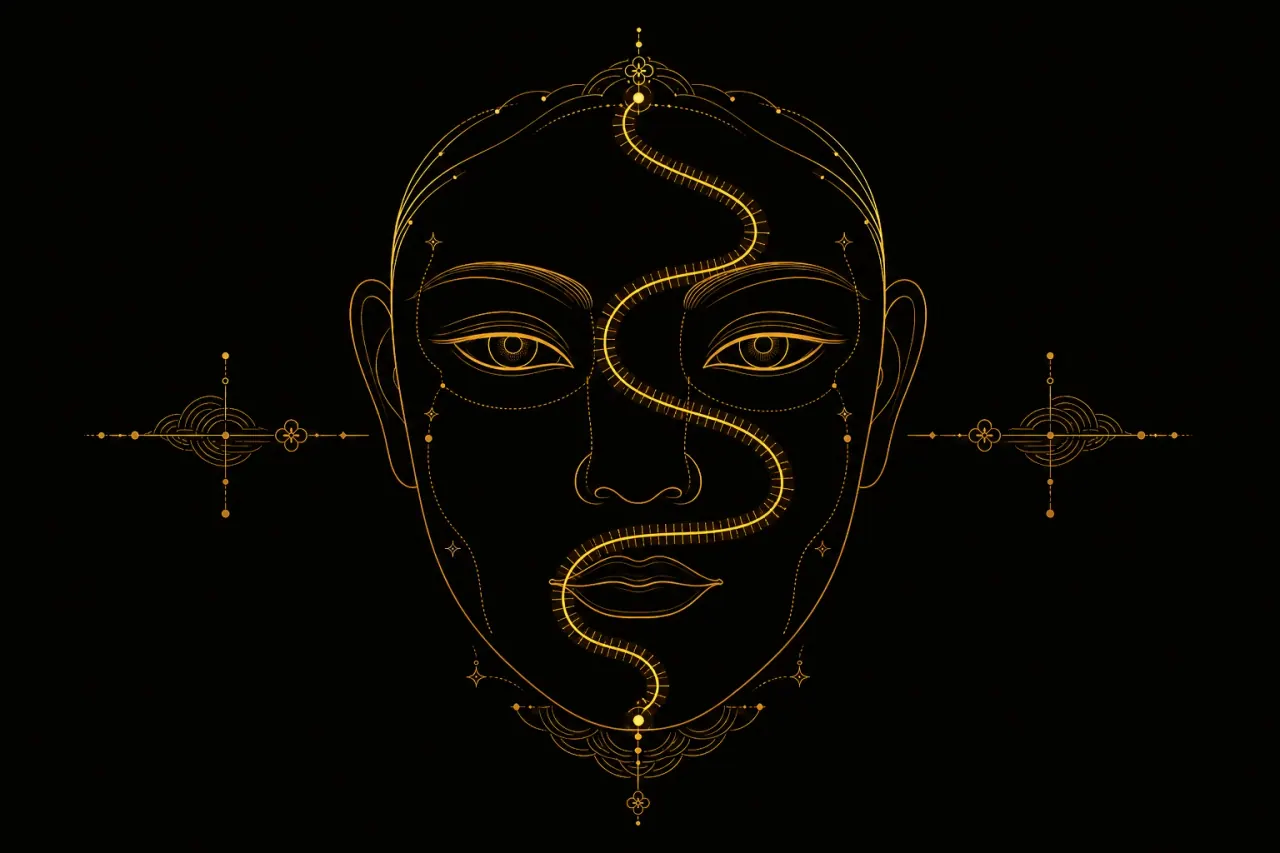
What the Flowing-Years Face Map Actually Is
The Flowing-Years Position Chart (流年運氣部位圖) is a traditional physiognomy diagram that assigns every age from 1 to 100 to a specific spot on the face. True to its name — 'flowing' and 'years' — it imagines age drifting across the face one square at a time as life moves along. Long discussed in the Mayi Xiangfa lineage of texts, it is a fascinating cultural artifact precisely because it spreads a whole human lifetime across a single face like a map.
Before we start, one clear promise. This age-by-age chart is not a table of prophecy that tells you what will happen at a given age; it is simply a picture in which people of the past arranged the flow of a life symbolically onto the face. So it never pins down anyone's destiny or future from a spot on the face. It has no scientific basis either, so it is best enjoyed for fun, the way you might browse an old map of a life story.
Even so, there is a reason this chart has been loved for so long. It sorts a person's years, from childhood to old age, into the three layers of the face — forehead, mid-face, and lower face — organizing life into a story that 'flows from top to bottom.' In this article we will walk through how the map is structured, which spots it marks for which ages, and why it is a symbolic arrangement rather than a prediction.
A Structure That Flows Top to Bottom — Forehead to Chin
The most striking feature of the Flowing-Years map is that age flows from the top of the face downward. Childhood begins near the forehead at the very top, middle age descends to the nose at the center (the mid-face), and old age flows down to the mouth and chin in the lower face. The march of age reads almost like a waterfall falling from top to bottom.
This structure meshes with the 'three zones' (三停) idea that divides the face into three layers in traditional physiognomy. The forehead region (upper zone) is said to correspond to early life, the area from the brows to the nose tip (middle zone) to midlife, and the mouth-to-chin area (lower zone) to later years. The Flowing-Years map is essentially a magnified version of this three-zone frame, laying ages onto it one year at a time.
Why It Starts High and Moves Down
Why it was arranged to begin high and flow downward is a matter of symbolism. Many read it as a metaphor: just as the sun rises in the east and sets low in the west, the forehead stands for life's morning and the chin for its evening. Images of a young tree growing upward, and the way the upper face settles first, are tangled into it too. It is only the symbolic imagination of people long ago, and it does not mean a face region and an age are actually linked by cause and effect.
Landmark Spots by Age — from the Ears to the Chin
Now let's trace the representative points the flowing-years chart marks at each age. The exact ages vary between lineages, but the broad flow is fairly consistent. Treat the ages and regions below as a widely cited guide for reading the old chart rather than as fixed answers.
Ages 1–14 — Childhood Begins at the Ears
Curiously, the chart begins not at the center of the face but at the two ears. Childhood from age 1 to 14 was traditionally placed at the ears, usually assigning ages 1–7 to one ear and 8–14 to the other. There is something charming about tucking the newborn, growing years into the ears at the edge of the face. Of course this does not mean an ear's shape can foretell a child's future; it is simply an old convention about where the chart places childhood.
Ages 15–30 — Youth Held in the Forehead
From age 15 the flow rises to the forehead. Roughly from Cheonjung (天中) at the very top, through Sagong (司空) and Jungjeong (中正), down to Indang (印堂) between the brows around age 28 — that span is the forehead stretch. A broad, open forehead was likened to the fresh start of youth, but whatever your forehead is like, it says nothing about ability or intelligence; it is only where the chart places these ages.
Ages 31–50 — Brows, Eyes, and Nose in Midlife
Entering the thirties, the flow passes the brows and eyes and gathers at the nose in the center of the face. The bridge's start between the eyes, Sangeun (山根), is set at 41, and the nose tip, Jundu (準頭), at 48. Since the nose is the face's center, the heart of midlife is placed here in the mid-face — but this is a symbolic position in the flow of ages, not a claim that reads wealth or success in midlife off the shape of a nose.
After 51 — The Philtrum, Mouth, and Chin
From the fifties the flow descends to the lower face. The philtrum between nose and mouth, Injung (人中), is set at 51, the mouth (水星) around 60, and the chin, Jigak (地閣), at 71, after which it is said to circle the chin area and continue toward 100. The latter half of life is held in the lower face as a closing — and this too is not a prophecy of one's late-life destiny but a symbolic ending that arranges a whole lifetime onto the face.
| Age range | Key region | Face location | Traditional description |
|---|---|---|---|
| Ages 1–14 | Ears (耳) | Both ears | Placed as the seat of childhood and growth |
| Ages 15–30 | Forehead (Cheonjung–Indang) | Upper face | Described as the flow of youth and early life |
| Age 28 | Indang (印堂) | Between the brows | The closing point of the forehead stretch |
| Age 41 | Sangeun (山根) | Start of the nose bridge, between the eyes | The passage into midlife |
| Age 48 | Jundu (準頭) | Nose tip | The center of the mid-face |
| Age 51 | Injung (人中) | Between nose and mouth | The step down into the lower face |
| Age 60 | Suseong (水星), the mouth | Mouth | A spot in the flow of old age |
| Age 71 | Jigak (地閣) | Chin | A spot symbolizing late life |
It Is a Symbolic Arrangement, Not a Prediction
Seen this far, the flowing-years map looks quite intricate, but the key is that it is not a prediction table. The chart promises where to look at a given age; it does not prove that 'a wrinkle here means such-and-such happens at that age.' It never pins down the destiny or success of an age from a spot on the face, because it is an old symbolic system, not an evidence-based forecast.
Calling it a symbolic arrangement means the chart is a kind of memory device and storytelling frame. Laying the long span of a lifetime, in order, over something as familiar as a face makes the flow of life far easier to memorize and narrate. When old physiognomists seemed to 'read a life down a face,' they were really spinning a story along this arranged order.
Same Age, Different People — the Chart Decides Nothing
The most important thing is the obvious fact that even at the same age, lives differ completely from person to person. A Sangeun at forty-one cannot mean the same thing for everyone, and even the same spot shifts in impression with light, angle, and expression. So no cell of the chart can be a basis for judging anyone's personality or future. Age-by-age physiognomy is not a yardstick for defining people, only a window into how people of the past viewed a life.
Enjoying the Flowing-Years Map as Culture
So how is this old chart best enjoyed? I see the Flowing-Years map as an epic poem of a life drawn onto a face. The very flow — beginning at the forehead's morning, passing the nose's noon, and fading into the chin's evening — is a piece of cultural history showing how people once imagined time and aging. Tracing the ages across the face and marveling, 'so this is how they divided a life,' is exactly the right way to take it.
Above all, it is best to set down any urge to use this chart to judge the luck of someone's age by looking at their face. A human life is far too large to fit into the chart's boxes, and no spot on a face decides a person's worth. The Flowing-Years map shines brightest when appreciated as the imaginative work of an old culture that told the story of a life through the face — not as a tool for sizing people up. Reading a source like the Mayi Xiangfa alongside it makes the grain of that imagination even clearer.
Frequently asked questions
What exactly is the Flowing-Years face map?
It is a traditional physiognomy chart that assigns each age from 1 to 100 to a specific spot on the face. Discussed in the Mayi Xiangfa lineage, its signature is a flow that starts at the forehead, passes the mid-face, and moves to the chin. But it is a symbolic arrangement, not a prophecy table telling you what happens at each age, so no spot pins down anyone's destiny. Enjoy it as a cultural story.
Which part of the face goes with which age?
By the widely cited standard, ages 1–14 sit at the ears, 15–30 at the forehead, the thirties to 50 across the brows, eyes, and nose, and after 51 at the philtrum, mouth, and chin. For example, Indang between the brows is set at 28, Sangeun on the nose bridge at 41, the nose tip Jundu at 48, and the chin Jigak at 71. The exact ages differ by lineage, and this placement is not a basis for judging real personality or the future.
If there is a wrinkle or mole on that spot, does something bad happen at that age?
No. The chart only pairs ages with regions as a symbolic convention; it is not proof that a wrinkle or mole on a given spot causes anything at that age. It is old cultural lore with no scientific basis, so it does not pin down anyone's luck or health from a face. Please enjoy it purely as the structure of an old diagram.
Why does age flow from the top (forehead) down to the bottom (chin)?
Many read it as a symbolic metaphor: as the sun rises high and sets low, life's morning sits at the forehead and its evening at the chin. It also meshes with the traditional frame that splits the face into three zones (forehead, mid-face, lower face) for early, middle, and late life. It is only the way people once imagined it, not a claim that region and age are linked by real cause and effect.
Can the Flowing-Years map tell me my future?
No, this chart cannot reveal an individual's future. Even at the same age lives differ completely, and the chart is a storytelling frame that arranges the flow of life onto the face symbolically, so it does not predict anyone's destiny or success. Rather than a yardstick for judging people, treat it as material for glimpsing how an old culture viewed the passage of time.
Article info & references
Published July 4, 2026 · Last updated July 4, 2026
- The Flowing-Years Position Chart (流年運氣部位圖), a traditional physiognomy diagram mapping ages onto face positions
- The Mayi Xiangfa (麻衣相法) lineage of traditional East Asian physiognomy texts
- The 'three zones' (三停) concept dividing the face into upper, middle, and lower regions in traditional physiognomy