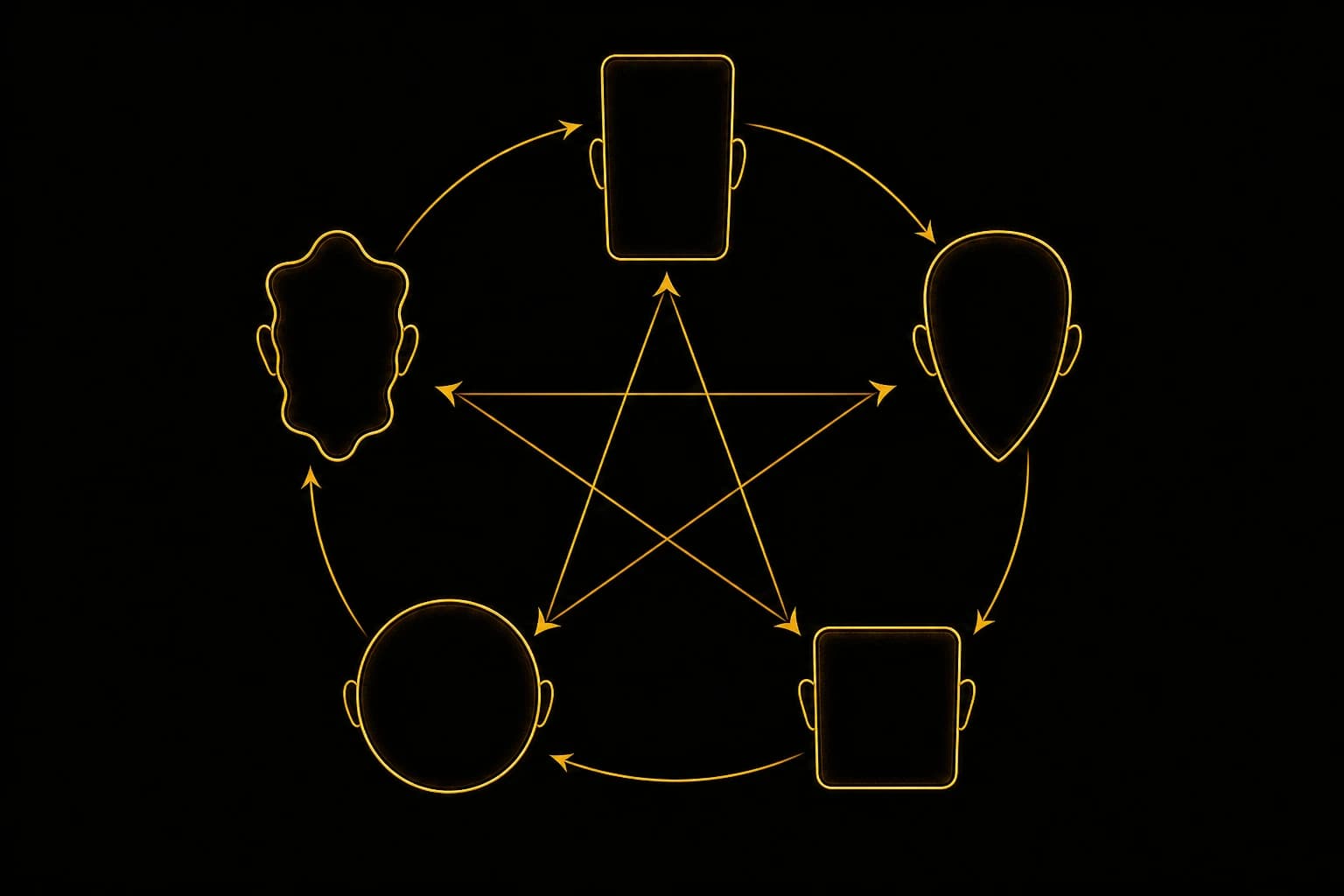
The five-element face types: sorting faces into five temperaments
The five-element face types (五行形) are a traditional East Asian way of reading a face as one of five kinds — Wood (木), Fire (火), Earth (土), Metal (金), and Water (水). People sorted into these five were called the 'five-form people' (五形人, ohyeong-in), and classic texts like Maui Sangbeop passed the framework down. Modern phrases like 'five-element physiognomy' and 'five-element face shapes' come straight from here.
Let me be clear up front: this article is not a method for guessing anyone's personality or destiny — it is a cultural and historical look at the grammar old observers used to describe faces. The five-form classification is not science, and it does not rank one face shape above another. So rather than hunting for 'which type am I' as if there were a correct answer, read it as sightseeing through an old taxonomy.
What makes the five-element types interesting is that they were never only about faces. They are one branch of a vast system that explained the whole world through five energies, pairing directions, seasons, and colors in fives. Within that web, a face was read as one place where those energies surfaced in the body — and knowing that backdrop makes the five types far richer.
Wood, Fire, Earth, Metal, Water — the five face shapes at a glance
Let me sketch the big image the old texts drew for each type first. The key idea is that each form was thought to echo how its element 'moves.' Wood grows straight up, Fire shoots up to a point, Earth settles thick and low, Metal is squared and trimmed, and Water flows in rounded curves. The descriptions and the table below simply organize traditional imagery; they are not a standard that fixes anyone's personality or ability.
Wood and Fire, reaching upward
The Wood form (木形) was described as tall and slender like a straight-growing tree, with a long, narrow face and an upright bone structure. The Fire form (火形) was drawn with a flame-like outline — pointed above and broad below (上尖下闊) — and sharp, prominent features. Both were seen as echoing an 'upward' energy, but this is old metaphor only and does not pin down anyone's temperament.
Earth, Metal, and Water — settling, squaring, rounding
The Earth form (土形) was pictured as thick and weighty like the ground, with a fuller face and a rounded nose; the Metal form (金形) as a square, upright face (方正) firm like metal; and the Water form (水形) as round and soft, full of gentle curves like flowing water. Stability, order, and flow were laid over the face in turn. Again, these are adjectives from an old classification and are not a basis for judging anyone's character or future.
| Five-form type | Traditional shape description | Element correspondence (direction · season · symbolic color) | Movement it echoed |
|---|---|---|---|
| Wood (木形) | Tall and slender, long narrow face | East · spring · blue-green (symbolic) | Growing straight up |
| Fire (火形) | Pointed above, broad below; sharp features | South · summer · red (symbolic) | Shooting upward |
| Earth (土形) | Thick and weighty, fuller face | Center · late summer · yellow (symbolic) | Settling low |
| Metal (金形) | Square, upright, firm face | West · autumn · white (symbolic) | Squared and trimmed |
| Water (水形) | Round and soft, gentle curves | North · winter · black (symbolic) | Flowing in curves |
Five elements as a 'web of correspondences' — the face was one strand
To really grasp the five-form people, you have to glance at five-element theory itself. Wu Xing is an old East Asian framework holding that five energies — Wood, Fire, Earth, Metal, Water — compose the world, and it paired all sorts of things in fives: directions, seasons, colors, sounds. The face-shape classification was only one cell in that sprawling table.
A table woven from direction, season, and symbolic color
Traditionally Wood paired with east, spring, and blue-green; Fire with south, summer, and red; Earth with the center, late summer, and yellow; Metal with west, autumn, and white; Water with north, winter, and black. Here color is a symbol for the element, not a description of real skin tone or health, and certainly not a yardstick for judging people. Confucian thought even layered five virtues on top — benevolence, propriety, faith, righteousness, wisdom — but that too was symbolic cosmology and is not a scorecard for anyone's personality.
The Yellow Emperor's 'twenty-five people'
One of the oldest currents that sorted body and face by five elements appears in the Huangdi Neijing as the idea of the 'Twenty-Five People of Yin and Yang' (陰陽二十五人). It splits people into the five major types and then subdivides each into five again, describing twenty-five finely drawn kinds. Even the old text refused to jam people into just five boxes, so treating the five forms as simple bins misses the point. This is a cultural and historical concept only and is not a medical assessment of anyone's health.
Generation and overcoming — reading a face as 'pure' or 'mixed'
Wu Xing carries two relationships: mutual generation (相生) and mutual overcoming (相剋). Generation is a chain where one energy births the next — Wood feeds Fire, Fire makes Earth, Earth bears Metal, Metal gathers Water, Water nourishes Wood. Overcoming is where one energy restrains another — Wood parts Earth, Earth dams Water, Water quenches Fire, Fire melts Metal, Metal cuts Wood. The familiar images of wood feeding a flame or water putting out a fire are exactly these rules.
Old physiognomists carried these rules onto the face, saying that when a face's shape, complexion, voice, and air gathered into one energy as if 'generating' each other, it was pure, and when different energies clashed, it was mixed. The saying that 'the five elements prize purity and shun jumbling' captures the attitude. But this was only an old grammar for reading a face as a consistent impression; it never meant a 'pure' form makes a better person, and it does not determine anyone's worth.
One more thing: the old texts held that you had to read spirit (神, the light and vitality in the eyes) and complexion (氣色) together with form (形) to read a type properly. The five forms were only a starting point for the broad frame of the facial bones; observers layered several elements to narrate 'what energy does this face seem to carry.' Pulling a single form out to define a person runs against even the old method — and it is certainly not a basis on which we today should fix anyone's personality or destiny.
So generation and overcoming were not tools for sorting people into good and bad, but imaginative devices for weaving a story about how five energies harmonize or collide. In today's terms it is a matter of impression — whether facial features look consistent or clash — and it does not tell you anyone's destiny or personality. Enjoy the logic of the old classification, but do not use it as a basis for judging.
How should we see the five-element types today?
Amusingly, the five face forms loosely overlap with the face-shape categories we use now — oblong, round, square, oval. Wood reads as oblong, Water as round, Metal as square, and so on. But this overlap is mostly a structural coincidence of dividing facial geometry similarly, and neither map tells you anything about someone's personality or ability; it does not work that way.
Modern first-impression research shows we form an impression of a face in an instant — and also that those impressions are often wrong. So whether it is the five-element types or modern face shapes, defining a person by a single face is stepping into the trap of first impressions. Enjoying an old classification and judging a person are plainly two different things; the former is not a verdict on anyone.
In short, the five-element types are the trace of a grand imaginative system — one that read the world through five energies — reaching all the way to the face. Enjoy the names and metaphors of the five types as culture, keep whichever images you like, but do not let them label you or anyone else. If you are curious about the old grammar of reading faces, continue on to the piece on the classic texts or the face-reading basics.
Frequently asked questions
How do I figure out my five-element face type?
By the traditional descriptions, a long face leans Wood, a pointed outline Fire, a full face Earth, a square face Metal, and a round face Water. In reality most faces mix several forms and rarely fall cleanly into one, and this classification is an old cultural framework rather than a readout of personality or destiny — so please treat it just for fun.
Is the five-form classification scientifically valid?
No. The five-element types are not a scientifically verified theory but one branch of traditional East Asian thought that explained the world through five energies. There is no scientific basis for reading health or ability from a face, and it should not be used as a basis for judging anyone.
What did generation and overcoming mean when reading a face?
In the old texts, when a face's shape, complexion, and air gathered into one energy it was called pure, and when different energies clashed it was called mixed. This was only an old way of reading a face as a consistent impression; it does not mean a pure form makes a better person, and it is not a prediction of anyone's destiny.
Are five-element face types the same as saju five elements?
They share the same five-element roots but look at different things. Saju interprets the time of your birth, while the face types interpret facial shape. Both are old cultural interpretations rather than scientific predictions, and neither should be treated as a basis for judging someone's personality or future — it does not decide who anyone is.
Does the symbolic color mean real skin color?
No. Blue-green, red, yellow, white, and black are symbols for the elements, paired with directions and seasons — they do not point to real skin color, race, or health, and they are not used to sort or judge people.
What are the Huangdi Neijing's 'twenty-five people'?
It is a concept in the Neijing's Lingshu that divides people into the five element types and then splits each into five again, describing twenty-five kinds. The fascinating part is that even an ancient text refused to cram people into five boxes. It is a cultural and historical concept only, not a medical matter, and it is not a basis for judging anyone.
Article info & references
Published July 4, 2026 · Last updated July 4, 2026
- Wu Xing (five-element) theory — general East Asian thought on the five energies (Wood, Fire, Earth, Metal, Water) and their mutual generation and overcoming
- The 'five-form people' (五形人) classification in Maui Sangbeop (麻衣相法) — a cultural concept from classic East Asian physiognomy texts
- The five-element human-type concept in the 'Twenty-Five People of Yin and Yang' (陰陽二十五人) of the Huangdi Neijing (黃帝內經, Lingshu) — referenced as a cultural and historical concept only
- Correlative-thinking correspondences of yin-yang and the five elements (direction, season, color, the five virtues) as general cultural concepts