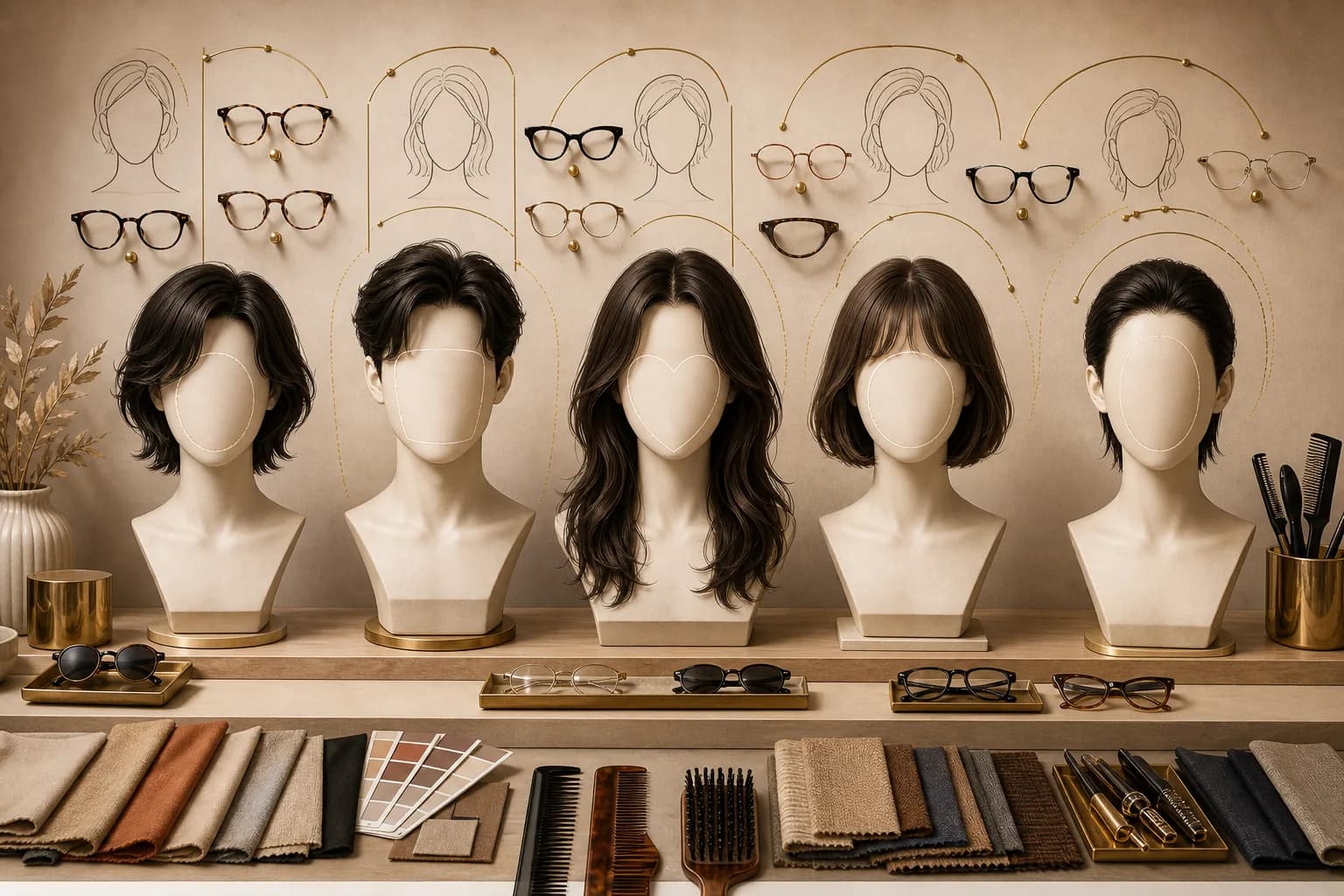
Why You Shouldn't Choose Hair and Glasses Separately
A lot of people decide on a hairstyle once, then pick glasses frames in a totally separate moment. The trouble is that when you finally wear both together, a pairing that looked fine on its own can suddenly feel heavy or a little too much. Hair and glasses both sit right along the outline of your face, which means they're really sharing the same stage. Treating them as one set from the start makes everything easier.
The word balance can sound complicated, but the idea is simple. Add a gentle point in the opposite direction of the impression your face already gives, and the whole picture settles down. If a face has lots of soft curves, a little straightness helps; if it reads as very straight, a little curve helps. If your hair covers one direction, let your glasses cover the other, so the two pieces aren't repeating the same line twice.
Please keep one thing in mind here. The impressions described in this article are only about visual mood — they are not the same as anyone's actual personality or ability. A round face looking friendlier, or an angular face looking firmer, is just a viewer's first impression, and styling is simply the fun of nudging that impression in a direction you like. So read this less as a search for the right answer and more as a way to find a combination that feels comfortable to you.
Quickly Sizing Up Your Face Shape
Before we get into the chart, roughly placing your own face shape makes the table far easier to read. You don't need fancy tools — just a mirror and your phone camera. Take one front-facing photo, then visually compare the width at three spots (forehead, cheekbones, jaw) along with the overall length. It doesn't need to be exact; sorting yourself into whichever of the five shapes looks closest is plenty.
Five Shapes, Sorted by Proportion
The easiest cues are the ratio of length to width and the shape of the jawline. Similar width and length with a rounded jaw means round; even width across forehead, cheeks, and jaw with a defined jawline means square. Noticeably longer than it is wide is long; a wide forehead narrowing to a slim chin is heart; and a balanced shape that tapers gently from forehead to jaw is oval.
When you're unsure, push your hair back and trace just the outline of your face with a finger. Whether the edge feels rounded, has corners, or stretches up and down becomes obvious fast. If you seem to sit between two shapes, just reference both — there's no need to force yourself into a single box.
Things to Watch When You Self-Check
Photos make a face shape look different depending on angle and lighting. Shooting slightly from above narrows the jaw, while shooting from below widens it. So for a self-check, a photo taken straight on at eye level in something close to natural light is the most useful reference.
Also, face shapes rarely land in one clean box; most people are a small mix. The chart's suggestions are only a starting point, so always try a look and confirm in the mirror that it feels right. In the end, the most reliable measure is whether it looks natural and pleasing to your own eye.
Hair × Glasses Combinations at a Glance
The chart below sums up, for each of the five face shapes, a suggested hairstyle, a suggested frame, and a combo to skip, all in one row. The table gives you the big picture on its own, but the next section unpacks why each pairing works, shape by shape. Treat the contents as a fun reference of general styling tendencies, not a rule you have to obey.
When reading the chart, pair the 'suggested' and 'combo to skip' columns together for faster understanding. Most combos to avoid are ones where the hair and glasses emphasize the same direction one more time and tip everything to one side. Keep the pairings that add balance, and trim the ones that repeat the same feature.
| Face shape | Suggested hair | Suggested frames | Combo to skip |
|---|---|---|---|
| Round | Crown volume, long layers | Slightly angular square / wellington | Round acetate + short round bob |
| Square | Soft curls, side-part layers | Rounded round / oval frames | Strong square frame + blunt bob |
| Long | Side-volume waves, bob / bangs | Generous top-to-bottom, horizontal | Long straight hair + narrow frame |
| Heart | Jawline-volume curls, side bangs | Soft-bottom oval / rimless | Thick top bar + full volume on top |
| Oval | Most styles work, by preference | Wide range of frames to try | Heavy volume on both hair and frame |
The Five Face Shapes, in Detail
Now let's unpack each row of the chart one at a time. Grouping the similar shapes in pairs makes the differences easier to see. Feel free to read only your own shape — or, if you sit between two, reference both.
Round · Square
Round faces shine through soft curves, so a direction that adds a touch of vertical length suits them well. Volume at the crown or long, dropping layers tidy the face up nicely. For glasses, slightly angular squares or wellington shapes create contrast with the curves and frame the outline. On the flip side, a round acetate frame plus a short, rounded bob repeats roundness twice and can start to feel a bit heavy.
Square faces give a crisp impression thanks to a defined jawline, and adding a little curve softens the mood. Naturally flowing curls, a side part, or layers that gently wrap the sides of the face work well. Round or oval frames balance the straight lines. Conversely, a strong chunky square frame plus a blunt straight bob stacks too many straight lines and can read as stiff, so let one side go curved.
Long · Heart
Long faces read as stretched vertically, so a direction that adds a horizontal point helps. Waves with side volume, bangs, or a bob-length cut visually shorten the length. Frames that are generous top to bottom, or designs that split the gaze horizontally, suit them well. By contrast, long straight hair plus a vertically narrow frame emphasizes the vertical line and can make the face look even longer.
Heart faces have a wide forehead narrowing to a slim chin, so easing weight up top and adding fullness lower down brings balance. Curls with volume near the jawline, side-swept bangs, or mid-length layers fit nicely. For glasses, oval or rimless styles that are soft or slightly wider at the bottom reduce the contrast with the broad forehead. Conversely, a thick, showy top bar plus full volume on top can make the upper half look heavier.
Combos Worth a Second Thought
The most common slip-up is hair and glasses shouting the same feature twice. A round face with a round bob and round acetate frames repeats curves three times; a long face with long straight hair and a vertically narrow frame only doubles down on length. If one side already emphasizes a direction, letting the other side go the opposite way is the basics of balance.
The second common issue is both pieces demanding too much attention. A dramatic volume hairstyle worn with thick, colorful frames clutters the top of the face, and your actual expression gets buried. Usually it reads cleanly if you let either the hair or the glasses be the lead, with the other playing a calm supporting role.
Finally, copying a trend or a combo that looked great on someone else is worth rethinking too. The same frame can feel quite different depending on your face shape and hair. In the end, the best measure is whether you feel comfortable and natural in the mirror. Remembering that an impression is only an impression — and doesn't define the person — makes styling feel a lot lighter.
Tips for Wearing Glasses and Bangs Together
Wearing bangs and glasses together puts both in the space between your forehead and eyes, so they collide easily. The safest move is to keep your bangs landing naturally just above the brows, and to keep the top bar of the frame from overlapping the ends of the bangs too much. If your bangs keep getting messed up against the glasses, switching to see-through or side-swept bangs makes it far more comfortable.
If the frame color and the hair color differ too sharply, it can look like two horizontal lines splitting the face. Choosing a frame in a tone close to your hair, or going with a light rimless or metal frame, lets the two pieces flow together. When you want to show a clear forehead, sweep the bangs to the side and use a slightly defined frame to draw the focus toward the eyes for a clean look.
When you change a combination for the first time, try swapping one thing at a time rather than both at once. Set the hair first and match glasses to it, or match the hair to the glasses you wear most. And please don't forget that all of this is just a fun reference. Style is less an exam in following rules and more a kind of play that makes you feel good.
Article info & references
Published June 7, 2026 · Last updated June 7, 2026
- Ministry of Foreign Affairs passport guidance — public photo specs (front-facing, even lighting)
- General social-psychology concepts such as the primacy effect and halo effect on first impressions
- General photography principles such as the rule of thirds in composition
- General visual-design concepts of contrast and balance in shape perception