"Looking Smaller" Is Just an Illusion
When you take a photo or look in the mirror, you've probably thought, "I wish my face looked a little smaller and more balanced." First, let me say something reassuring. Everything in this article is not about actually making your face smaller — it's about gently changing where a viewer's eye lingers, an optical illusion. Adjust the position of your hair, the shape of a collar, or the height of the camera a little, and the empty space and proportions around your face shift, so the overall "mood" simply feels different.
And here's the more important part. A bigger face isn't bad, and a smaller one isn't better — not at all. Round faces, long faces, and angular faces each have their own charm, and there's no "correct" set of proportions. This article is only a styling reference for "here's how you might look more relaxed and happy," never a suggestion that you should evaluate or change your appearance. Pick only what you like and try it for fun.
The basic principle of the illusion comes down to just two things. First, our eyes perceive anything "vertically long" as slimmer. Second, when there's a point that draws the eye, our gaze goes there and we notice the rest less. Keep these two ideas in mind and the upcoming talk about hair, clothes, accessories, and angles will make much more sense.
Framing Your Face with Hair
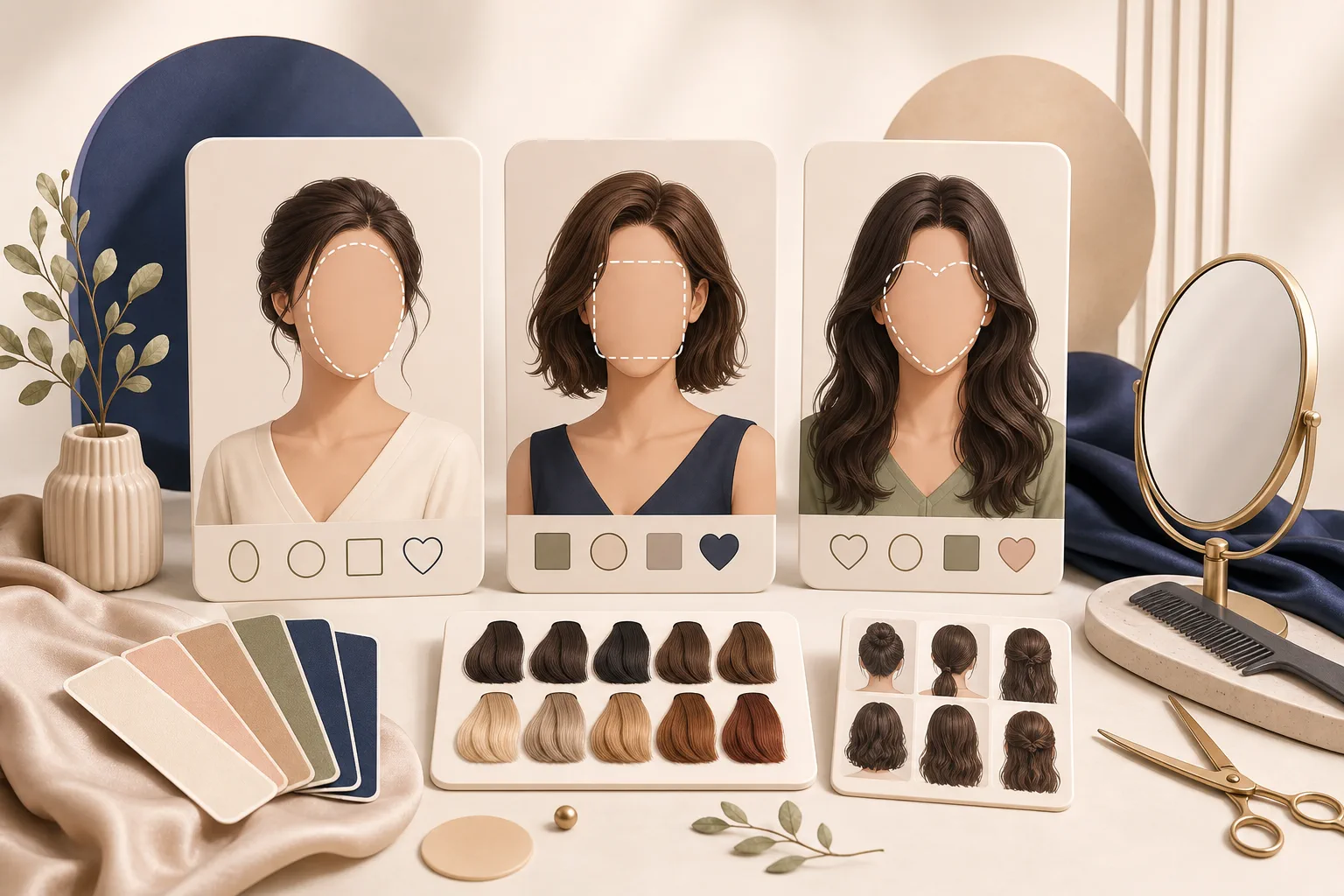
The single biggest factor in facial impression is actually your hair. Hair acts like a "frame" around the face, so what it covers and what it reveals dramatically changes the face's visible proportions. The key is to gently soften the widest-looking part of the face while keeping a vertical flow up top.
Side Hair and Face-Framing Layers
When hair softly brushes past your cheekbones or jaw, the outer outline of your face blends into the hair so its width stands out less. The light layers that fall along the sides of the face — commonly called "face-framing layers" — do exactly this. Side bangs or see-through bangs that fall along the part also lightly cover the sides of the forehead to create vertical lines, which helps a slimmer impression. By contrast, tucking all your hair firmly behind the ears reveals the full face width as is, so try comparing both and see which you prefer.
Crown Volume and Parting
Adding a little volume at the crown emphasizes vertical length, so the face feels slimmer. When hair sits flat, the horizontal width shows relatively more. The parting matters too. A dead-center part emphasizes left-right symmetry for a crisp look, while a slightly off-center part adds asymmetry, vertical flow, and softness. If a wide forehead is your concern a side part helps, and if your face reads as long, light bangs help — so it's much easier if you figure out your face shape first and then choose.
The Role of Necklines, Collars, and Accessories
The neckline and collar that continue below your face change facial impression more than you'd expect. When the neck looks long and open, an illusion forms in which the face looks slimmer too. Add a focal point with earrings or accessories and the viewer's eye moves naturally, softening the overall balance.
A Neckline That Looks Vertically Long
Even with the same outfit, the neckline shape changes the impression. A "vertically open" neckline — a V-neck, a deep U-neck, or a shirt with one or two buttons undone — makes the neck look longer and carries a slimming flow up to the face. By contrast, a high neck that wraps the neck snugly or a wide round boat-neck emphasizes horizontal lines, so the face can stand out a bit more. If you dislike a closed-in look, open up the V-zone; if you want a cozy mood, enjoy a high neck — both are great choices.
Spreading the Gaze with Earrings
Long drop earrings add a vertical line, helping the face look slimmer. Big round earrings that sit close to the face tend to emphasize horizontal width, so if you want a slimmer impression, an up-and-down design is a safe bet. That said, this isn't a "rule" either. Enjoying them in a way that suits your face shape and the day's mood comes first; approach it as the fun of lightly experimenting with where to place a focal point.
Hats, Brims, and Makeup as Accents
A hat is an item that adds a lovely frame above your face. A wide-brimmed hat softly wraps the face and pulls the eye upward. A very short brim or a beanie that hugs the head, on the other hand, reveals the face outline as is. Wearing a hat slightly tilted creates asymmetry that adds vertical flow and an easygoing mood, and a design with a bit of height at the crown emphasizes vertical length to help a slimmer impression. The fastest way to learn which brim and height suit your face shape is simply to try them on and compare.
Let me add makeup as a light reference too. Shading (contour) means laying a subtle darker tone along the outer edges of the face or under the jawline to create shadow, while highlighter goes lightly on parts that catch light — the bridge of the nose, the center of the forehead, the tops of the cheekbones — to add dimension. Sweeping blush diagonally from the top of the cheekbone toward the temple adds vertical flow and a healthy glow. The key is "subtle," not "heavy." Overdone, it looks unnatural, so check once in natural light and build gently. And of course, do only as much as you enjoy.
Illusions Made by Camera Angle and Distance
As much as styling — maybe even more — camera angle drives the impression in a photo. The same face is captured completely differently depending on the lens height, the distance, and which way your body faces. It's not that your real face changed; it's an illusion created by perspective and viewpoint.
Height and Chin — Slightly Above, Chin Forward and Down
Place the camera just a touch above eye level and look up toward it, and a perspective forms where the upper face is nearer and the lower face is farther, tidying the jawline into a slimmer line. People often phrase it as "camera slightly up, chin pushed slightly forward and down." Pushing the chin a tiny bit forward as you lower it reduces a double chin and sharpens the jawline. But shoot from too high and only the crown looks big; shoot from below and the chin and nostrils get emphasized — so "just slightly" is the point.
The Three-Quarter Angle and Shooting Distance
Turn your body and face about 15 to 30 degrees off of straight-on into a "three-quarter" angle, and the face gains dimension and the outline looks slimmer. Straight-on is the angle that tends to capture the widest face, so even a small turn changes the impression. Distance matters too. Holding the lens too close to your face exaggerates the nearby nose and forehead with distortion, so step back and zoom in slightly for far more natural proportions. Using a selfie stick or a timer to add distance is a good move too.
| Element | Helps vertical flow / slimness | Tends to emphasize width | One-line note |
|---|---|---|---|
| Hair | Side hair, face-framing layers, crown volume | Hair tucked tightly back, flat crown | Use bangs to manage forehead width |
| Neckline | V-neck, deep U-neck, undone buttons | High neck, wide boat-neck | Open the V-zone if it feels closed-in |
| Accessories | Long up-and-down drop earrings | Big round studs close to the face | Use as a focal point to spread the gaze |
| Hats | Wide brim, slight tilt, a little height | Short brim hugging the head | Trying on and comparing is best |
| Angle | Slightly above, three-quarter, a step back | Straight-on, close-up | Chin slightly forward and down |
Wrap-Up: It Gets Easy Once You Know Your Face Shape
If I compress all of this into one line, it's: "emphasize vertical flow, create a focal point, and adjust perspective with angle." But which method suits you depends, in the end, on your face shape. A round face wants vertical lines, a long face wants a moderate horizontal accent, an angular face wants soft curves — the direction shifts a little for each. So more than anything, figuring out your face shape first makes choosing hair, clothes, hats, and angles much easier.
One last time: none of this is about evaluating or feeling you should change your appearance. A bigger face isn't bad and a smaller one isn't better; it's just a small game of making a frame in which you look happy and relaxed. FaceOracle's mood report only plays with the impression a photo gives off — it never grades who you are or what you can do, just a light suggestion to enjoy your photos for fun. Pick just one or two things you like and capture today's you, comfortably.
Frequently asked questions
Why does my face look bigger in selfies?
Holding the phone close and straight-on causes lens distortion that gently puffs up whatever is nearest the camera. Lifting the camera a touch above eye level and shooting from about an arm's length away makes the proportions read more naturally. It isn't that your real face changed — it's just an illusion created by distance and angle.
Does letting your bangs down really make your face look smaller?
Your face doesn't actually get smaller, but framing the forehead or sides with hair shrinks the area the eye lingers on, so it reads as smaller and more balanced. Different face shapes suit different cuts — a rounder face can lean into side-skimming lines, a longer-looking one into width and horizontal volume. Treat it purely as styling for the vibe you want.
Is there a specific angle that makes a face look smaller in photos?
Turning your body slightly and angling your face about 45 degrees — the three-quarter angle — adds dimension and tends to look slimmer than a flat front-on shot. Dipping your chin just a little and keeping the camera a touch above eye level helps it settle naturally. It's not about rating how you look — just a fun way to capture the same face in a way you like more.
Article info & references
Published June 13, 2026 · Last updated June 13, 2026
- General visual-illusion knowledge, such as how vertical and horizontal lines affect perceived proportion
- General photography knowledge on perspective and lens-distance distortion
- General portrait-photography knowledge on angles such as the three-quarter view
- General fashion and beauty knowledge on hair and neckline styling by face shape
- General principles of dimensional makeup, such as shading and highlighting