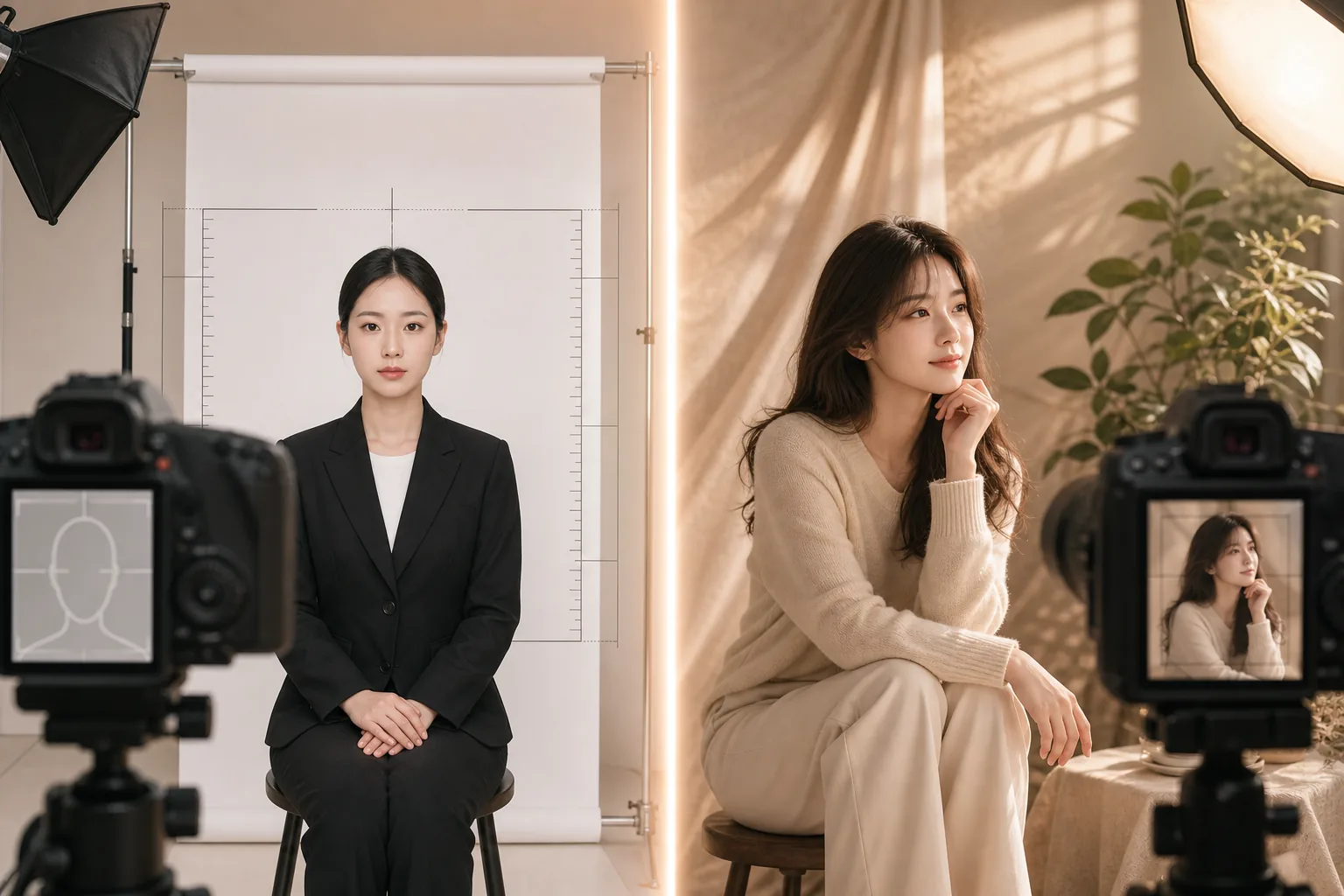
They Were Built for Different Jobs
A lot of people mix up ID photos and profile photos. Both show your face, so they look similar at a glance, but they are made for completely different reasons from the very start. An ID photo exists so that anyone can confirm 'this document belongs to this person.' That's why being consistent and clearly legible matters far more than looking stylish.
A profile photo, on the other hand, is all about 'what impression do I want to give?' It lives on social media, company about pages, portfolios, and dating apps — places where you form a first impression on the viewer. Here, mood and expression matter more than specs. So even if the same person shoots both on the same day, the two photos can feel quite different.
Keep in mind that the impression a photo gives is just an impression. A bright, smiling profile photo does not literally tell you someone's real personality, and a neutral ID photo does not mean the person is cold. The photo-mood ideas we share at FaceOracle are all for fun and styling reference — please remember that first.
Background, Dress, and Expression Run Opposite
The clearest split between the two photos is background, dress, and expression. An ID photo passes if it 'followed the rules,' while a profile photo succeeds if it 'suits you.' In the H3 sections below, let's separate the strict-spec parts from the expression differences.
One thing makes it easier to remember. For an ID photo, the longer the list of 'not allowed' things, the better the shot; for a profile photo, the wider the range of 'allowed' things, the more choices you have. That's exactly why you should request the two shots separately, even at the same studio.
Specs: ID Must Pass, Profile Is Free
ID photos usually use a white or pale solid background. Shadows or patterns often mean a reshoot. Face size, headroom above the hair, and eye-level position follow fixed ratios, so you can't crop freely. Glare on glasses, bangs covering the eyes or brows, and heavy accessories are mostly restricted.
Profile photos are far looser about all of this. A café window, a bookshelf, or an outdoor setting is chosen on purpose for mood. Composition can go beyond straight-on to a slight three-quarter angle, half-body, or full-body. Photographers often use general framing ideas like the rule of thirds to guide the eye naturally.
Expression: Neutral vs Expressive
An ID photo defaults to a natural, closed-mouth neutral look. A wide smile or showing teeth can change your facial outline and break the spec. Looking straight at the camera with level shoulders is the recommended posture.
In a profile photo, expression is the message. A soft smile reads as friendly, a calm neutral look as professional, a slight side glance as relaxed. But what an expression creates is an 'impression,' not the person's actual ability or character. So it helps to think of it as 'staging' the expression that fits the occasion.
| Item | ID Photo | Profile Photo |
|---|---|---|
| Purpose | Official identity confirmation | Express impression and mood |
| Background | White/solid, no shadows | Café, outdoors — freely chosen |
| Expression | Natural neutral look | Smile, glance — free expression |
| Dress | Tidy, recommended standard | Varied to match the concept |
| Retouch limit | Blemishes only, no reshaping | Up to color and mood grading |
| Specs | Strict for passport/visa | No mandatory spec, fit the setting |
Lighting and Retouching — How Far Can You Go?
We can't skip the retouching talk. The two photos have completely different standards for 'how much can you touch this?' An ID photo has a very narrow retouch range because you must remain recognizable. You can lightly smooth blemishes or a temporary breakout, but reshaping your jaw, raising your nose bridge, or enlarging your eyes is off-limits. Change too much and it no longer matches the real you, which defeats its whole purpose.
Lighting differs a lot too. ID photos use even frontal light that removes shadows as much as possible. The goal is similar brightness on the left and right of the face with no shadow on the background. That makes it easy for anyone to clearly recognize the same person.
For a profile photo, lighting and retouching are tools of expression. Side light for dimension, backlight for a soft mood, or a warm versus calm color grade — all of it is fair game. The impression color gives can be described with general color-theory concepts: warm tones tend to feel friendly, cool tones tend to feel crisp. Of course that's only a tendency, not a fixed formula.
Specs (Passport/Visa) vs Freedom — Which to Follow
Among ID photos, passport and visa photos have the strictest rules. Photo size, face ratio, background color, and whether glasses are allowed differ a little by country and by document. That's why trying to reuse 'an old ID photo' often gets rejected. Checking the agency's public guide once before submitting is a really important habit.
Profile photos have no such mandatory specs. Instead, each platform suggests different ratios or moods. A job-oriented profile like LinkedIn suits a tidy half-body shot, while somewhere like Instagram welcomes more distinctive composition. The skill you need is not 'follow the spec' but 'fit the setting.'
In short, an ID photo follows external rules, while a profile photo is one where you set the intent. Understanding just this difference keeps you from being confused about what to prepare for which situation.
Which One to Use, Situation by Situation
Now for the practical part. For official documents that need identity confirmation — government forms, passports, visas, certifications, student IDs — you must use a spec-compliant ID photo. Submit a nice-looking profile photo there and it's likely to be rejected for spec mismatch.
Conversely, places that 'show off you' — company about pages, business cards, portfolios, social media, dating apps — suit a profile photo far better. Posting a neutral ID photo to social media can look stiff. Resumes, though, depend on the company or industry. Conservative places lean toward a tidy ID photo, while creative ones tend to prefer a clean profile photo.
When in doubt, just ask: 'will the viewer of this photo inspect rules, or receive an impression?' If they inspect, go ID photo; if they receive an impression, go profile photo. That one sentence settles most cases.
Can One Shot Do Both?
Bottom line: 'one shot that perfectly does both' is hard. The purposes and rules point in opposite directions, so satisfying one side easily breaks the other. A spec-perfect ID photo is a bit stiff as a profile, and a mood-rich profile often fails the spec check.
Still, there's a realistic compromise. At a studio, ask them to shoot an ID cut and a profile cut from the same setup. Share the hair, makeup, and outfit, and split only the expression, background, and retouch into two versions — that way you save time and money while covering both. These days plenty of people split shots like this even at self-photo studios.
Finally, whichever photo you pick, it's just a choice about 'how to show today's you.' The expression or mood in a photo does not literally state your real personality or ability. So don't stress too much — enjoy picking the one shot that fits the setting. And if you'd like a light, for-fun read on what mood your photo gives off, FaceOracle's mood report is there to play with.
Article info & references
Published June 7, 2026 · Last updated June 7, 2026
- Government passport guidance — passport photo specifications (public guides)
- Visa and immigration agencies' public photo-spec guidance by country
- General photography principles such as the rule of thirds
- General color-theory concepts such as the Munsell color system
- General social-psychology concepts such as the primacy and halo effects