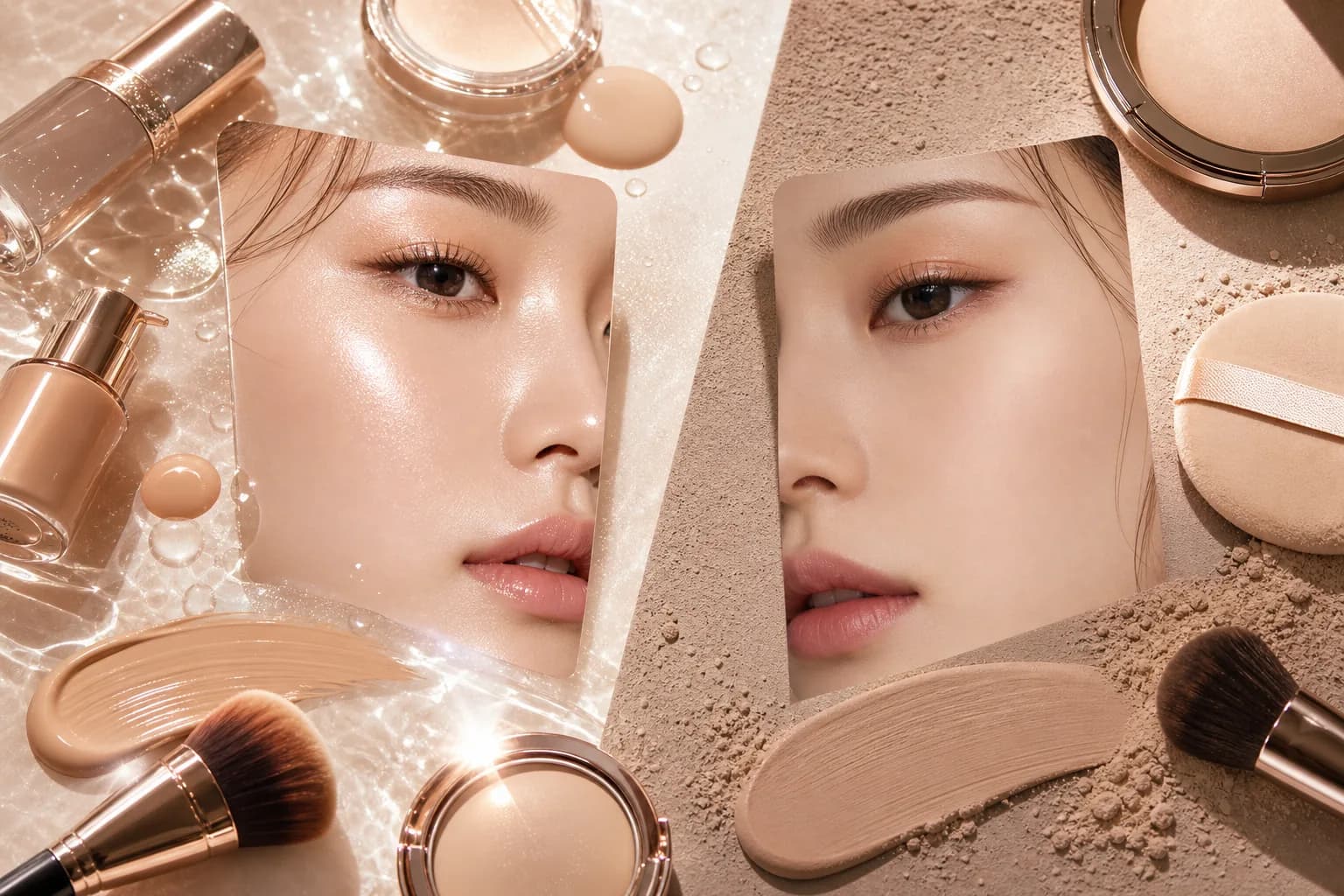
Two Streams of Base Makeup: Glow and Matte
Talk about base makeup these days and two words always come up: glow and matte. Glow refers to a moist, luminous finish that looks like light is coming from inside the skin, while matte cuts down on light reflection for a smooth, polished look. Neither one is inherently better—they're simply options you pick depending on your mood and your skin that day.
For the last several seasons, the glow side—best represented by the 'dewy' look—has clearly led the conversation. It reads as natural and healthy, which is why it caught on. But matte hasn't disappeared. For situations that need to last all day, or on days when shine bothers you, matte is still a reliable choice. Trends come and go, so it's easier on the mind not to treat just one as the right answer.
One thing worth remembering: a finish only gives off an 'impression.' The sense that glow looks more youthful or matte looks more composed is just an impression of mood—it has nothing to do with someone's actual personality or ability. So enjoy the mood as mood, and simply choose whichever feels comfortable on your skin.
Choosing a Base for Your Skin Type
The first thing to check is, of course, your skin type. Apply the same product, and dry and oily skin end up looking completely different as the hours pass. The table below splits things into four types—dry, oily, combination, and sensitive—showing roughly how much glow versus matte is suggested, plus a one-line tip for each. Treat it not as a hard rule but as a starting point to gauge where you fall.
When reading the table, it helps to take the recommendation level as a direction, not a score. Just because glow suits dry skin well doesn't mean matte is off-limits—lay down enough moisture and pick a matte formula that isn't too drying, and it works just fine. Oily skin, in turn, can add liveliness with a touch of glow on select spots. In the end, your type is the starting line, and the fine-tuning is up to you.
| Skin Type | Glow Suggested | Matte Suggested | One-Line Tip |
|---|---|---|---|
| Dry | Very high | Low to medium | Lay enough moisture, lead with sheen; pick a hydrating matte |
| Oily | Medium | High | Oil-control primer first; sheen only on the cheekbones |
| Combination | High | Medium | Sheen in the center, partial matte on nose and forehead |
| Sensitive | Medium | Medium | Favor gentle formulas; build thin, multiple layers |
Choosing Glow or Matte by Occasion
Just as important as skin type is 'where am I going today.' Even for the same person, the flattering finish shifts with the situation. Let's break it into three common scenarios: daily wear, photo shoots, and summer.
Daily and Close-Up Settings
On days you meet people face to face—at work or out with friends—a soft sheen is more comfortable than heavy glow. Up close, an overdone dewy look easily reads as greasy shine. For these moments, a balanced 'partial matte' works well: a little sheen on the center of the face, with shine-prone areas like the nose and forehead lightly smoothed down. You don't have to unify one finish across the whole face.
For daily wear, naturalness is everything. Building the base in thin layers looks far more natural and lasts longer than one thick coat. When you're short on time, just dabbing a glow product onto the spots that need sheen is enough to freshen up your impression.
Under Photo Lighting
On days you take photos or video, lighting is the variable. Under strong light, glow can register as oily, so semi-matte or matte surprisingly often looks more polished. That said, full matte can flatten the face by reducing dimension, so leaving the faintest sheen on the cheekbones and nose bridge keeps the photo looking alive.
If flash is involved, glow products heavy with shimmer can over-reflect and look washed out and chalky. Before shooting, switch to a product with little or no shimmer, and pressing on a touch of powder at the end captures things more crisply.
Somewhere In Between: Semi-Matte and Dewy
The truth is, for many people the best answer is neither full glow nor full matte but somewhere in the middle. A base isn't black and white—there's a wide gray zone between them. The classic examples are semi-matte and dewy, both smart picks that borrow just the strengths of each extreme.
Semi-matte strikes a balance between smoothness and sheen. It doesn't look as dry as matte, yet it keeps shine in check, so it suits almost any situation. If you're not sure of your skin type or you're choosing a base for the first time, starting with semi-matte is a great idea.
Dewy is a more moisturized take on glow. It reads as healthy and youthful, but overdone it can look tacky. So when you go for dewy, focus the sheen on the areas light touches rather than the whole face, and lightly smooth the rest to create contrast—that looks refined. A finish, in the end, is less about unifying one tone and more about a sense for adjusting intensity.
Two Common Mistakes
When a base disappoints, the cause tends to repeat in surprisingly similar places. Let's point out the two most common mistakes. Once you know them, they aren't hard to avoid.
Using Too Much Powder
Wanting a matte look, people pile on powder—but that easily tips past smooth into dry and dull. Powder building up in mobile areas like the eyes and mouth settles into fine lines and makes them stand out more. Apply powder only on shine-prone spots, in a small amount, pressing it on with a puff. There's no need to coat the entire face.
Instead of relying on powder, controlling oil earlier at the base step looks far more natural. Laying a pore- and oil-controlling primer on oilier areas keeps things smooth for longer without a thick layer of powder.
Letting Shine Go Unchecked
Conversely, glow lovers make the mistake of leaving the shine that builds up over time. Oil that surfaces hours later differs from the original 'sheen'—it tends to read as dull and broken-down. When this happens, lightly press with blotting paper or a soft tissue to lift only the oil, then dab a little sheen back on top if needed.
Shine and glow are really paper-thin apart. The key is distinguishing the 'sheen you intended' from the 'oil that time created.' Keep the intended sheen and tidy only the broken-down spots, and you can hold a clean impression all day long.
A Setting Routine That Lasts
Last comes setting, which makes any finish last longer. Even a great base falls apart fast if you skip setting. Just following the order noticeably changes staying power.
First, moisturize and prep thoroughly before laying down the base. Too dry and matte flakes; too oily and glow slides off. Once the foundation is set, build up your foundation or cushion in thin layers, then lightly press powder only on areas prone to breaking down. Misting a setting spray at the end settles the artificial feel of powder and helps the base cling to the skin.
If you want glow to last, try using a setting spray like a mist once more. A light spritz when the base looks a little stuffy while you're out revives the sheen. In the end, the secret to a long-lasting base isn't applying thickly—it's layering thin and tending only the spots that need it. Enjoy the mood as mood, but finding the finish your skin is happiest with is what matters most.
Article info & references
Published June 7, 2026 · Last updated June 7, 2026
- General color-science concepts on light reflection and sheen, such as the Munsell color system
- General skincare knowledge on skin-type classification by oil and moisture balance
- General photography principles such as lighting and exposure
- General social-psychology concepts on first impressions, such as the primacy and halo effects