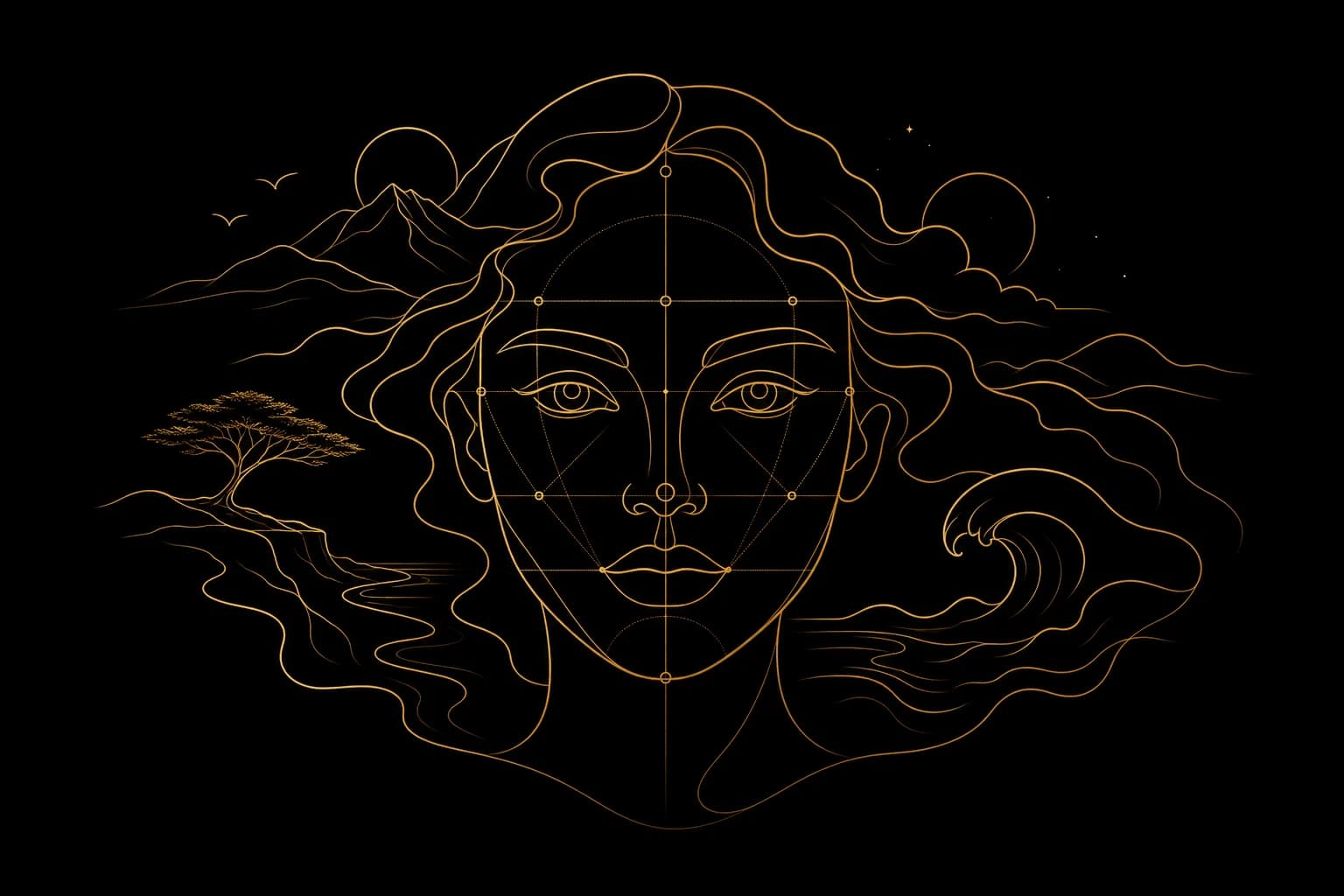
In part one we walked the birthplaces of Western words like physiognomy, phrenology, and highbrow. Part two turns the map toward East Asia, and especially toward the face-reading vocabulary living inside Korean. The legend stays the same: the old manuals claimed a face could reveal character and fortune, a claim modern psychology does not support — this piece is entertainment content about the history of words, not a basis for judging anyone.
One character: sang (相)
At the center of East Asian face-reading vocabulary sits a single Chinese character, 相 (sang)— originally "appearance; to observe." Combined with other characters it produced gwansang (觀相, observing the face), sanghak (相學, the study of it), and sangbeop (相法, its methods). The same root branched into palm reading (手相), foot reading (足相), and terms for reading gait or voice. Where the West packed everything into the single word physiognomy, East Asia used 相 as a snap-on module and grew a far bushier vocabulary tree.
The trap on this map: Gwansanggam
Here is the pitfall this map must flag. The Joseon-dynasty office called Gwansanggam (觀象監) sounds exactly like a face-reading bureau — but it was actually the state agency for astronomy, geography, calendrical science, weather observation, and water clocks. The character 象 here means celestial phenomena, not faces; think of it as the Joseon counterpart of a national observatory and weather service. It is a famous homophone trap in Korean: same sound, different character, completely different map. If a costume drama or a quiz show brings it up, check the hanja first.
The Mayi Xiangfa and the hemp-robe legend
The biggest supplier of East Asian face-reading vocabulary is the family of texts around the Mayi Xiangfa (麻衣相法). As the story is handed down, a hermit who always wore hemp robes — hence the name "Master Mayi," robe instead of name — taught his method to his student Chen Tuan (陳摶, d. 989), who wrote it down for the world. That is tradition, though: who actually wrote it and when it took shape cannot be settled today. What is certain is that this lineage became East Asia's most widely read face-reading literature and standardized vocabulary sets like the three courts (三停), the twelve palaces (十二宮), and the five mountains and four rivers (五嶽四瀆). The landscape imagination of that last set has its own tour, and the twelve palace names are covered in a separate guide.
Joseon bookshelves and everyday Korean
These words settled deep into Joseon Korea. The Encyclopedia of Korean Culture lists the Sangseocho (相書抄), an undated manuscript by an unknown compiler that excerpts the key parts of the Shenxiang Quanbian and Mayi lineage manuals — evidence that face-reading books were read and copied enough to warrant digests. Its pages read the face part by part, and even gait and table manners.
The more entertaining fingerprints are in everyday speech. Korean idioms like "a bright, open forehead invites luck," "handsome ears," "a bok-filled (blessed-looking) face," or the playful "simsulbo" (a pouch of spite said to sit on the cheek) are all face-reading vocabulary dissolved into proverbs and compliments. Of course, these phrases are no longer a basis for judging character from a face — they survive purely as affectionate figures of speech. Just like highbrow in part one, the theory retreated and the words stayed behind.
The vocabulary on screen
In modern Korea this map unfolded most spectacularly in the cinema. The 2013 film The Face Reader (Gwansang), directed by Han Jae-rim and starring Song Kang-ho, Lee Jung-jae, and Kim Hye-soo, drew about 9.13 million admissions. A historical fiction that plants an imaginary master face-reader inside the real 1453 coup, it turned a single animal-analogy line — calling a schemer "wolf-faced" — into a national catchphrase. The pseudo-Aristotelian animal analogy, resold in a Korean theater two millennia later: vocabulary is stubbornly alive. How the film's success spawned coinages like "gwansang surgery" is picked up in another piece.
Folding the map
Lay the two parts side by side and the routes look strikingly alike: a text is born under a borrowed authority (pseudo-Aristotle; the Mayi legend), a bestseller popularizes the vocabulary (Lavater's Fragments; the Mayi lineage), and the theory retreats under scrutiny while the words survive in idiom and pop culture. Whichever hemisphere it comes from, the claim that a face reveals character or destiny is one modern psychology does not support, and the healthiest way to hold these words is as cultural heritage — never as a basis for judging people. That is also why FaceOracle labels its own reports entertainment. Look up the terms from this tour in the glossary, and see the ground rules for healthy enjoyment in the Face-Reading Literacy Room.