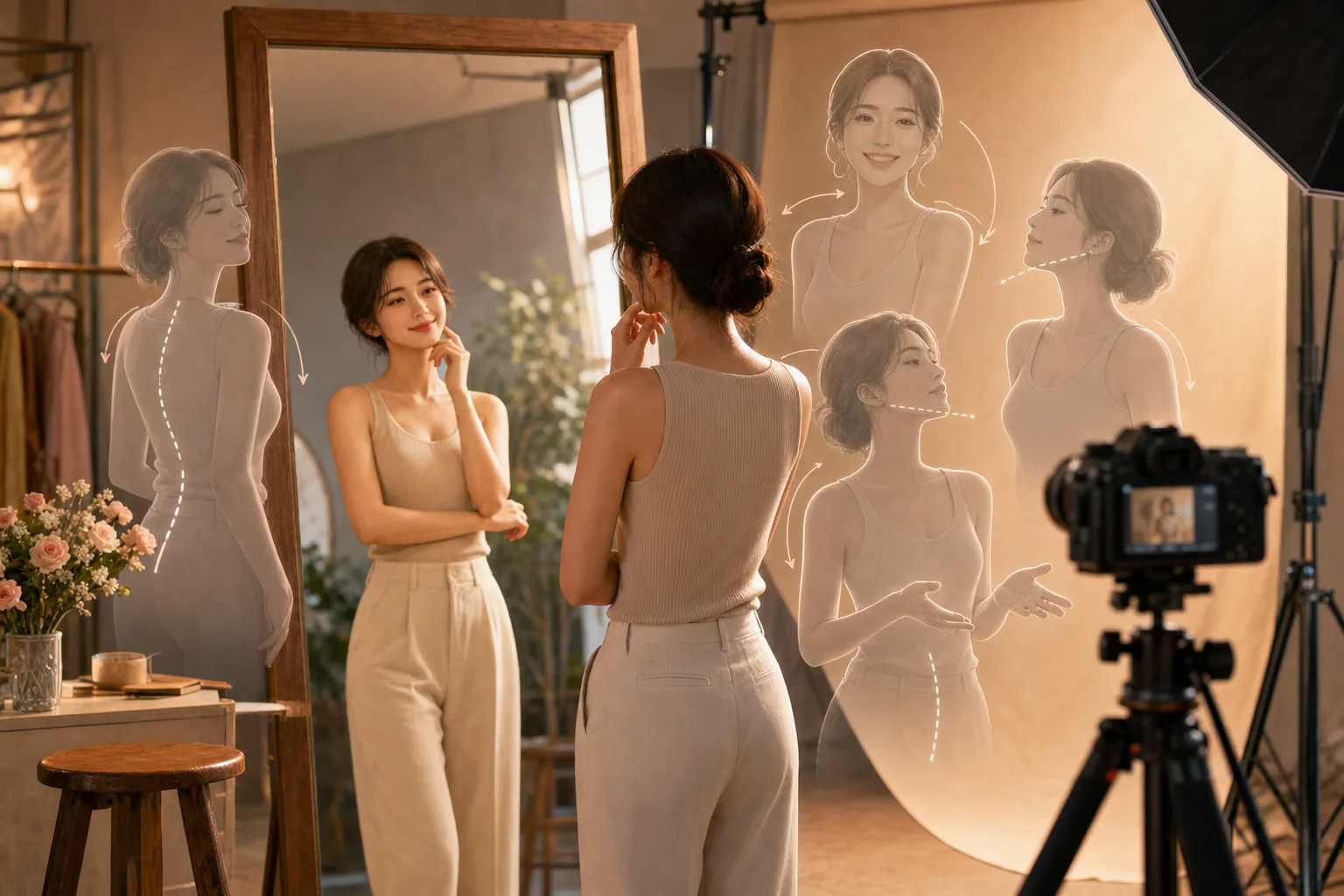
How Expression and Posture Shape an Impression
Almost everyone has looked at a photo of themselves and thought, "Why do I look so stiff here?" The truth is that awkwardness in front of a camera usually has little to do with how you look and a lot to do with expression and posture drifting slightly away from your everyday self. When we look at a photo, the first things we read are tiny signals: the direction of the lips, the tension around the eyes, the height of the shoulders. When those signals look relaxed, the whole photo feels softer too.
Psychology has a general idea called the facial feedback hypothesis, which suggests that the act of making an expression can influence how a person feels. You can sense something similar in photos. When you lift the corners of your mouth a touch and let the tension drop from your shoulders, your expression softens, and that softness carries into the mood of the photo. It is not a fancy technique; even small adjustments to posture can change the feel quite a bit.
One thing worth saying clearly: the impression in a photo is only an impression. A calm-looking expression does not mean someone always has a calm personality, and one beaming photo says nothing about a person's character or abilities. An impression is just a single frame shaped by that moment's light, angle, and mood. Please read this article lightly, as a fun and styling suggestion of "here's how you might look more natural," rather than as a verdict about anyone.
A Natural Smile and Smiling Eyes
The smile is the part of a photo that shows the most. If you shout "cheese" and just open your mouth wide, the mouth smiles while the eyes stay still, which often reads as frozen. The secret to a natural smile lives not in the mouth but around the eyes. When the muscles around the eyes gather slightly and the eyes curve gently, you get what people call smiling eyes, and that is what makes a photo feel warm.
To practice smiling eyes, stand in front of a mirror and recall a happy moment. Thinking of someone you love, a meal you enjoyed, or something that made you laugh softens the area around your eyes on its own. Just before the shutter, exhale gently and lift the corners of your mouth only about seventy percent of the way rather than all the way; it looks far more natural. A soft, contained smile often reads as more relaxed than a big open grin.
A closed-mouth smile is a great option too. A look where the upper teeth barely show, or simply lifting the corners of the mouth while keeping it closed, creates a calm yet friendly mood. Which smile suits you best varies from person to person, so take several versions with a mirror or selfie and remember the expression you like. It makes the real moment much easier.
Building the Impression with Your Upper Body
The mood of a photo is decided by the upper body almost as much as by the face. Depending on how the neck, shoulders, and hands are placed, the very same expression can read completely differently. Here we'll break the upper body down part by part, with the spots that commonly turn awkward and light tips to fix them.
Chin and Neck: Avoiding the Forward-Head Look
Many people unconsciously crane the neck forward to look at the camera. This forward-head posture creates shadows under the chin and shortens the neck, making the impression feel cramped. Instead, lengthen your neck as if gently lifting the crown of your head toward the ceiling, and lower your chin while pushing it just a touch forward. That cleans up the jawline crisply.
People often phrase it as "forehead toward the camera, chin slightly down." If you raise the chin too much, the nostrils get emphasized; if you tuck it too hard, a double chin appears, so the point is to find the middle. Practicing a long neck in the mirror a few times means your posture falls into place naturally even at the moment the shutter clicks.
Shoulders and Body Angle
When the shoulders are bunched up high, the tension goes straight into the photo. Before the shutter, shrug your shoulders up once and let them drop; the shoulder line lowers, the neck looks longer, and the expression softens. Rather than facing the camera dead-on, twist your body about fifteen to thirty degrees, which makes the shoulders look narrower and adds dimension.
Place one shoulder slightly closer to the camera and shift your weight onto one leg, and a natural curve appears in your stance. Leaning your upper body just a little toward the camera can create an engaged, friendly mood. There isn't a single right answer, so try several angles and find the direction that suits your build.
| Area | Common mistake | Improvement tip | One-line memo |
|---|---|---|---|
| Chin & neck | Craning the neck forward | Lengthen the neck as if lifting your crown | Lower the chin only slightly |
| Shoulders | Shoulders bunched up high | Shrug up and drop before the shutter | Twist body 15 to 30 degrees |
| Gaze | Unfocused, wavering eyes | Softly fix on a point past the lens | Blink once just before |
| Lips & smile | Frozen grin with mouth only | Add smiling eyes, lift 70 percent | Recall a happy moment |
| Hands | Stiff hands with nowhere to go | Give hands a small job with hair or clothes | Turn the hand edge to the lens |
Refining the Details Around the Face
As much as the expression itself, the small movements happening around the face steer the impression. Gaze and hands, in particular, carry surprising weight in a photo. Let's look at these two, broken down part by part.
Deciding Where to Look
When the gaze wavers, the whole photo feels uneasy. It helps to decide before the shutter whether you'll look straight into the lens or slightly off to the side. Looking right into the lens gives a clear, confident mood, while letting your gaze drift just past the camera toward something far away feels atmospheric and calm.
If you strain your eyes too hard it can look intense, so instead of staring at the lens, softly fix your eyes on a point just beyond it. Blinking once and reopening your eyes right before the shutter releases the tension around them, capturing a livelier look.
Keeping Hands and Arms Natural
Photos where someone freezes up because they don't know what to do with their hands are incredibly common. When hands have nowhere to go, the whole body tends to tense. Giving your hands a small "job" such as lightly touching your hair, gently holding a collar or sleeve, or hooking just your fingertips into a pocket makes the pose far more natural.
Rather than spreading your hand flat with the palm facing the camera, turn it slightly so the edge of the hand faces the lens; it looks smaller and tidier. Keeping your arms a little away from your sides, instead of pressed against them, keeps the upper arm from flattening so the line looks clean. They're small details, but they lift the overall mood a notch.
A Relaxation Routine and How to Practice
No matter how many good tips you know, a stiff body shows up directly in the photo. That's why a short routine to release tension right before shooting helps enormously. First, breathe in slowly through your nose and exhale long through your mouth, repeating two or three times. Shrug your shoulders up and down, and roll your neck gently side to side to let the upper-body tension go.
It's good to loosen the facial muscles too. Moving your mouth wide through the vowel sounds, or puffing your cheeks with air and releasing a few times, keeps your face from freezing. Hold a faint smile just before pressing the shutter and aim to keep that expression for just one second through the moment the photo is taken; awkward frames drop dramatically.
Getting to know your angles with everyday selfies is great practice as well. Knowing which side of your face feels easier, which smile you like, and which gaze feels natural cuts down on hesitation in the real moment. Take several shots, compare them, and remember the pattern you like, and your next photo will come far more comfortably.
Finally, remember that a photo is only ever a single frame of a moment. A flattering photo doesn't raise your worth, and an awkward one doesn't diminish you. Gently refining your expression and posture is just a small practice for capturing a more relaxed version of yourself, not a test with a correct answer.
Closing: An Impression Is Just an Impression
The smile, neck, shoulders, gaze, and hands we've covered are all things you can shift with just a little awareness to change a photo's mood. Rather than minding everything at once, learn them one at a time, like shoulders today and gaze next time, and before long the camera will feel much easier. Small habits add up into natural ease.
And once more, please remember that the impression in a photo is not the same as a person's actual personality or abilities. FaceOracle's mood report and styling articles like this one don't hand down verdicts; they're just light suggestions to enjoy your photos more. Use them for fun without pressure, and capture a comfortable version of yourself today.
Article info & references
Published June 7, 2026 · Last updated June 7, 2026
- General photo composition principles such as the rule of thirds
- Common photography lighting knowledge on light direction, size, and shadows
- The facial feedback hypothesis as a general psychology concept on expression and mood
- Common self-care knowledge on releasing tension through breathing and muscle relaxation