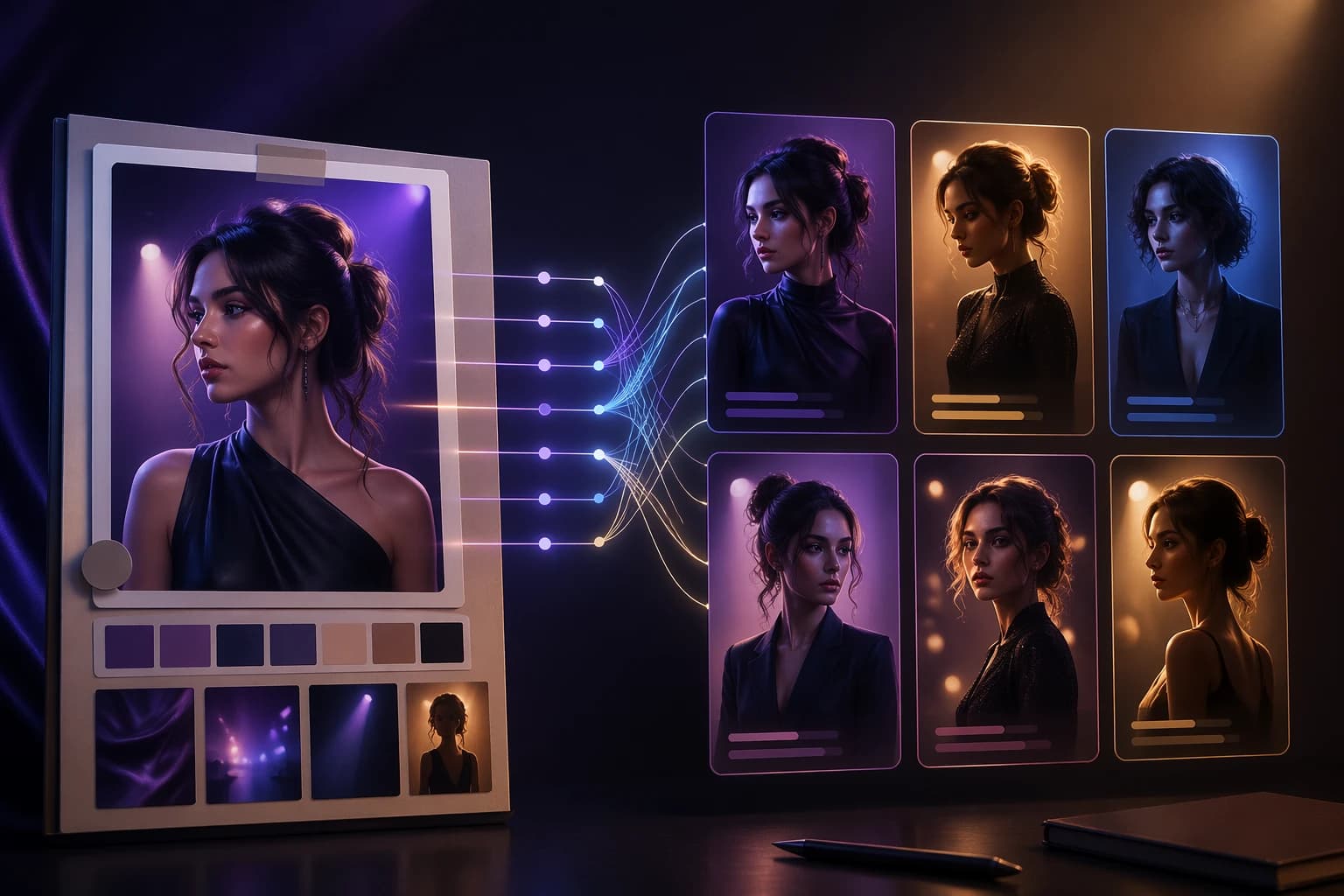
"Which celebrity vibe does my photo resemble?" This article explains how AI connects the mood and features of an uploaded photo with public celebrity names, and how to shoot a better photo. It is a for-fun style reference, not face recognition or identity verification.
How the Similar-Vibe Celebrity Reference AI Works
Step 1: Facial Feature Extraction
AI first extracts key facial feature points from the uploaded photo. It precisely measures dozens of values including the distance between eyes, nose length and width, mouth size, jawline angle, and forehead width. This forms the foundation data for matching.
Step 2: Embedding Vector Generation
The extracted features are converted into high-dimensional number vectors (embedding vectors). This vector serves as a unique "digital fingerprint" for each face. Celebrity databases store pre-generated vectors created using the same process.
Step 3: Cosine Similarity Calculation
When comparing user and celebrity vectors, the system uses Cosine Similarity. The more similar the direction both vectors point in, the closer the similarity score approaches 1; the more different, the closer to 0. The celebrity with the highest similarity score surfaces as your similar-vibe mood reference — a visual-similarity match, not face recognition or identity verification.
Photo tips for a steadier mood read
For a more consistent read, face the camera directly and shoot in natural light. Remove hats or sunglasses, and avoid heavy filters or retouching. A natural expression tends to yield the most stable style-mood reference. These results are always a for-fun style reference, not face recognition or a claim of actual resemblance.
How to Read the Similarity Score
The similarity score shown with a match is a value between 0 and 1. Closer to 1 means the two images’ feature vectors point in a similar direction; closer to 0 means they differ. Roughly, 0.8 and up reads as “a fairly close mood,” and around 0.6 as “a partly similar mood.” A higher number is not more “correct,” though — a 0.6 match often feels more alike than a 0.85 one, because human eyes read the whole impression, not the number. So treat the score as a for-fun reference for how close the image vibe reads, not proof that you resemble anyone.
Mood Matching Is Not Feature Matching
Even within “lookalike,” there are two yardsticks. One is structural similarity — how close the underlying bone structure is. The other is mood similarity — the overall vibe from hair, expression, and color. People are usually drawn to mood and feel “the vibe matches,” while structure-based matching can return surprises. FaceOracle’s reference leans toward the mood side — a for-fun style reference.
Why the Result Changes Every Time
The same person on the same day can get different matches photo to photo. Warmer light shifts the color mood, a new angle changes how proportions read, and a single expression can flip the whole impression. So the result is not a “correct answer” but a light reference to that photo’s vibe. It is an entertainment style-mood match against public celebrity names, not face recognition or identity verification.
FaceOracle's Similar-Vibe Celebrity Reference
FaceOracle uses Claude AI's multimodal vision to connect a photo's mood and features with publicly known celebrity names. It does not build face-recognition templates or support identity verification — the results are entertainment-only style references, not a claim of actual resemblance.