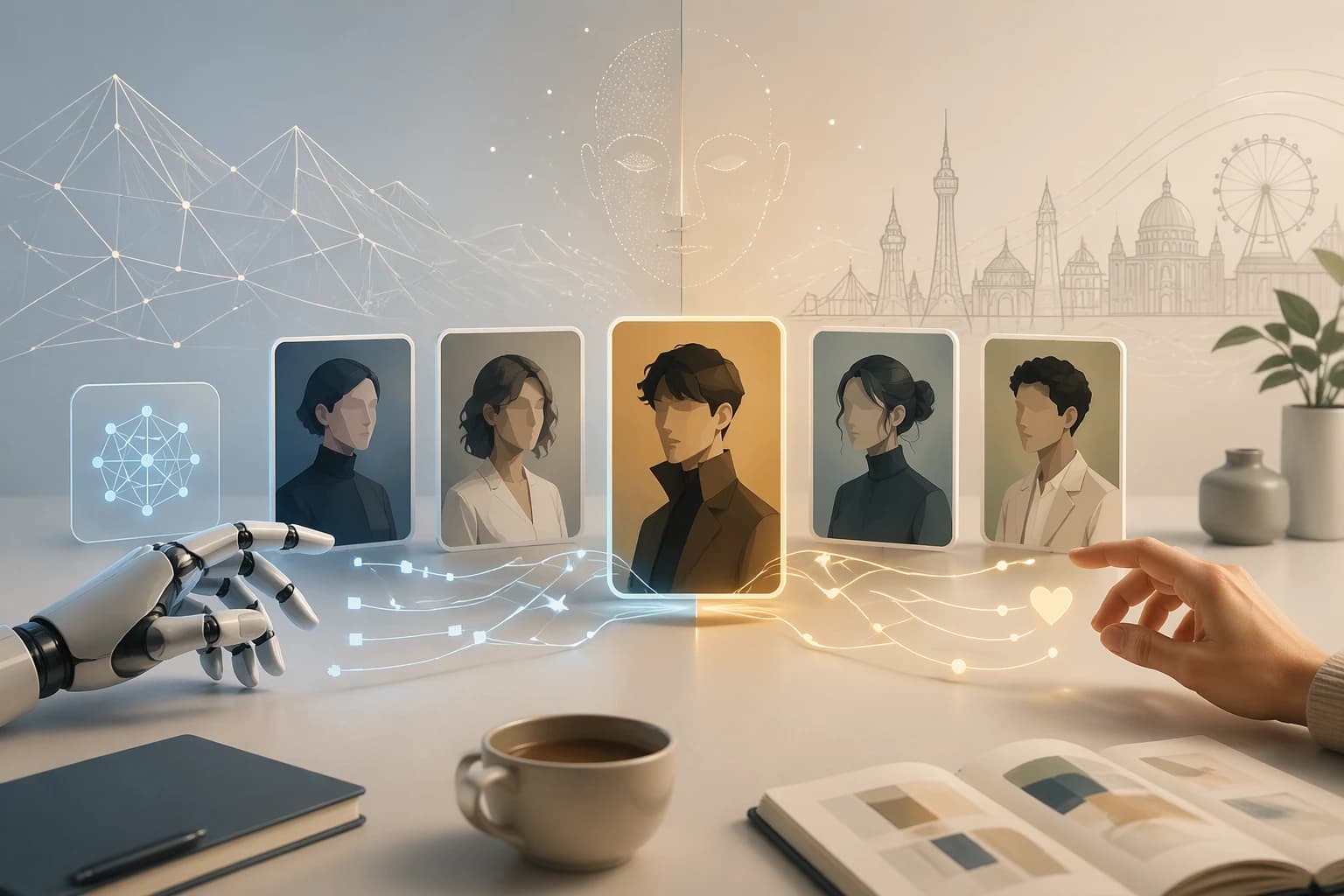
Similar-Vibe Celebrity References — AI vs Human Perception
"Hey, you remind me of..." We've all heard it, and the friend next to us often disagrees completely. Everyone has a different sense of visual similarity. This article looks at how AI connects the mood and features of an uploaded photo to public celebrity names, and how that differs from human judgment. This is entertainment content, not face recognition or identity verification.
How the Similar-Vibe Celebrity Reference Is Computed
AI similar-vibe celebrity mood reference works in three surprisingly systematic steps (it is a visual similarity reference, not face recognition):
Step 1: Feature Extraction
The AI first identifies hundreds of landmark points on your face: eye size and spacing, nose height and length, mouth width, jawline angle, cheekbone position, and more. A deep learning model then converts the facial image into a 128- or 512-dimensional vector — essentially turning your face into a unique combination of hundreds of numbers!
Step 2: Vector Comparison
These numbers are then compared against a celebrity database using "cosine similarity." This measures how closely two vectors point in the same direction, producing a score between 0 and 1 — the closer to 1, the more alike. A score of 0.87, for example, means "remarkably similar!"
Step 3: Ranking and Results
After calculating similarity scores against every celebrity in the database, the top 1–3 matches are presented to you. The entire process takes just seconds. While a human is still thinking "Hmm, who do they remind me of...", the AI has already compared thousands of faces!
Human Perception vs. AI Calculation
How Humans See Resemblance
Humans are influenced more by "vibe" and "impression" than by actual bone structure. A similar hairstyle, a matching smile, or even a similar voice can make us think two people look alike. That's why opinions split so dramatically — one person says "twins!" while another says "not even close."
How AI Measures Resemblance
AI, on the other hand, focuses strictly on skeletal structure and feature proportions. It strips away hairstyle, makeup, and expression to compare pure facial geometry. This is why AI results sometimes feel unexpected — but when you look closely at the bone structure and feature placement, the similarity is often genuinely striking.
Surprising Experiment Findings
Unexpected Matches
One of the most interesting phenomena in AI matching is finding high similarity scores between people you'd never have connected. AI sometimes even pairs people across genders because of underlying skeletal similarities. These "hidden lookalikes" are impossible for the human eye to catch, making them genuinely fascinating!
Cultural Differences in Perception
Even more interestingly, people from different cultural backgrounds often think of different celebrities when looking at the same face. In the research literature this is known as the "Other-Race Effect" — we tend to notice finer differences in faces that look more familiar to us. AI vibe references sit outside that pattern, while human intuition still brings in memory, hair, outfit, and expression in a way AI doesn't. Neither one is "the real answer"; they just capture different sides of a vibe.
So which one is closer to the truth?
The word "truth" is a bit too strong here. AI surfaces structure-based style-mood references; humans feel the mood through hair, clothes, expression, and memory. The fun is in looking at both together — and neither side is claiming that you actually resemble or are related to the referenced person.
FaceOracle connects your photo’s visual mood and features with 3 publicly known celebrity names as a fun style reference. This is entertainment only and is not face recognition or identity verification.