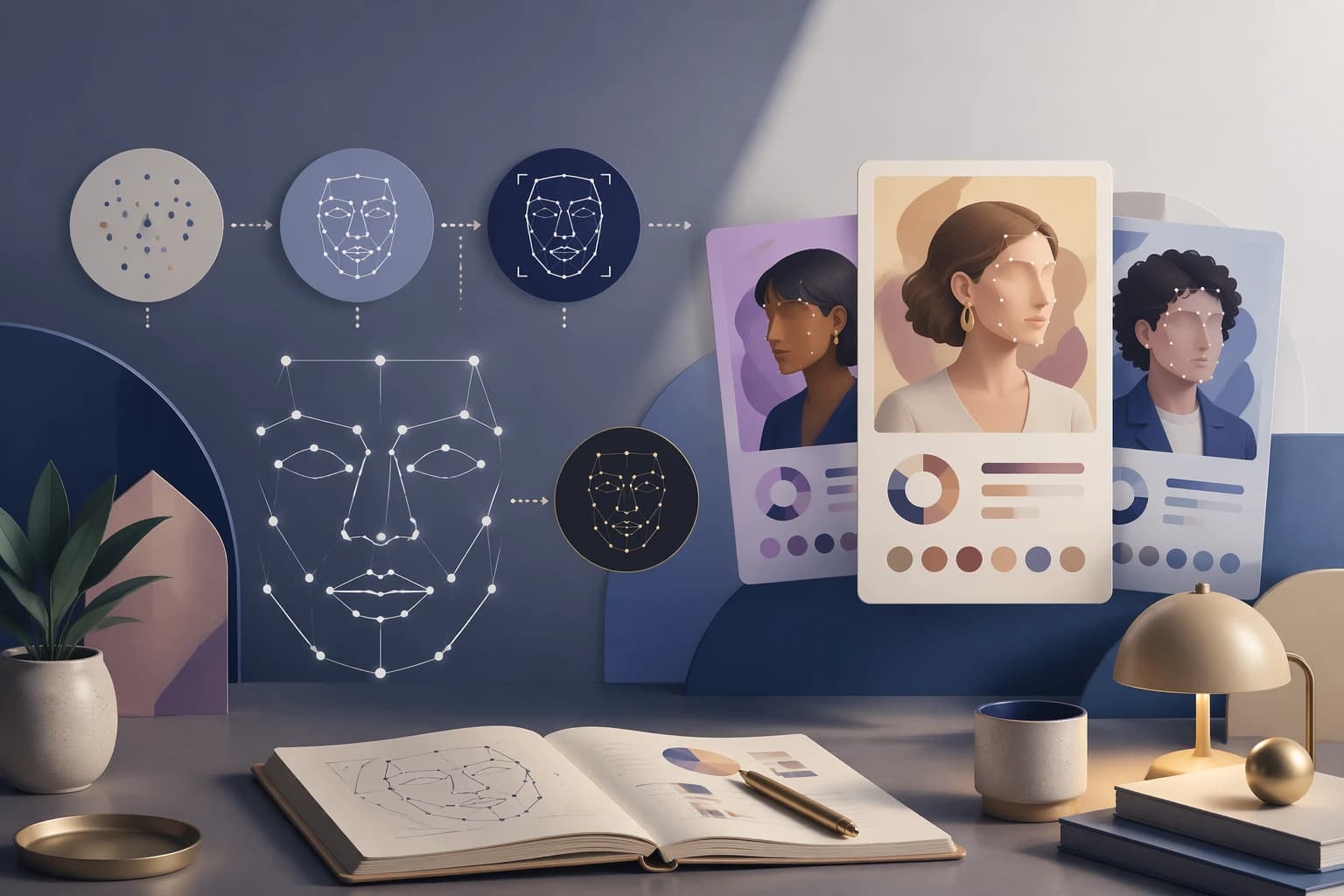
From unlocking your smartphone to passing through airport immigration, face recognition technology is everywhere in our daily lives. But what exactly does AI "see" when it looks at a face? Let's break down how AI face recognition works in a simple and fun way!
Stage 1: Face Detection
The first thing AI does is find "where the face is" in a photo or video. This is called a Bounding Box — a rectangle drawn around the face region. Whether the background is complex or there are multiple people, AI detects face positions reliably. Note that this step only localises where faces appear in the image and does not infer any personal attribute.
One popular technique is MTCNN (Multi-task Cascaded Convolutional Networks). This algorithm passes through three neural networks sequentially, progressively filtering face candidates with increasing precision. It can detect small faces and even side profiles surprisingly well.
Stage 2: Feature Extraction (Facial Landmarks)
Once the face is located, the system extracts detailed "feature points." Typically, 68 landmark points are used, precisely mapping eyebrow positions, eye contours, nose shape, lip boundaries, and jawline.
These 68 points serve as a "map" of the face. By calculating distances and ratios between points, the facial structure can be expressed numerically. Recently, technologies using over 468 mesh points have emerged, enabling capture of even the subtlest facial differences.
Stage 3: Analysis — Embedding Vector Generation
This is the most crucial step! AI converts extracted features into a 128-dimensional or 512-dimensional "embedding vector." In simple terms, it transforms a person's facial features into a combination of hundreds of numbers.
This numerical combination acts like a "facial fingerprint." By comparing embedding vectors of two faces, you can calculate how similar they are (cosine similarity). Same person: above 0.9. Lookalike: 0.6 to 0.8. Completely different: below 0.3.
How Does Deep Learning Learn?
The foundation of this entire process is deep learning, specifically CNNs (Convolutional Neural Networks). AI models learn from tens of thousands to millions of face images, automatically discovering patterns like "eyes shaped like this indicate these features." Humans do not manually program rules — the system learns automatically from data.
Recently, models like ArcFace and VGGFace have reached levels surpassing human face recognition ability. Even with different lighting, changed expressions, glasses, or new hairstyles, they can accurately identify the same person.
What Technology Does FaceOracle Use?
FaceOracle leverages Anthropic's Claude AI multimodal vision technology. Rather than simply comparing numbers, it comprehensively analyzes the overall impression and atmosphere of a face, much like a human would. By combining face reading interpretations with AI visual understanding, it delivers results that are both entertaining and meaningful.
Is My Privacy Safe?
One of the most critical issues in face recognition technology is privacy protection. FaceOracle does not store uploaded photos on any server. Once analysis is complete, the image data is immediately deleted and retained nowhere. You can enjoy the fun analysis without worrying about your privacy at all!