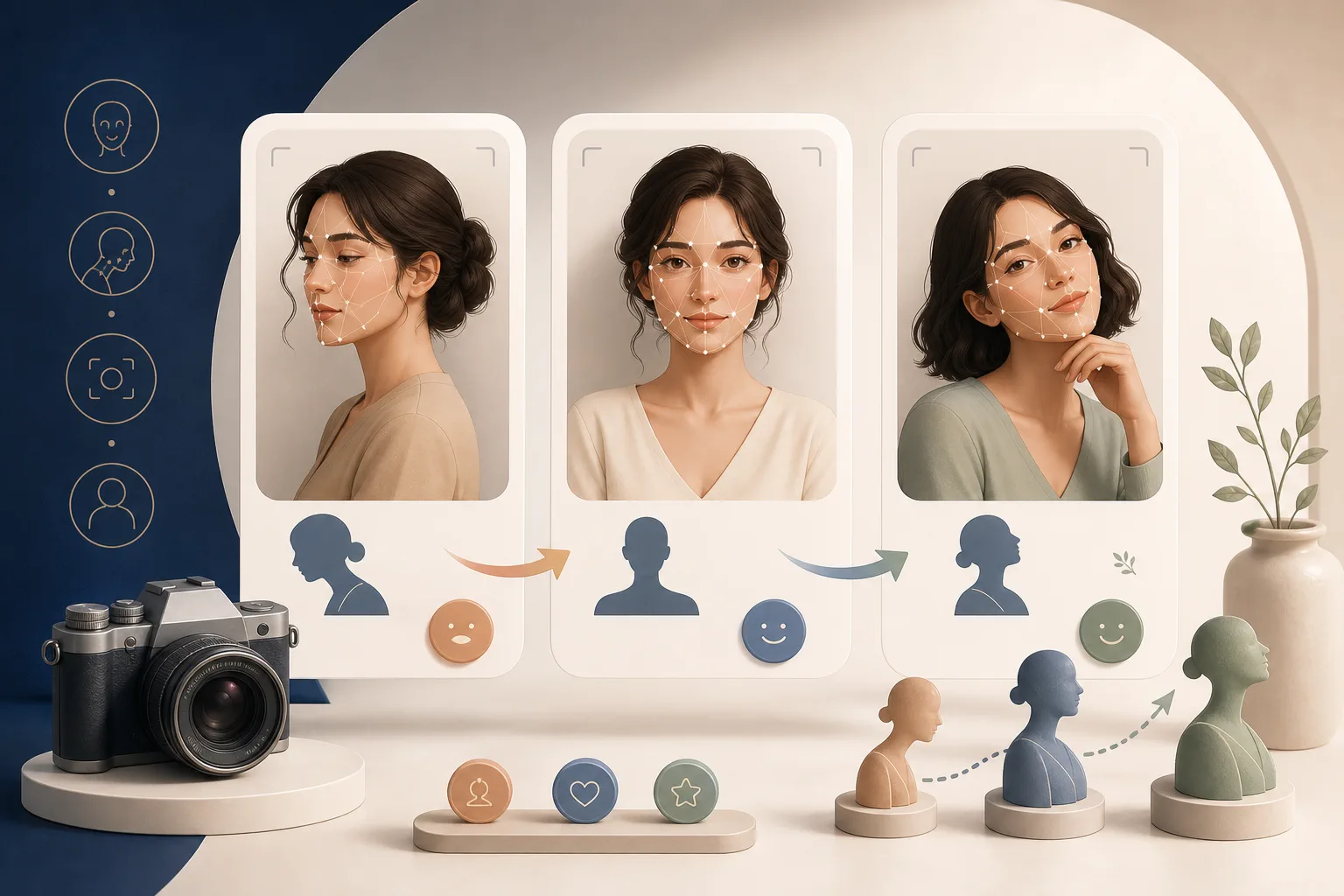
A neutral face reading as cold is not your fault
You have probably had that moment where you catch your own face in a mirror or a candid photo and it looks colder than you expected. You are not angry, you are not in a bad mood, yet your fully relaxed everyday face somehow gives off a stiff, standoffish feeling. Here is the short answer up front: this is not a personality problem at all. When a human face goes completely slack, the mouth corners drop a little and the eyes and brows settle downward, so looking slightly glum at rest is actually the natural state of things.
One more thing stacks on top of that. For the sake of safety, our brains tend to notice negative cues faster and more strongly. So even with the very same neutral face, an observer is quick to read it as slightly uneasy rather than simply relaxed. In other words, looking cold is not the true feeling behind your face. It is closer to the viewer's quick first read. That is exactly why the same face can come across so differently depending on mood, angle, and light.
So this article is absolutely not saying you need to fix your everyday face. A neutral face is completely normal and perfectly fine. It is just that, in short moments where impressions get set fast, like taking a photo or meeting someone for the first time, there are small tricks that make it easier to share the mood you actually want. This is all impression and mood reference, never a piece that evaluates a person.
Why impressions get set in a split second
People take in a new face as a single bundled impression in a tiny instant. Like the primacy effect or halo effect that social psychology often talks about, the first feeling that lands keeps shaping the reads that follow. Once a neutral face gets read as cold, even the behavior after that tends to be seen through that tinted lens. Conversely, when the first feeling is easy, small slips get forgiven more generously.
The key point is that this does not tell you who the person really is. A first impression is just a fast guess made in an instant, and it does not judge a person's personality or ability. It is closer to a temporary note the viewer jotted down while quickly sorting things. That is why impressions can always be softened, and the methods are not grand at all.
Expression is only part of the signal
A first impression is never set by expression alone. Your gaze, the direction of your eyes, the angle of your shoulders and head, even your tone of voice all combine into one bundled mood. So rather than fixating on your mouth corners alone, gently loosening your eyes and posture together works far better. The fact that there are many signals means, put another way, that there are just as many spots we can adjust, which makes it all feel much lighter.
A small genuine smile shifts the mood
There is an idea that expression and mood influence each other. It does not mean forcing a big grin. It means that even a tiny smile, just a little extra effort at the mouth corners and the edges of the eyes, softens the whole face. This is not stating it as scientific fact; it is a light reference to the link between expression and feeling. The point is not big, but genuine-looking.
The most natural smile starts not at the mouth but at the eyes. A smile where the corners of the eyes narrow a little and warm up looks real, while a smile that only pulls the mouth tends to come across as awkward. So in front of a mirror, try practicing by picturing someone you love or a cute puppy and letting the softness begin from your eyes. That way you can find the strength of smile that suits you.
Besides smiling, there are small moves that help. Lifting your brows just slightly opens up eyes that looked heavy and brightens the whole impression, and easing a clenched jaw so there is a small gap between your back teeth releases the tension in the lower face. Doing just these two together already gives off a far more relaxed mood than your usual neutral face.
Finding the micro-smile that fits you
The size of smile that suits each person is different. With your phone camera, take a neutral face, a very faint smile, a normal smile, and a full grin in turn and compare them side by side. Usually the faint smile that makes you think it barely looks like smiling comes out the most natural and relaxed in photos. That spot is the baseline of your micro-smile. Once you find it, it is easy to pull out in any setting.
Your eyes and gaze create the warmth
Your gaze carries a surprisingly large share of a cold-looking impression. Put too much force into your eyes and you seem to be glaring; let them go too slack and you look blank. Somewhere in between, easing the tension around your eyes and keeping a soft gaze is the key. Rather than staring hard at a person's brow or a single point in their pupil, looking as if you are loosely cradling both eyes and the area around them makes your gaze far gentler.
In a first meeting, a rhythm of naturally releasing and re-meeting the gaze is better than holding it the whole time. Meeting eyes briefly while speaking, glancing slightly elsewhere while thinking, then coming back is plenty. In photos, look straight at the lens but ease the force in your eyes, and breathing out lightly while dropping your shoulders right before the shutter lets a much softer gaze come through.
| Area | At rest | Small adjustment | How it shifts |
|---|---|---|---|
| Mouth | Corners droop, glum | A faint micro-smile | Easy and warm |
| Eyes | Tense, cold | Ease the force, soft gaze | Warm and bright |
| Brows | Settle downward | Lift just slightly | Open, brighter look |
| Jaw | Clenched, tense | Small gap between teeth | Loose and natural |
| Posture | Shoulders, head forward | Drop shoulders, long neck | Relaxed and steady |
Just changing posture and angle loosens the impression
Even if you leave your expression as is, adjusting only posture and angle changes the mood quite a bit. Raised shoulders or a head that juts forward easily give off a tense, defensive feeling. Shrug your shoulders up once and let them drop to release the force, and keep your neck long as if gently stretching the crown of your head upward, and that alone makes you look more at ease. When the body's tension releases, the face's tension releases along with it.
In photos, instead of facing the camera stiffly head-on, turning your body slightly at an angle and rotating only your head toward the lens softens the impression. Tucking your chin down just a touch keeps the eyes relaxed too. Shooting from too high above or too low below easily distorts the expression, so an angle near eye level is the safest. All of these adjustments are simply suggestions to help you look more at ease.
A 30-second routine right before the photo
Right before a photo, it helps to remember one short sequence. First breathe out long and drop your shoulders, tuck your chin a touch, lift your brows just a little, then add a small bit of effort to your mouth corners while picturing something you love. Going slowly through these four beats keeps you from freezing into a blank face. It feels awkward at first, but after a few tries your body remembers, and later it comes out naturally right on the shutter sound.
A neutral face is not something to fix
If reading this far made you wonder whether your face was the problem, I hope you will gently set that thought down. An everyday neutral face is completely normal, and there is nothing wrong with it in itself. A calm face at rest can even read as a composed, thoughtful kind of charm. What we looked at is not how to change your face, but small tricks to share the mood you want a little more comfortably in the moments you choose.
And please remember this. The mood that shows up in a photo or first impression is not the whole of a person. An impression is a surface feeling that shifts endlessly with light, angle, and the day's condition, so it does not judge personality or ability. Even saying a neutral face looks cold is just a single moment's impression. Take these ideas lightly, only as a fun styling reference, and that is more than enough.
Frequently asked questions
I have a neutral face but people keep asking if I'm upset, why is that?
When a face is fully relaxed, the corners of the mouth and eyes can drift slightly downward, which may read as cold or stern to whoever is looking. That is just a first impression on the viewer's side, not a statement about your real personality or mood. Adding the tiniest bit of lift to the corners of your mouth already softens how you come across.
Is there a way to practice a natural smile that doesn't look forced?
Start in front of a mirror with a micro-smile, lifting just the corners of your mouth a millimeter or two, so the mood warms up without a full grin. Picturing someone or something you like lets your eyes relax too, which makes it look more genuine. A few seconds a day is enough for a more at-ease resting expression to settle in.
My expression always looks stiff in selfies, what can I do?
Right before the shutter, breathe out slowly and let your shoulders drop a little so the tension eases and your face softens. Instead of staring down the camera, keep your gaze gentle and add a small smile for a more relaxed feel. Pick the most natural shot from a few tries, and treat all of this as lighthearted impression reference.
Article info & references
Published June 13, 2026 · Last updated June 13, 2026
- General social-psychology concepts of how first impressions form, such as the primacy and halo effects
- Common psychology knowledge about a negativity bias that notices negative cues faster
- A light, popular idea that expression and emotion influence each other
- A general observation that a genuine smile begins at the corners of the eyes
- General photography tips on how angle, lighting, and posture affect an impression