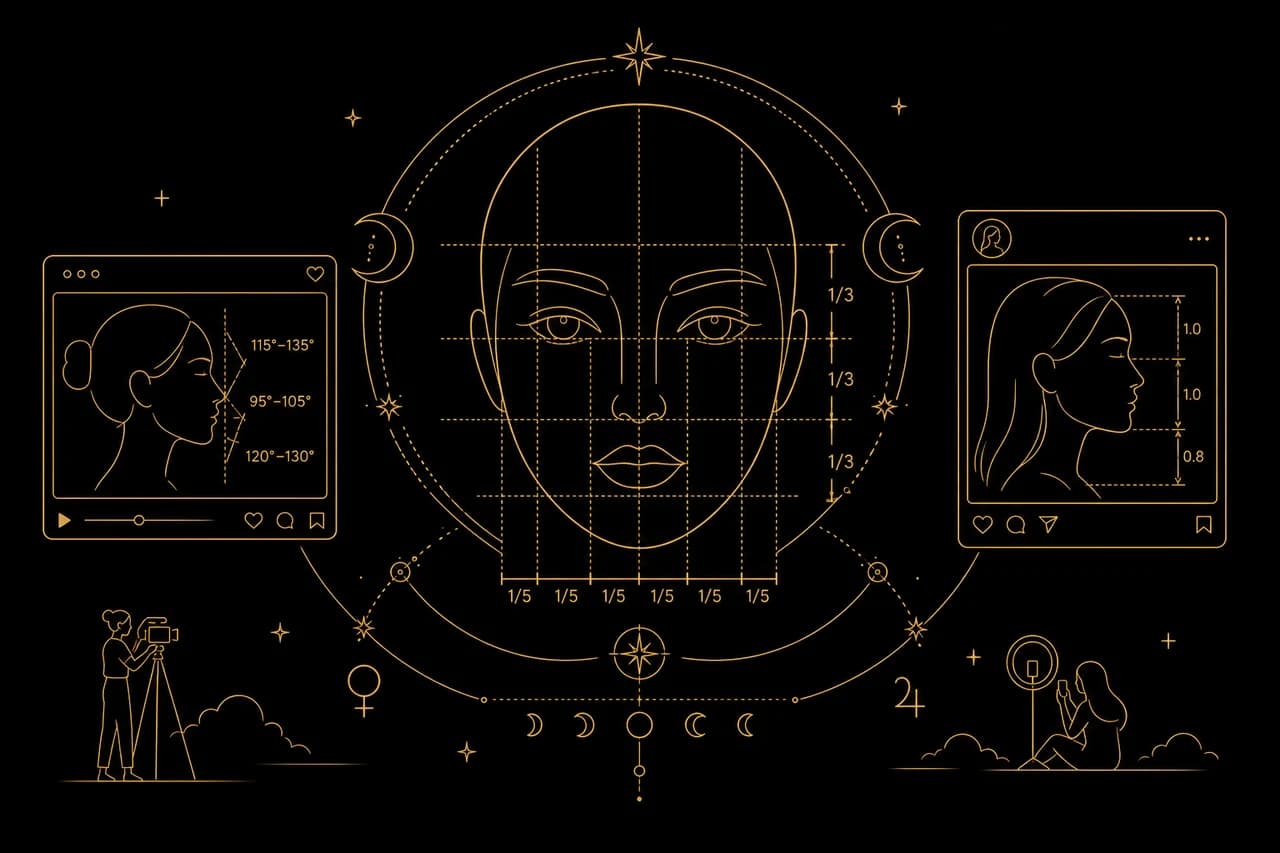
It's Not That You're "Too Sensitive" — It's the Water We Swim In
You've probably had this experience at least once: you take about twenty profile photos, don't like a single one, and delete them all. In moments like that we tend to blame ourselves — "I guess I'm just unusually sensitive about my looks." But a demanding standard for one's own face is often less about individual temperament and more about the water of images we begin swimming in the moment we open our eyes. Ads, idol stages, drama close-ups, real-time beauty filters, and the profile photos we exchange every day — we live in an era when the sheer volume of facial images passing before us each day is the greatest in human history.
Let me be clear up front. This article is not here to evaluate anyone's face or to tell you "this is how you should fix it." Nor does it hold that a face can determine a person's character, ability, or destiny. It simply takes a light, curious look — through the lens of psychology and sociology — at how the standard of a "beautiful face" is socially constructed and repeated. Once you know what the standard really is, you can be shaken a little less in front of it.
Objectification Theory — When You See Yourself as a "Thing to Be Looked At"
Objectification theory, proposed by psychologists Fredrickson and Roberts in 1997, is a good starting point for this problem. The two argued that people who grow up in a culture that frequently treats women's bodies as "things to be looked at" eventually internalize the observer's gaze. This is called self-objectification. You come to inspect yourself in the third person — looking down at yourself from above, the way others might. As a result, they pointed out, habitual body surveillance takes hold, shame and anxiety grow, and you become numb to the very sensations rising from within your own body.
Narrowing this theory to the face makes the story even sharper. The face is the part of the body most often exposed, most photographed, and most shared. So the camera of self-surveillance tends to linger especially long over the face. Once third-person questions like "How does my expression look right now?" or "Does my nose look big from this angle?" become a habit, mirrors and smartphones stop being tools that reflect you and become a scorecard that grades you. The trouble is that the criteria for that grading didn't come from within you — they flowed in from outside.
Korea's "Face Consciousness" — Why the Face in Particular?
Western body-image research long focused on figure and weight. But studies looking into the Korean context note that the center of gravity of concern sits somewhere a little different — on the face. The 2014 "face consciousness" study by Kim, Seo, and Baek is a representative example. The researchers sought to capture, as a single psychological construct, the awareness and concern Korean women hold toward their own faces, and they emphasized that this concern is bound up not only with individual disposition but with the socio-cultural environment. It's an observation that the sense of "appearance means the face" is especially pronounced in Korea.
The 2020 study by Lin and Raval on the body image and appearance-management behaviors of adult women in South Korea is a literature review synthesizing prior research. What the review highlights is that the demand around appearance does not come from media alone — it operates across several socio-cultural layers at once: family and peer expectations, advantages in the job and marriage markets, and a comparatively high social acceptance of cosmetic surgery. Within that, you can also read an atmosphere in which appearance management is treated less as personal taste and more as a social competence one is almost expected to possess. In other words, a person who cares about their face isn't being excessive; an environment that makes people care, from many directions, came first.
Repetition Makes the Standard — Ads, Magazines, Idols
So where, concretely, is this standard repeated? A 2009 study by Jung and Lee placed women's fashion and beauty magazine advertisements from the United States and South Korea side by side and analyzed their content. Ads show, page after page, the images deemed ideal — and this very repetition is the device that quietly molds a sense of the "normal." When you encounter the same facial grammar hundreds of times, your brain begins to mistake it not for a particular trend but for a "default" that was beautiful all along.
The ad page is only the beginning. Idol music videos, drama close-ups, YouTube thumbnails, model shots at the cosmetics counter — a few elements like smooth skin, sharply defined eyes, and a small, slender contour overlap endlessly across different channels. Recall the simple principle from earlier: what we see often comes to feel comfortable and appealing. In the end, much of what we now feel is "naturally pretty" is not an answer decreed by nature but something closer to a consensus manufactured by repetition.
Filters and Profile Photos — When Self-Gaze Becomes Everyday
In the past, the ideal face lived "over there," in a magazine or on the TV screen. Now it's different. The moment you open the camera app, a real-time beauty filter overlays an "improved me" right onto my own face. The object of comparison is no longer a distant model but another me, smoothly polished in the palm of my hand. Once your eyes grow used to the face the filter makes, a reversal can occur in which the original face — with the filter off — looks unfamiliar and lacking instead. This isn't an individual delusion; it's a common experience produced by an augmented standard.
On top of that, the face has become the first line of one's self-introduction. Profile photos on messengers, social media, and dating apps introduce you before you even speak. So self-gaze is no longer a special moment when you happen to stand before a mirror — it has become a daily habit repeated several times a day. Read alongside our separate pieces on why you look awkward in photos and why selfies differ from real life, and the nature of this unfamiliarity will come into much sharper focus.
| Source | What it repeats | Psychological effect |
|---|---|---|
| Ads & magazines | Page-after-page repetition of faces deemed ideal | Mistaking a particular trend for the "default" |
| Idols & dramas | Close-ups of smooth skin and sharply defined eyes | Faces seen often come to feel comfortable and pretty |
| Beauty filters | Overlaying an "improved me" in real time | The original face looks unfamiliar and lacking |
| Profile photos | The face becomes the first line of self-introduction | Self-gaze hardens into a daily habit |
| Family / peers / job & marriage markets | Expecting appearance management as a required social competence | The environment reinforces self-surveillance |
Face Surveillance No Longer Cares About Gender
The studies introduced so far focused mainly on women's experiences because the pressure of objectification has long weighed more heavily on women. But as the image environment grows denser, the habit of inspecting one's face in the third person is increasingly crossing the boundary of gender. Grooming content for men, "glass skin" routines, tips on taking good profile photos — such information pours out, and dating apps and video calls make men, too, face their own faces all day long.
So this isn't the peculiar vanity of one particular gender but something closer to a shared condition that almost everyone living in a camera-saturated era experiences to some degree. Instead of pinning the problem on individual character or gender, if we shift it toward the "environment," self-blame eases and room opens up to understand one another. It's not that I'm strange — it's just that the place we've all been put in is like this.
The Standard Is Not a Law of Nature but a History
There's something I really want to underline here: the standard for a beautiful face has changed ceaselessly across eras and regions. In one era a round face was the ideal, in another a slender one, and the texture of it differed from place to place. So the standard we now take for granted is not an eternal truth but something closer to a trend that this period and this society have provisionally agreed upon. And if the standard is something that was made, then we have no obligation to fit ourselves to it entirely.
In this flow the topic of cosmetic surgery comes up, but this article treats it strictly as a cultural and psychological phenomenon. This article is not medical advice, and it does not recommend any procedure or surgery. Please make any decision about your body only after fully consulting a specialist. And whatever you choose, we do not judge that choice as right or wrong. What we want to see is not "what should be fixed" but the structural question of "why have we been taught to feel this way."
Practicing Setting the Scorecard Down for a While
It's hard to switch self-surveillance off entirely — it's already an ingrained habit. But simply knowing where the standard comes from noticeably drains its power. The moment you name it once — "This dissatisfaction isn't a flaw in my face; it comes from a scorecard planted by repeated images" — a small gap opens between the emotion and you. That gap is exactly the room to breathe.
Small practices help too. Instead of accounts that keep shrinking you, change your visual diet to feeds that show a variety of faces. Sometimes turn the filter off and let your eyes slowly grow used to your original face. Above all, treat your face not as an object to be scored each time but as a kind neighbor you'll live alongside for a lifetime. A face standard is, in the end, a story someone made up. If you remember that you yourself can become the author of that story, you'll find yourself a little less likely to pawn your whole day's mood to a single profile photo taken today.
Frequently asked questions
Is it because I'm unusual that I keep fixating on face standards?
There's no need to see it that way. Fredrickson and Roberts's 1997 objectification theory explains that people raised in a culture that treats them as "things to be looked at" internalize the observer's gaze and come to habitually inspect their own faces. In other words, it's less about individual sensitivity and closer to a habit created by the image environment. Understanding the environment, rather than blaming yourself, helps.
Why does concern in Korea cluster on the face rather than the figure?
Kim, Seo, and Baek's 2014 "face consciousness" study noted that Korean women's appearance concern is markedly concentrated on the face. This is understood not as individual temperament but as a phenomenon bound up with the socio-cultural environment. This article examines that from a cultural and psychological angle only; it does not judge any person by their face.
Is using filters wrong?
No. This article does not judge filter use as right or wrong. Still, knowing that once your eyes grow used to the face a filter makes, your original face with the filter off can feel unfamiliar, helps you enjoy the tool without being overly swayed by it.
Does this perspective oppose cosmetic surgery?
Neither for nor against. This article treats cosmetic surgery only as a cultural and psychological phenomenon; it is not medical advice and does not recommend any procedure or surgery. We encourage you to make decisions about your body yourself, only after fully consulting a specialist, and we do not judge anyone's choice as right or wrong.
Can beauty standards never be changed?
Beauty standards are a "manufactured consensus" that has shifted across eras and regions. As Jung and Lee's 2009 magazine-ad analysis shows, repeated images mold a sense of the "normal." It's hard for an individual to change all of society, but simply choosing which images you see often and recognizing where the standard comes from noticeably reduces its influence.
Article info & references
Published July 4, 2026 · Last updated July 4, 2026
- Fredrickson, B. L. & Roberts, T.-A., Objectification Theory: Toward Understanding Women's Lived Experiences and Mental Health Risks (1997)
- Kim, Seo & Baek, Face Consciousness among South Korean Women (2014)
- Lin, L. & Raval, V. V., Understanding Body Image and Appearance Management Behaviors Among Adult Women in South Korea (2020)
- Jung, J. & Lee, Y.-J., Cross-Cultural Examination of Women's Fashion and Beauty Magazine Advertisements in the United States and South Korea (2009)