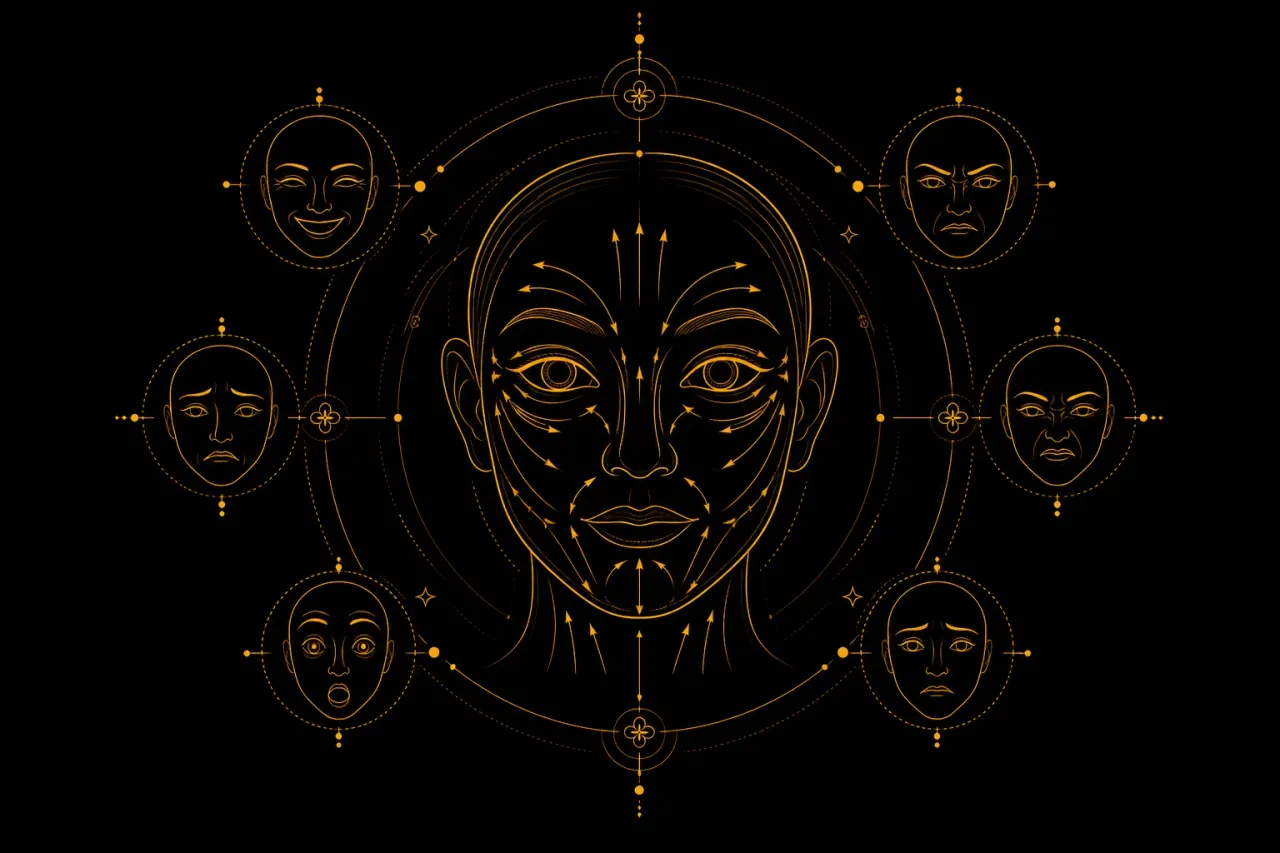
Do faces honestly reveal what we feel?
See a smile and we think 'happy'; see a scowl and we think 'angry.' We read faces dozens of times a day. Yet the natural belief that expressions honestly reveal emotion has been one of psychology's most fiercely debated questions for half a century. This is a piece of expression psychology that tries to present both sides fairly.
On one side stands Paul Ekman, who held that basic emotions like joy, sadness, anger, fear, surprise, and disgust show up as broadly similar facial movements across cultures. On the other stands Lisa Feldman Barrett, who countered that the very same expression can mean entirely different things depending on culture and context.
To be clear up front: this article does not claim you can read a person's inner mind from their face. If anything, the opposite — it walks through real research to show that the link between expression and emotion is far more tangled than it looks.
Ekman's basic emotions and FACS — an attempt to 'measure' the face
In the 1960s, a young psychologist named Paul Ekman traveled to the Fore people of the Papua New Guinea highlands, a group with almost no contact with the outside world. He showed them photos of expressions and asked what situation each face belonged to. The result was striking: faces that Westerners read as 'anger,' the Fore read in much the same way (Ekman & Friesen, 1971).
From this, Ekman built his 'basic emotions' theory: a handful of core emotions are shared through human evolution, so their expressions are, to a degree, universal across cultures. This view became one of the major pillars of emotion research for decades.
FACS — breaking the face into action units
In 1978, Ekman and Wallace Friesen published the Facial Action Coding System (FACS). Before interpreting any emotion, it objectively records what moved on the face. Muscle-level movements — an inner brow raise, a lip-corner pull — are broken into numbered 'action units' (AUs) and logged.
FACS's power is that it postpones interpretation. Instead of 'this person is sad,' it first coolly records 'AU1 (inner brow raise) and AU15 (lip-corner depressor) appeared.' That is why it is still a shared language for handling expression in animation, psychology, and medical research.
Micro-expressions — a 0.2-second leak?
Ekman proposed that when someone tries to hide a feeling, the real emotion can flit across the face for a fraction of a second (roughly 0.04–0.2s). He called these 'micro-expressions,' and the TV drama Lie to Me made the idea famous.
But caution is due here. Observing that micro-expressions exist is one thing; concluding from one that 'this person is lying' is another entirely. This article does not treat a single fleeting expression as proof of a lie or of a hidden mind, because that claim has weak scientific support.
The Duchenne smile — the root of 'a real smile reaches the eyes'
You have surely heard that a real smile 'reaches the eyes,' not just the mouth. That saying has a fairly old scientific root. In 1862, the French neurologist Guillaume Duchenne probed the secret of the smile by applying electrical stimulation to facial muscles.
He distinguished two kinds of smile. A smile using only the zygomatic major, which lifts the corners of the mouth, can be produced on demand; but a smile where the orbicularis oculi around the eye also contracts, crinkling the corners of the eyes, tends to appear on its own in genuine delight. Ekman later named this the 'Duchenne smile.'
Of course, this is no ironclad formula either. Actors can train an eye-smile, and the meaning of a smile shifts endlessly with culture and situation. So it is best not to read 'crow's feet equal sincerity' as a fixed rule; crow's feet alone are not proof of what someone truly feels.
| Basic emotion | Ekman's typical expression | Main facial muscles | Barrett-style objection |
|---|---|---|---|
| Joy | Raised mouth corners, eye crinkle (Duchenne smile) | Zygomatic major, orbicularis oculi | Polite or nervous smiles can look the same |
| Sadness | Inner brows up, mouth corners down | Corrugator, depressor anguli oris | Sadness can also show as a blank face |
| Anger | Brows lowered and drawn in, lips pressed | Corrugator, orbicularis oris | A scowl is not always anger (focus, sun) |
| Fear | Eyes widened, brows raised | Frontalis, orbicularis oculi | Overlaps facially with surprise |
| Surprise | Brows raised, mouth open | Frontalis, relaxed jaw | Some cultures group it with fear |
| Disgust | Nose wrinkled, upper lip raised | Levator labii superioris, nasalis | Moral scorn vs. revulsion differ by context |
Barrett's challenge — emotion is not 'read' but 'constructed'
In 2017, the psychologist and neuroscientist Lisa Feldman Barrett offered a sharply different picture in How Emotions Are Made. Under her 'theory of constructed emotion,' the brain does not 'detect' emotion in a face; it constructs emotion on the spot by marshalling context, past experience, and cultural concepts.
Her key evidence is that expression and emotion do not map onto each other as consistently as assumed. When Barrett and colleagues synthesized a large body of research in 2019, strong claims like 'anger always scowls' or 'a scowl is always anger' did not hold (Barrett et al., 2019). People smile when furious, cry when thrilled, and go blank when afraid.
Same scowl, different mind
The same 'scowling face' means wholly different things on a striker roaring after a goal, a person lifting a heavy load, and someone squinting into bright sun. Barrett argues that the moment we strip away context and read the expression alone as 'this is anger,' we are not discovering an emotion but laying a guess on top of it.
Culture matters greatly too. Some societies fold surprise and fear into one facial category, and the very concepts that carve up emotion differ from language to language. For Barrett, an expression is not the 'fingerprint' of an emotion but more of a 'clue' whose meaning is filled in only within a context.
So can a face never lie? — reading the two views together
The two camps are not as flatly opposed as they seem. Ekman's side never claimed expressions mirror emotion with 100% mechanical fidelity, and it recognized 'display rules' — the idea that cultures differ in norms for showing or hiding feelings — early on. Barrett's side does not say facial movements carry no meaning in communication.
The point closest to consensus is this: expression is related to emotion but is not a one-to-one cipher. A smile does not always mean happiness, nor a scowl always anger; meaning opens only with the key of context. So pinning down someone's true feelings or character from one expression does not hold up psychologically, and this article does not do that.
This balance matters for practical reasons. 'Emotion-recognition' technology that claims to read feelings from faces is now used in hiring interviews and marketing, and Barrett's work warns us against any tool that translates an expression straight into an emotion. An expression is a reference signal at most, not a yardstick for evaluating or judging anyone.
In daily life and in photos, how to treat an expression
The practical lesson of this debate is surprisingly plain: another person's expression is not information to be locked down by reading, but a thread to ask about. Rather than concluding 'they're angry' at a scowl, asking 'is something wrong?' is the most honest stance expression psychology points to.
The same goes for photos. In a profile picture, an eased, Duchenne-like smile with relaxed eyes tends to leave a warm impression — but that is strictly a matter of impression. An expression in a photo does not directly tell you the person's emotion or character, and this article does not claim it does.
The more you study the link between expression and emotion, the less you read people carelessly — because you learn how slippery the certainty 'I know what that face feels' really is. An expression is something to observe with enjoyment, and it is not a yardstick for sizing anyone up — that may be the finest gift this old debate has to give.
Frequently asked questions
Can you tell someone's emotion just from their face?
Not fully. Expression is related to emotion but is not a one-to-one code — the same scowl can mean anger, concentration, or squinting at the sun. So a face alone is not a basis for concluding what someone feels, and it is better to check with context and conversation.
Does a Duchenne smile always mean sincerity?
Not necessarily. The Duchenne smile, which also engages the muscle around the eyes, is linked to spontaneous enjoyment, but people can train an eye-smile, and its meaning shifts with culture and situation. So crow's feet alone are not proof of a sincere heart.
Can micro-expressions catch a lie?
There is research that brief micro-expressions exist, but the claim that they alone catch lies has weak scientific support. It is safer not to treat a single expression as evidence of deceit, and this article does not use expressions as a tool for that judgment.
Who is right, Ekman or Barrett?
It is hard to say only one is right. Ekman's observation of some shared patterns and Barrett's argument that context and culture shape interpretation actually complement each other. The field's center of gravity today is closer to 'an expression is a clue to emotion, not a fixed code.'
Is it okay to use expression psychology to judge people?
We would not recommend it. An expression is only a clue for guessing a feeling; it is not a basis for judging someone's character or true intent. Use it lightly, for fun and communication, and not as a yardstick to evaluate anyone.
Article info & references
Published July 4, 2026 · Last updated July 4, 2026
- Paul Ekman & Wallace V. Friesen, Facial Action Coding System (FACS), Consulting Psychologists Press (1978)
- Ekman, P. & Friesen, W. V. (1971), 'Constants across cultures in the face and emotion,' Journal of Personality and Social Psychology — Ekman's basic-emotion and cross-cultural work
- Guillaume-Benjamin Duchenne de Boulogne (1862), Mécanisme de la physionomie humaine — origin of the 'Duchenne smile' concept
- Lisa Feldman Barrett (2017), How Emotions Are Made: The Secret Life of the Brain, Houghton Mifflin Harcourt
- Barrett, Adolphs, Marsh, Martinez & Pollak (2019), 'Emotional Expressions Reconsidered: Challenges to Inferring Emotion From Human Facial Movements,' Psychological Science in the Public Interest