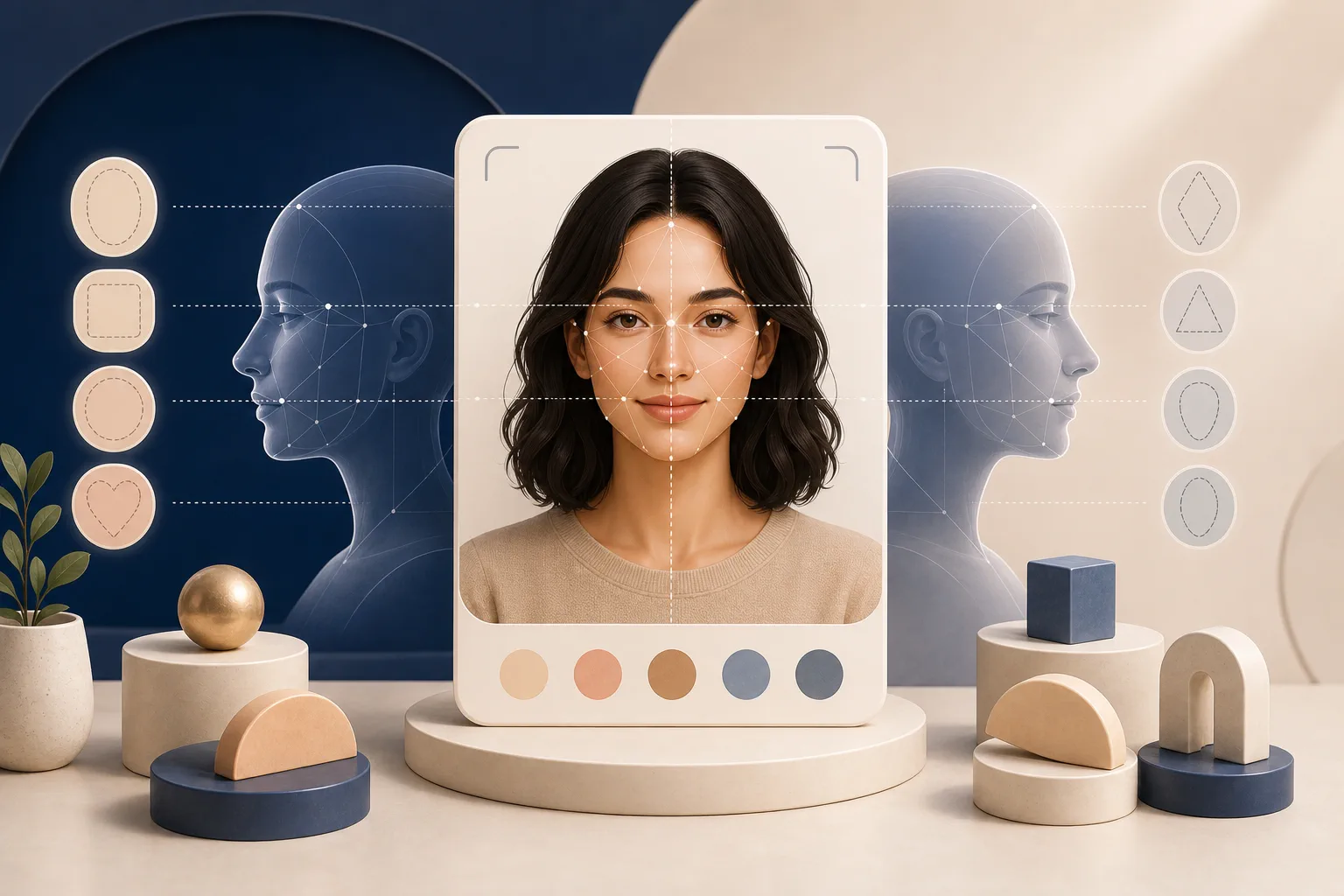
Asymmetry is the default, not a flaw
Almost everyone has paused at a mirror or photo and thought, 'Is one eye a little bigger?' or 'Why does only one corner of my mouth lift?' Here is the reassuring part right away: having slightly different left and right sides is completely natural. Human faces were never built to be perfectly symmetrical, and a face that is exactly mirrored can even look strangely artificial.
So instead of treating asymmetry as a defect to be fixed, it feels much lighter to accept it as a natural feature that gives your face its character. This article is not a medical diagnosis or an evaluation; it is purely a fun, impression-and-mood styling reference. The simple fact that your two sides differ a little takes nothing away from anyone's charm. In the end, asymmetry is less a 'mistake' and more a trace that lived time and expression habits naturally leave behind.
Why it keeps catching your eye
You may not notice it day to day, yet the moment you take a selfie or receive an ID photo, the asymmetry can suddenly stand out. That is because we are used to seeing our own faces 'only in a mirror.' When the left-right direction you see every day flips in a photo, the same face looks unfamiliar, and small differences you normally skipped over jump out at you. Because a mirror shows you reversed, we have actually grown more familiar with a 'flipped self' our whole lives.
A gentle self-check with a mirror and a photo
When you look at asymmetry, the mindset of 'observing' works better than 'scoring.' You are not trying to grade anything; lightly knowing how your two sides differ simply gives you styling hints.
The method is simple. Under bright frontal light, face a mirror straight on and slowly compare the heights of your brows, eyes, and mouth corners. Then take one photo in the same pose and compare it with the mirror view, and the differences become clearer. Sweeping your hair back to bare your forehead lets you take in the left-right flow of your brows and hairline at a glance too. Just remember this is an impression reference, not a precise measurement.
The right mindset for checking
A self-check is not a time to scold yourself; it is a time to get friendly with your own face. Finding a left-right difference does not make it a deduction from your charm. Treat it instead as a chance to learn your own preferences, like which side smiles more comfortably or which angle you enjoy most.
Using the photo mirror flip
If you flip a photo left to right in your phone gallery, it matches the direction you usually see in the mirror, and the 'you' you are used to appears. Undo the flip and you see the direction others see. Switching between the two, you can feel that much of the asymmetry comes from a 'difference in familiarity' rather than a real difference. Since both are equally you, there is no need to rank one side as better than the other.
The illusions created by habits and photos
Even the same face looks different left to right depending on the day's condition, sleeping posture, and expression habits. Chewing only on one side, always lying on the same side to sleep, or habitually raising just one brow can, over time, make your everyday expression subtly uneven on the two sides. Carrying a bag on only one shoulder or often resting your chin on one hand quietly adds to it as well.
Add the quirks of photography. Selfie apps often show a mirror-flipped preview yet save the original direction, so the direction when you shoot and when you view differs, and asymmetry can look exaggerated. Shooting up close also widens the center through lens distortion, which adds to the effect. That is why, on the same day with the same face, some photos look fine while others look unusually crooked.
Lighting and angle as variables
When light comes from one side only, shadows make the two sides look different, and even a slight turn of the head makes one side of the face look larger. So when you think 'my asymmetry looks worse today,' it is calmer to suspect the variables of lighting and angle before the face itself. Natural light from the front makes left-right differences look far gentler. Standing facing a window, or shooting under the soft light of an overcast day, reduces shadows so the impression settles more evenly.
Balancing naturally with styling
Rather than straining to 'erase' asymmetry, it is far easier to approach it as softly tidying the overall mood. Just using three tools well, hair, brows, and angle, settles the whole impression into something more comfortable. The table below gathers the essentials.
Above all, none of this is about 'getting the right answer'; it is a playful search for the look that feels comfortable to you. Try things in front of the mirror, and when you find a combination you like, that is enough.
Parting and face-framing
Where you set your parting changes how the eye travels across your face. If one cheek looks more prominent, shifting the parting slightly to the opposite side, or adding similar volume on both sides with a face-framing cut, makes the two sides look calmer. Matching the length of your fringe on both sides is a small but effective detail too. Simply spreading volume evenly across both sides instead of piling it on one makes the impression look more settled.
Working with brows and angle
Brows are the fastest way to tidy your left-right impression. Drawing both brows with similar start points and arch positions in makeup makes your expression look more balanced. When taking photos, a slightly turned three-quarter angle rather than dead-on adds dimension, and many people find it the more comfortable angle. Knowing your favorite 'good side' in advance makes selfies much more enjoyable. Placing the camera a touch above eye level and gently tucking your chin often captures the two sides more evenly.
Often it is just perception or lighting
If you feel several times a day that 'my asymmetry got worse,' your face has not actually changed in most cases; factors like the day's fatigue, puffiness, the direction of light, and screen quality have shaped your perception. Looking again in the afternoon as puffiness fades, or under different lighting, the impression has often shifted. After salty food or a short night's sleep, anyone can feel more uneven than usual the next morning.
So you do not need to place too much weight on a single photo or a single mirror moment. Remembering that asymmetry is more like a 'variable' that ebbs and flows with condition and environment lets you look at your face far more lightly, without being swayed by small differences. Since even your mood and posture seep into a photo, it is okay not to fret over any one shot.
| Concern | Light try | Likely effect | One-line tip |
|---|---|---|---|
| One cheek stands out | Shift parting to the other side | Spreads the gaze | Compare sides in mirror |
| Brow heights differ | Match start points in makeup | Tidies expression | Unify the arch first |
| Front-on feels stiff | Three-quarter angle | Adds dimension | Remember your good side |
| Jawline bothers you | Face-framing hair | Softens the outline | Match volume on both sides |
| Photos vary a lot | Shoot in frontal natural light | Reduces illusion | Check the flip too |
Symmetry is only one small part of impression
A person's impression is not decided by left-right symmetry alone. The warmth of an expression, the ease in someone's eyes, tone and atmosphere, even the day's mood, all blend together to create it. Symmetry is just one tiny piece of that, and not a decisive standard of charm.
And one thing must be clear. This observing and styling exists only to enjoy mood as a fun reference; it does not judge a person's personality or ability. A left-right difference in a face is not a measure of someone's worth or character, so please keep that in mind. Enjoying it with a light, warm heart is the very best way to use it.
Frequently asked questions
Can I check on my own with photos whether my asymmetry is pronounced?
Take one photo straight on in frontal natural light and compare it with your mirror view to lightly observe the difference. Keep in mind this is an impression reference, not a precise measurement, so it is best not to read too much into small differences. Puffiness and lighting can make the result look different anyway.
Can wearing a mask or glasses make asymmetry less visible?
Eyeglass frames can spread the gaze across both brows and eye lines, making left-right differences look calmer. Choosing a frame that softly hugs the face or temples of a moderate thickness gives a naturally balanced impression. This is styling that refines the mood, and it is not a medical correction.
Why do my selfies always come out tilted to one side?
Your head or shoulder often leans slightly toward the hand holding the camera, and because of the app's mirror-flipped preview, you may be a little off even when it feels straight. Line up your shoulders against a background with a visible horizon, and turn on the screen grid to align, and your shots come out much straighter.
Article info & references
Published June 13, 2026 · Last updated June 13, 2026
- It is common general knowledge that perfectly symmetrical faces are rare.
- Side lighting that enters from one side makes the two sides of a face look different.
- A selfie app's mirror-flipped preview is a common reason photos look unfamiliar.
- The three-quarter angle is a widely used composition that adds dimension in portraits.
- Hair parting and fringe placement are easy elements that affect facial impression.