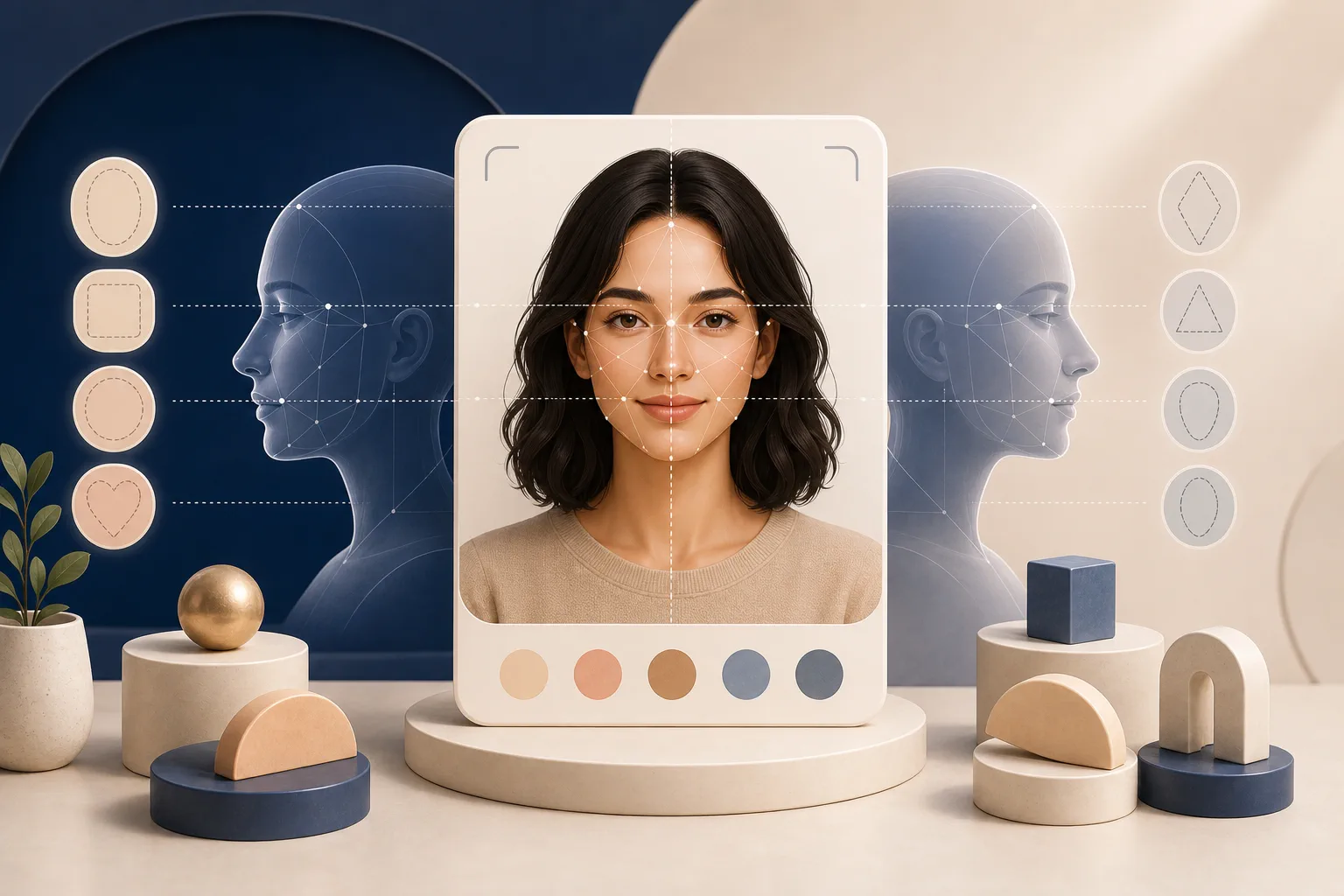
Search for facial symmetry or proportion and you will see them framed as the 'beauty metric.' What rarely gets explained is what a symmetry or ratio score actually tells you, and what it cannot. The short answer: a symmetry number and a golden-ratio number are just one of several lenses for reading a face, not an answer key.
This piece walks cause-to-effect through where the golden ratio (1:1.618) comes from, why that number swings so easily depending on your measurement points, and why left-right symmetry has a weaker effect on attractiveness than people assume. It also gathers the mirror-and-photo self-check, the illusions habits and lenses create, and practical styling with hair, brows, and angle into a single read.
It is a fun, tradition-and-style reference. It does not judge anyone's personality, worth, or character from a left-right difference or a ratio. The goal is to look at your own face lightly, without being pulled around by numbers.
What symmetry and ratio scores do and don't tell you
Start with what the score actually is. A symmetry number measures how much your left and right sides mathematically overlap; a golden-ratio number measures how close a particular pair of segments is to 1.618. Both come from placing landmarks on a single photo and measuring lengths, so the whole number shifts depending on where you set the reference points. Move the hairline up by a centimeter, or part your lips slightly instead of closing them, and the ratio wobbles.
So what a score 'tells you' is clear: in this photo, this expression, this angle, how balanced the left-right or segment lengths look, summarized from one frame. What it cannot tell you is far more. The warmth of an expression, the ease in someone's eyes, skin-tone uniformity, the day's condition, and the standard of attractiveness that shifts across cultures and eras do not convert into a number. In fact, first-impression research finds smile, gaze, and skin uniformity weigh far more on likability than symmetry does.
In short, a symmetry or ratio score is not a pass/fail exam grade; it is one of several lenses for viewing a face. With that premise in place, the golden-ratio story and the symmetry experiment below become much lighter to enjoy.
Why the same face gets a swinging score
Even for one person, there are three measurement variables. (1) Landmarks — where you mark the hairline, nose tip, and chin. (2) Expression — a single smile changes mouth-corner height and segment lengths. (3) Capture — lens distance and angle distort the ratio. When all three stack, the same face splits into 'balanced today / crooked today.' That is why a score should be read as 'one value under these conditions,' not an absolute.
The golden ratio 1:1.618 — where it comes from and where it breaks
The golden ratio is the proportion 1:1.618 (Phi, Φ). The column spacing of the Parthenon, da Vinci's 'Vitruvian Man,' even the spiral of sunflower seeds are said to approximate it, and because consecutive numbers in the Fibonacci sequence (1, 1, 2, 3, 5, 8, 13, 21…) converge toward 1.618, it has been nicknamed 'God's ratio.' Showing up so often in nature added to its mystique.
Applied to faces, three points are usually checked. First, the 'vertical thirds' — hairline-to-brow, brow-to-nose-tip, nose-tip-to-chin are similar when a face reads balanced, and the closer nose-tip-to-lip : lip-to-chin is to 1:1.618, the more ideal it is said to be. Second, the 'rule of fifths' — the horizontal eye width equals the distance between the eyes, and a brow-spacing to nose-length ratio near 1:1.618 reads harmonious. Third, nose width : mouth width around 1:1.618 is considered balanced.
But this is where it breaks down. Academia has never confirmed 'beauty = 1.618.' Because of the landmark problem above, the number shifts easily, and one expression changes the ratio. Beyond that, attractiveness holds far more that no ratio captures — a youthful impression, clear eyes, healthy skin tone, a natural smile. So the golden ratio belongs as one lens for viewing a face, not an answer key.
The photo rewrites your ratio
The interesting part is that 'your ratio' is not one inherited number. Shooting up close creates a wide-angle (proximity) distortion that enlarges the nose and forehead, while pulling back from a little farther makes the features look flatter and more balanced. Angle is a big variable too — shooting slightly from above shrinks the chin and enlarges the eyes. The same face takes a different ratio every time depending on lens, distance, and angle. So rather than chaining yourself to a number, finding 'your own good angle' is far more practical.
Why perfect symmetry actually looks off — the composite experiment
It is true that left-right symmetry is a universally recognized factor of attractiveness. Evolutionary psychology explains it as a 'signal of healthy genes': a symmetrical face is indirect evidence of fewer genetic defects or environmental stressors during development, so it reads unconsciously as a good signal. Even newborns gaze longer at symmetrical faces, suggesting the preference is nearly instinctive. Yet even in biology this effect is reported as a weak tendency, not a strong rule — it only stands out when asymmetry is extreme.
So would a 100% perfectly symmetrical face be the most beautiful? A famous composite experiment answers. Split a photo down the middle and mirror the left half onto itself (left+left), then the right half onto itself (right+right) — both composites look more awkward and unnatural than the original. The cloned half widens the face and a sense of 'this isn't really me' creeps in.
The reason is that our brains are drawn to 'natural balance,' not mathematical perfection. Human faces differ subtly left to right, and those tiny differences are what create naturalness and comfort. A 100% symmetrical face triggers an 'uncanny valley,' looking mannequin-like as if computer-generated. So the good 'symmetry' here means overall balance, not mathematical perfection.
The mirror-and-photo self-check and the truth about illusions
When you look at asymmetry, the mindset of 'observing' beats 'scoring.' The method is simple. Under bright frontal light, face a mirror straight on and slowly compare the heights of your brows, eyes, and mouth corners; then take one photo in the same pose and compare it with the mirror view. Sweeping your hair back to bare your forehead lets you take in the left-right flow of brows and hairline at a glance. Just remember this is an impression reference, not a precise measurement.
Here is the key illusion. A mirror shows a flipped image, so we have grown used to a 'reversed self' our whole lives. A photo (especially the rear camera) shows the left-right that others see, so a selfie often feels off not because of asymmetry but because of a 'difference in familiarity.' Flip a photo in your gallery and the familiar mirror-you appears; undo the flip and the you others see appears. Switching between the two, you feel that much asymmetry is a familiarity difference, not a real one.
Habits and environment shift the left-right impression too. Chewing only on one side, always sleeping on the same side, raising just one brow, carrying a bag on one shoulder, or often resting your chin on one hand can, over time, make your everyday expression subtly uneven. Selfie apps often show a mirror-flipped preview but save the original direction, so shoot-and-view directions diverge and asymmetry looks exaggerated. Light from one side casts shadows that make the sides look different, and even a slight head turn enlarges one side. When you think 'my asymmetry looks worse today,' it is calmer to suspect lighting, angle, puffiness, and screen quality before the face.
Why your selfies keep coming out tilted
Your head or shoulder often leans slightly toward the hand holding the camera, and because of the app's mirror-flipped preview, you may be a little off even when it feels straight. Line up your shoulders against a background with a visible horizon and turn on the screen grid to align, and your shots come out much straighter. Shooting in frontal natural light, or under the soft light of an overcast day, reduces shadows so the two sides are captured more evenly.
Refining balance with styling
Rather than straining to 'erase' asymmetry, treat it as softly tidying the mood. Just three tools — hair, brows, and angle — settle the whole impression. The essentials are gathered in the table below.
A parting changes where the eye travels. If one cheek looks more prominent, shift the parting slightly to the opposite side, or add similar volume on both sides with a face-framing cut, and the two sides look calmer. Matching fringe length on both sides and spreading volume evenly instead of piling it on one side settles the impression. Interestingly, a dead-center part can read flat while an off-center part adds character, and a single statement earring pulls the eye so asymmetry becomes a natural rhythm.
Brows tidy the left-right impression fastest. Drawing both brows with similar start points and arch positions in makeup makes the expression look balanced. For photos, a slightly turned three-quarter (3/4) angle adds dimension and is the angle many people find more comfortable than dead-on. Knowing your 'better side' in advance makes selfies easier. Placing the camera a touch above eye level and gently tucking your chin often captures the two sides more evenly.
| Concern | Cause | Light try | Likely effect |
|---|---|---|---|
| One cheek stands out | Uneven volume | Shift parting to the other side / statement earring | Spreads the gaze |
| Brow heights differ | Expression habit, muscle difference | Unify start point and arch in makeup | Tidies expression |
| Front-on feels stiff | Familiarity gap, flat read | Three-quarter (3/4) angle, use your good side | Adds dimension |
| Jawline bothers you | Outline asymmetry | Match volume on both sides with face-framing hair | Softens the outline |
| Photos vary a lot | Lens, angle, flip variables | Shoot in frontal natural light + check the flip | Reduces illusion |
| Nose or chin looks big | Close wide-angle distortion | Pull back and shoot from farther | Flattens the ratio |
What works on impression more than symmetry
A person's impression is not decided by left-right symmetry alone. What first-impression research repeatedly highlights is not any single proportion but a 'combination': averageness (faces closer to a group's average feel familiar and rate slightly more attractive), expression (one smile raises attractiveness ratings more strongly than symmetry), gaze (a face looking straight into the camera rates higher), skin uniformity (not perfect skin but even tone works as an attractiveness signal, heavily driven by makeup and lighting), and cultural context (what counts as attractive varies by culture and era, with no universal yardstick).
That is why a beaming asymmetric face is almost always rated more attractive than a blank symmetrical one. Asymmetry itself can be a source of character and charm — one lifted mouth corner, slightly different eye sizes, a nose that tilts a touch all create someone's particular aura. Rather than reducing symmetry to a number, focusing on larger, more controllable factors like expression, gaze, and lighting is far more rewarding.
Frequently asked questions
Is a face closer to the golden ratio prettier?
Academia has never confirmed 'beauty = 1.618.' The golden ratio changes easily depending on where you set the measurement points (hairline, nose tip, chin), and one expression alters the ratio. Attractiveness holds far more that no ratio captures — a youthful impression, the eyes, skin tone, a smile — so the golden ratio belongs as one lens for viewing a face, not an answer key.
Is a perfectly symmetrical face the most beautiful?
No. A 100% symmetrical face made by splitting a photo and mirroring one half usually strikes people as more awkward and mannequin-like than the original. Our brains are drawn to 'natural balance,' not mathematical perfection, and subtle left-right differences are what create naturalness and comfort. There is an evolutionary preference for symmetry, but it is a weak tendency and only stands out at extreme asymmetry.
Can I check on my own with photos whether my asymmetry is pronounced?
Take one photo straight on in frontal natural light and compare it with your mirror view to lightly observe the difference. Toggling the flip on and off in your gallery also lets you feel the familiarity gap. But this is an impression reference, not a precise measurement. Puffiness, lighting, angle, and screen quality make the result look different, so it is best not to read too much into small differences.
Why do my selfies always come out tilted to one side?
Your head or shoulder often leans slightly toward the hand holding the camera, and because of the app's mirror-flipped preview, you may be a little off even when it feels straight. Line up your shoulders against a background with a visible horizon and turn on the screen grid to align, and shots come out straighter. Shooting up close also enlarges the nose and forehead through wide-angle distortion, so pulling back and shooting from farther helps too.