The cultural fingerprint left in emoticons
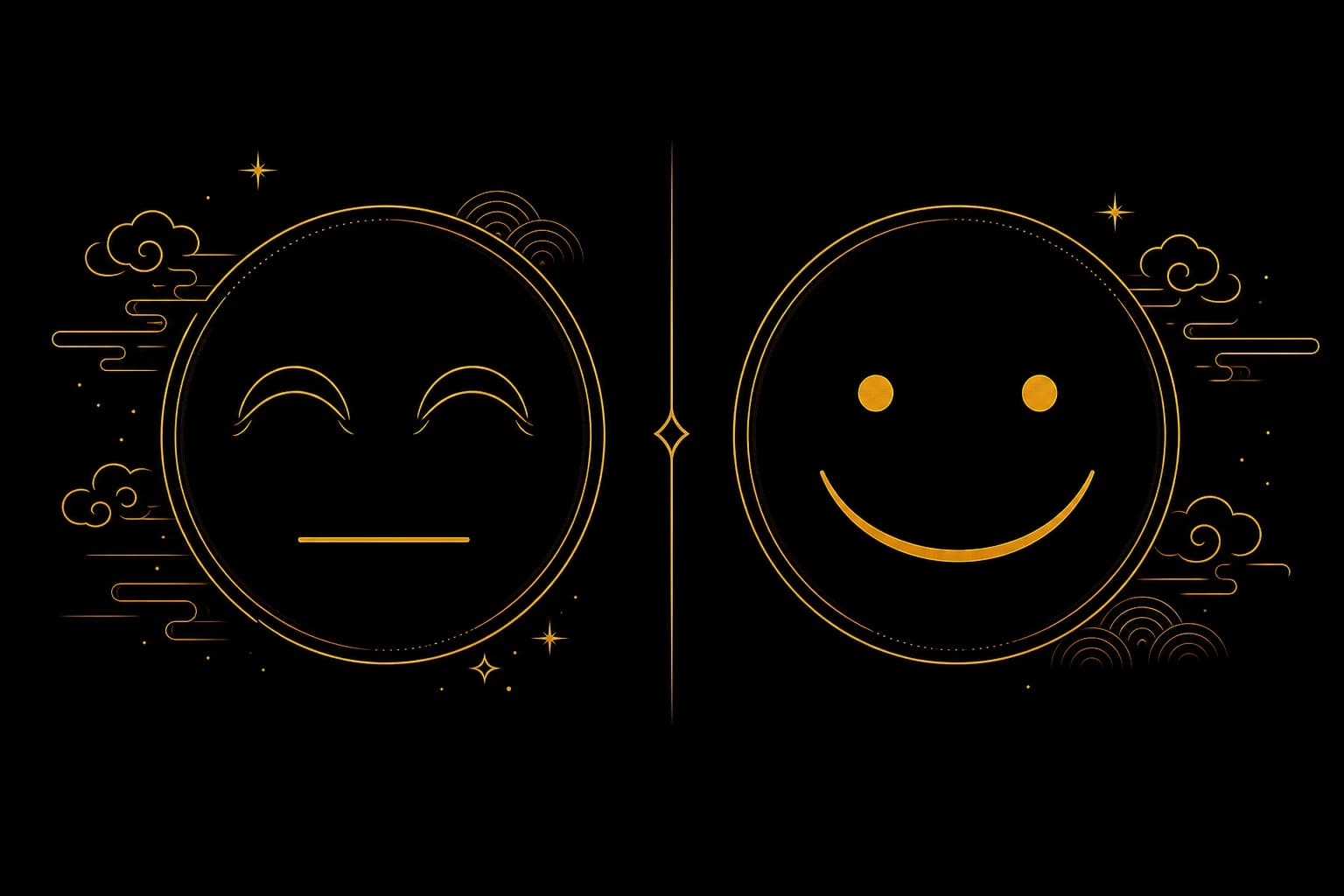
When you send a smiling face in chat, which one do you type? People who grew up in Korea or Japan often reach first for ^^ or ^_^ — T_T when sad, O_O when surprised. People who grew up in English-speaking countries more often use the sideways :) or :D, and :( for sad. What is fun is that the two families change opposite parts of the face to show emotion.
Eastern-style emoticons change the eyes (^, T, O) and mostly leave the mouth as is. Western-style emoticons lie sideways at 90 degrees and change the mouth ( ), (, D ) while the eyes ( : ) stay fixed. To make the same 'smiling face,' one crinkles the eyes and the other opens the mouth.
That small habit turns out to touch a cultural tendency — which part of the face you look at most when reading emotion from an expression. That is the study we are here to talk about.
'Are the windows to the soul the same?' — a 2007 experiment
Masaki Yuki of Hokkaido University, with colleagues Maddux and Masuda, published a paper with a memorable title in the Journal of Experimental Social Psychology in 2007: 'Are the windows to the soul the same in the East and West?' The researchers showed Japanese and American participants faces (and emoticons) that combined the emotional expression of the eyes and the mouth separately, and asked how happy or sad each face looked.
The result: Japanese participants more often judged a face 'happy' when the eyes were smiling, whatever the mouth did, while American participants more often judged it 'happy' when the mouth was smiling. In short, when reading emotion, the Japanese side leaned on the eyes and the American side on the mouth. The difference was especially clear in the emoticon condition. The gap between the ^^ and :) we type without thinking was, in effect, reproduced in the lab.
| Emotion | Eastern (eyes change) | Western (mouth changes) | Core difference |
|---|---|---|---|
| Happy | ^_^ / ^^ | :) / :D | Crinkle the eyes vs open the mouth |
| Sad | T_T | :( | Tears (eyes) vs a downturned mouth |
| Surprise | O_O / o_o | :O | Round eyes vs an open mouth |
| Wink / playful | ^_~ | ;) | One eye vs one eye plus mouth |
Why the eyes for one, the mouth for the other?
One explanation the researchers offer is a difference in norms of emotional display. In cultures that restrain rather than broadcast feelings, reading someone's true mood means watching the parts that are hard to control. The mouth is easy to fake into a smile, but the area around the eyes is comparatively hard to hide. So where suppressing emotion is the stronger norm, attention naturally shifts to the eyes.
Conversely, in cultures where showing emotion openly is natural, the largest and most visible signal — the movement of the mouth — becomes the main cue for reading feeling. Of course, this is a 'tendency,' not a law that erases individual differences. It varies person to person within a culture, and in an age when emoji and content cross borders freely, the boundary keeps blurring.
It connects to eye-contact research too
This eye-focused tendency loosely connects to other work on gaze. Several cross-cultural comparisons have reported that East Asian participants tend to feel strong eye contact as more uncomfortable or intense. If you read emotion in the eyes and also feel the pressure of a gaze strongly there, it says how sensitive that 'eye' channel is.
Still, such comparisons speak only to average tendencies; reading them as 'everyone from that culture is like this' goes wrong. Culture is one of many backgrounds that help explain a person, not a label that defines the individual.
Are expressions really universal?
It was once widely accepted that the basic emotional expressions are universal to humankind. But recent research puts a careful question mark on that. In a 2012 study in PNAS, Rachael Jack and colleagues found that East Asian and Western participants differ, subtly, in how they mentally represent emotion in the face itself — suggesting the grammar of sending and reading expressions may not be exactly identical across cultures.
This topic is still debated in the field. 'Much is shared, but the details differ by culture' is close to the balanced summary right now. The one thing to remember is this: even the way we read expressions is shaped by learned, inherited habits — which makes it hard to be sure that 'the expression I read' equals 'what the other person truly feels.'
So misunderstandings arise — and so does fun
Knowing this difference dissolves small misunderstandings. To someone who reads a smile in the eyes, a Western :) can look like a flat, mouth-only grin; to someone who reads a smile in the mouth, ^^ can feel faint in emotion. Neither is right or wrong — the focus simply sits on a different part. That masks and sunglasses change impressions so much may also be because they cover the channel a given culture watches most closely.
From emoji design to character expressions to the staging of emotion in animation, where on the face we route a feeling still differs a little by culture. Noticing that difference is the pleasure of reading the world a bit more carefully.
Eyes or mouth, it is not a ruler for people
A final note for balance. 'Reading with the eyes' versus 'reading with the mouth' is a tendency in the habit of noticing emotion — it does not mean anyone's culture is more emotional or more honest. And the feeling you read in an expression is not always the same as the other person's true heart. An expression is a signal shaped together by situation, culture, and the day's condition.
Please see FaceOracle's mood report the same way. Putting one photo's atmosphere into words is a modern version of the old fun of 'reading a story in a face,' not a verdict on who someone is. Whether you look to the eyes or the mouth, not pinning a person down at the end of it — that is how to enjoy this game in a healthy way.
Frequently asked questions
Is it really true that the East reads eyes and the West reads the mouth?
It is an average tendency observed in experiments. In Yuki and colleagues' 2007 study, Japanese participants weighted the eyes and American participants the mouth when judging emotion. But individual differences are large and the boundary is blurring as cultures mix, so it should not be read as a rule that 'everyone is like this.'
Do emoticons really show this difference?
Quite well. Eastern-style ^_^ and T_T change the eyes to show feeling, while Western-style :) and :( change the mouth. The study found the eye-versus-mouth focus especially clear in the emoticon condition.
I was taught expressions are universal — are they not?
'Much is shared, but the details may differ by culture' is the balanced understanding right now. Findings like Jack et al. (2012) report cross-cultural differences, so it is hard to declare them 'completely identical.' It is still an actively researched topic.
Can this difference tell me someone's disposition?
No. Where you look to read emotion is a tendency of cultural habit; it does not tell you that a person is more emotional or more honest. Culture is one of several backgrounds that help explain a person, not a yardstick that defines them.
Article info & references
Published July 9, 2026 · Last updated July 9, 2026
- Yuki, M., Maddux, W. W., & Masuda, T. (2007). Are the windows to the soul the same in the East and West? Journal of Experimental Social Psychology, 43(2).
- Jack, R. E., Garrod, O. G. B., Yu, H., Caldara, R., & Schyns, P. G. (2012). Facial expressions of emotion are not culturally universal. PNAS, 109(19).
- Masuda, T., et al. (2008). Cross-cultural work on context and judgments of facial emotion (East Asian sensitivity to context).
- General references on East and West emoticon / kaomoji (顔文字) conventions