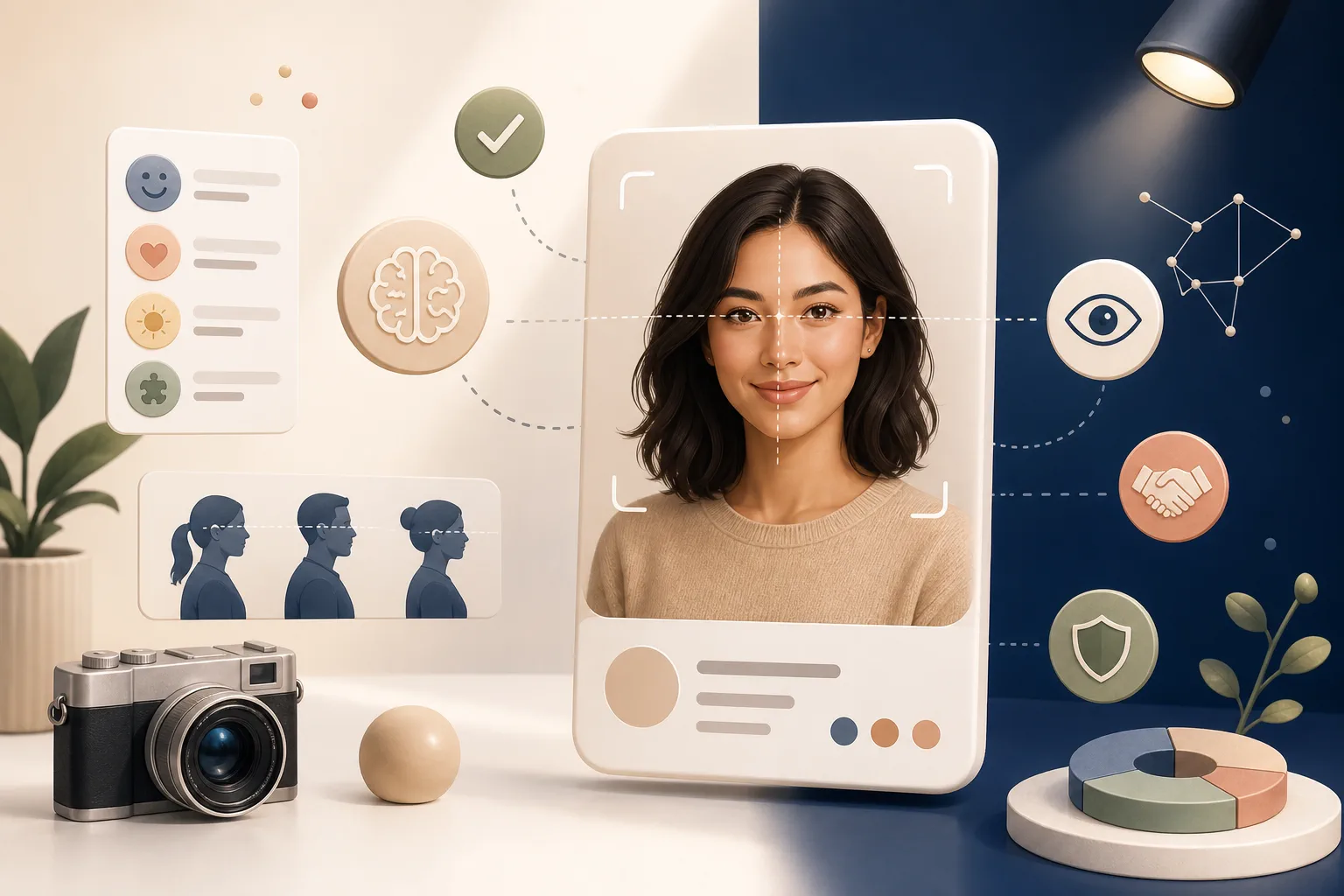
What Makes a Profile Photo Feel Approachable
When a blind date gets set up or you're filling out a dating-app profile, the first worry is usually the same: "Which photo should I make my main shot?" The good news is that an approachable photo has no grand secret behind it. It really comes down to two things. First, it looks relaxed. Second, it actually looks like you. Keep those two in mind and a photo instantly reads as easier to approach.
When we first see someone's profile photo, our mind very quickly sketches an impression: "What's this person like?" Soft light, a gentle micro-smile, and a clearly visible face all create a sense of "I could comfortably say hello." The opposite happens when the face is hidden, when heavy editing makes it hard to tell who you are, or when the expression looks frozen — the impression simply gets blurry.
One thing to say up front: the impression you get from a photo is only an impression, never a measure of someone's character or abilities. Even the phrase "approachable photo" isn't a ranking of who's better; it's closer to a way of showing yourself comfortably. Please read this not as an answer key but as a light styling suggestion for choosing the shot that feels most like you.
Five Cues for Choosing Your Main Photo
Your main photo is the face of your profile. It's the one people look at longest, the shot that makes them pause and think, "Maybe I'll look again." This one is worth a little extra care. The five cues below are light, expression, framing, background, and whether it's a solo shot. It isn't about fancy gear or editing — just keeping these five lightly in mind makes your main photo's impression far clearer. Run through them one by one as you pick it.
Light and Expression
The easiest, highest-impact choice is natural light. By a window on an overcast day, or outdoors in soft shade in the morning or late afternoon, the light falls gently across your face and the impression feels far more relaxed. Harsh midday sun from straight overhead tends to cast shadows under the eyes, so it's best avoided. For expression, a smile that lifts the corners of your mouth only about seventy percent and reaches faintly to the eyes feels more approachable than a wide grin. Recalling a happy moment right before the shutter softens those smiling eyes.
Framing and Background
Keeping the camera at eye level is the safe bet. Shooting from too high looking down can make you seem shrunken, while shooting from too low looking up can feel overbearing. At eye level, head-on or at a slight angle, the photo stays close to your real proportions. The simpler the background, the better — a tidy cafe, a clean wall, or a natural landscape keeps attention on your face. And for the main shot, choose a solo photo where anyone can immediately tell, "Oh, that's them."
Show a Small Set, Not Just One Shot
A profile rarely stops at a single main photo. You usually show three or four together, and here a varied set works far better than several near-identical frames. Four shots from the same cafe with only the expression changing tell less than four that mix face, full body, and everyday life — the latter lets someone naturally picture who you might be.
The basic set I'd suggest splits into three strands. First, a close-up where your face shows clearly — a shot of your most natural expression, ideal for the main. Second, a full-body or upper-body photo. It conveys your overall vibe, style, and a sense of proportion without any fuss. Third, a hobby or everyday shot. A picture of you doing something you love — hiking, cooking, reading at a cafe — creates a thread for conversation. It gives the other person something to ask, like "Where was this?"
When picking the set, it helps to mix photos that look like they're from different times and places. Slightly varied clothes, backgrounds, and expressions let your different sides come through. Just leave out anything too old. If you look very different in person, it's awkward for everyone, so filling the set with recent shots of yourself is ultimately the kindest choice for all.
One more thing — the order you show them in makes a small difference too. Put the shot you're most confident in first, then alternate the full-body and hobby frames so the flow feels natural. Several photos in the same tone back to back can feel monotonous, so mixing indoor and outdoor, close-up and full shot, helps. Once you've picked them all, shrink them down and skim the set at a glance. If your face stays clear and the mood feels consistent even from a distance, it's a well-tied set.
| Element | Approachable choice | Better to skip | One-line note |
|---|---|---|---|
| Light | Window on a cloudy day, soft outdoor shade | Harsh midday sun, dark indoors | Soften under-eye shadows |
| Expression | A 70% smile that reaches the eyes | A frozen, mouth-only grin | Recall a happy moment |
| Framing | Eye level, head-on or slight angle | Extreme low or high angles | Stay close to real proportions |
| Main shot | A clear solo where it's clearly you | Group photos, eyes behind sunglasses | Unmistakably you |
| The set | Face, full body, and hobby mixed | Several near-identical frames | Fill it with recent you |
Better to Skip These
Choosing good photos matters, and so does removing the ones that blur your impression. The common slip-ups mostly cluster around one thing: making the face hard to see.
Hiding or Muddling the Face
Using a group photo as your main is the most common letdown. Making people hunt for "which one is them?" scatters the impression. Keep group shots as extras and always pick a solo for the main. Photos where sunglasses or a big hat hide the eyes are also best avoided as the main. People read an impression by looking at the eyes, so when the eyes are covered, a sense of distance creeps in. Heavy filters or editing do the same — smoothing away all skin texture or reshaping features makes you look so different from real life that a first meeting can feel awkward for both of you. It's better to keep editing light, just nudging brightness and color a touch.
Angle and Quality
Extreme low or high angles distort proportions and drift away from reality. Shooting from way down emphasizes the chin, while shooting from way up makes you look smaller. A close selfie can make the nose or forehead look slightly larger because of how the lens renders distance, so if you can, set the camera a bit farther away or step back to stay closer to your real proportions. Blurry, dark, or low-resolution photos also muddy the impression, so choose bright, clear frames.
Honest and Kind — Presenting Yourself Well
Taking a good profile photo isn't about deceiving anyone; it's about presenting yourself well. You're simply capturing yourself on a good day, with a relaxed expression. The smaller the gap between a great photo and real life, the more comfortable the first meeting feels. So choosing "a photo that looks like you today" is, in the end, the best strategy.
Some days the photos just don't come out, and some people freeze up in front of a camera. That's okay. One photo can't hold all of your charm, and an awkward frame doesn't diminish you. Take several, remember the expression you like, and the next round gets easier. Small bits of practice add up, and naturalness grows with them.
And one more thing — always look after your privacy. Whether for a profile or a mood report, the photos you upload should be your own. Using someone else's photo without consent isn't okay, and it's safer to double-check shots that reveal your exact location. Presenting yourself kindly, and safely, is what completes a good profile photo.
In Closing: An Impression Isn't a Verdict
The light, the smile, eye-level framing, a simple background, and the small face–body–hobby set we've walked through can all shift a photo's mood with just a little awareness. Rather than doing everything at once, learn one at a time — light today, framing next — and before long the camera will feel far more comfortable.
Finally, please remember once more: the impression a photo gives is just a frame shaped by that moment's light and angle, not a judgment of anyone's character or abilities. FaceOracle's mood report and styling articles like this one don't hand down answers either; they're a light invitation to play with your photos more joyfully. Use them for fun, with no pressure, and comfortably pick the one shot that feels most like you.
Frequently asked questions
For a dating-app profile photo, is a selfie or a regular camera shot better?
Both can work, but for your main shot it looks more natural to add a little distance. Selfies are taken so close that your facial proportions can look different from real life, so for the main photo it helps to have a friend take it or use a self-timer from a step back. Mix in a selfie or two as supporting shots to add some mood.
How much photo editing is okay?
Lightly tweaking brightness or color is plenty, but it's best to skip heavy edits that reshape your face or features. If the editing is too strong, the photo can look very different from you in person and feel awkward when you actually meet. The closer the photo is to the real you, the more relaxed that first meeting will be.
I'm nervous about showing my face too much — how do I protect my privacy?
Take a quick look to make sure the background doesn't reveal your location, like your home, a workplace sign, or a license plate. Your main shot is best as a clear solo photo where your face is visible, but other shots can lean on a side profile or a hobby scene to set the mood. And note that FaceOracle's mood report is just a for-fun reference — it doesn't verify identity or evaluate people, so enjoy it lightly.
Article info & references
Published June 13, 2026 · Last updated June 13, 2026
- General social-psychology ideas about first impressions, such as the primacy effect and the halo effect
- Common photography knowledge about the direction and size of light sources and the shadows they create
- General photo-composition principles such as the rule of thirds
- General photography knowledge about lens perspective distortion in close-range shots
- General privacy guidelines for uploading photos online