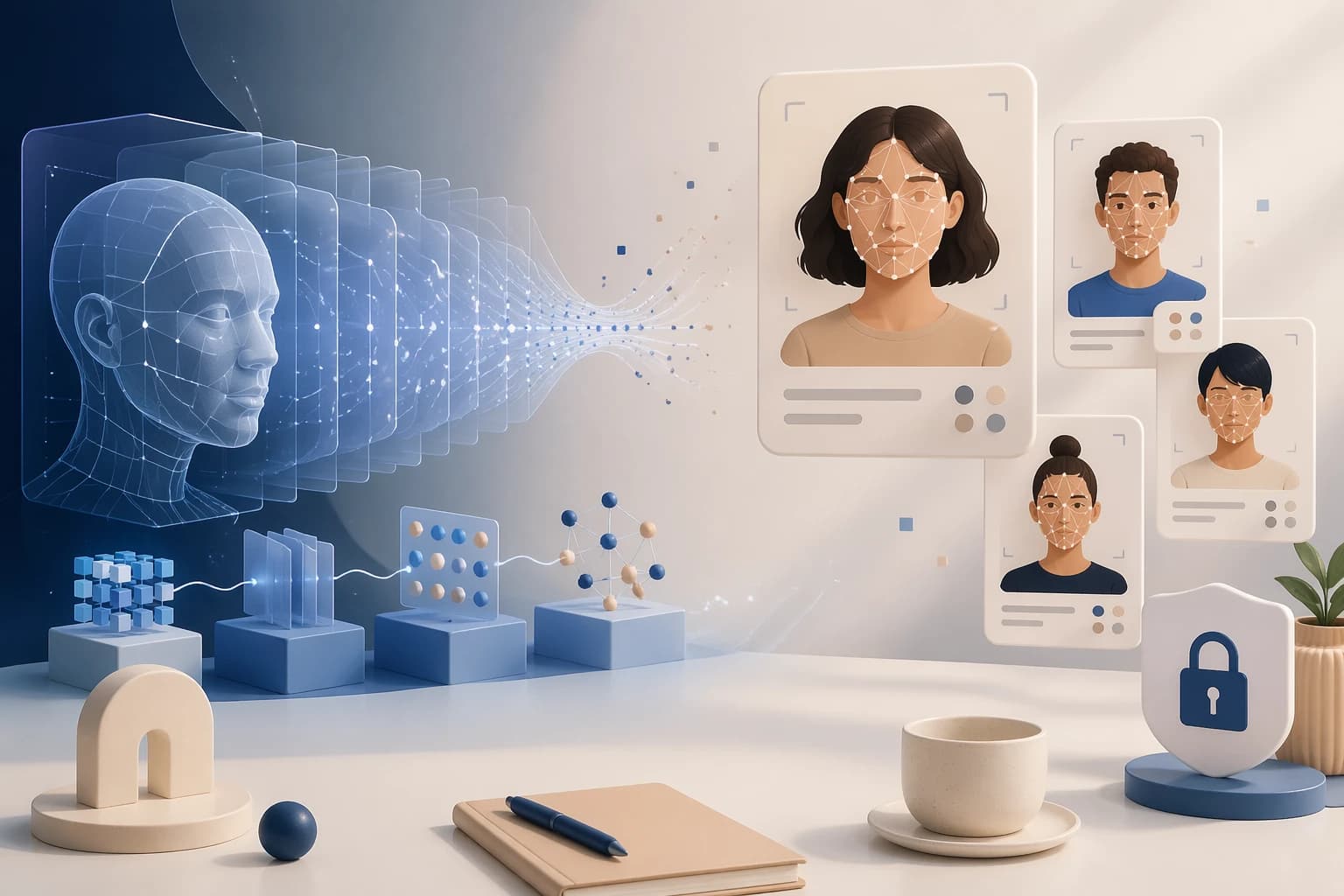
AI face analysis technology has evolved at a remarkable pace over the past decade. This article is a general overview of the underlying research. It is not a judgment about any individual's gender, identity, or health. (This service, FaceOracle, does not build face-recognition templates or perform identity verification.)
Core Technologies Behind Deep Learning Face Analysis
Face Detection
Every face analysis begins with finding faces in an image. While early approaches used traditional methods like Haar Cascades, today's mainstream relies on deep learning models such as MTCNN (Multi-task Cascaded Convolutional Networks) and RetinaFace. RetinaFace excels at detecting small or partially occluded faces, making it widely adopted in production systems.
Facial Landmarks
Once a face is detected, the system extracts detailed feature points. While 68 landmark points are standard, cutting-edge technologies like Google's MediaPipe can extract 468 3D mesh points in real time. These points map the precise positions of eyes, nose, mouth, and jawline, forming the foundation for subsequent analysis.
Face Embedding Technology
The heart of face analysis is embedding technology. CNN-based models like VGGFace, FaceNet, and the latest ArcFace convert facial images into 128 to 512-dimensional vectors — essentially a unique "facial fingerprint." ArcFace introduced Angular Margin loss, dramatically improving the ability to distinguish between different faces.
Vision Transformer — The Latest Trend
Since the 2020s, Vision Transformers (ViT) have been applied to face analysis. While traditional CNNs excel at local features, ViT is superior at understanding the overall context of a face. It recognizes the same person more accurately even when expressions change or lighting varies.
Diverse Applications of AI Face Analysis
Face analysis technology is used across many fields: security (access authentication), entertainment (AR filters, similar-vibe celebrity references — a mood reference, not face recognition), healthcare (genetic disorder screening), and marketing (customer reaction analysis). Entertainment services like FaceOracle that combine face-reading concepts with AI are one example, and this article is a general technical overview, not identity verification.
Ethical Considerations
As AI face analysis grows more powerful, privacy protection and bias issues become increasingly important. Research highlights representation gaps across races and genders, and facial data collected without consent remains a recurring concern. This article is a research-side overview and does not infer any individual's sensitive attributes.