Summer is the season of changing faces
Last time we toured the color language painted onto faces by stage professionals — Peking opera's lianpu and kabuki's kumadori. This time, let's step down from the stage. Every summer, at festivals around the world, ordinary people put on masks, paint their faces, and walk the streets as someone else for a while.
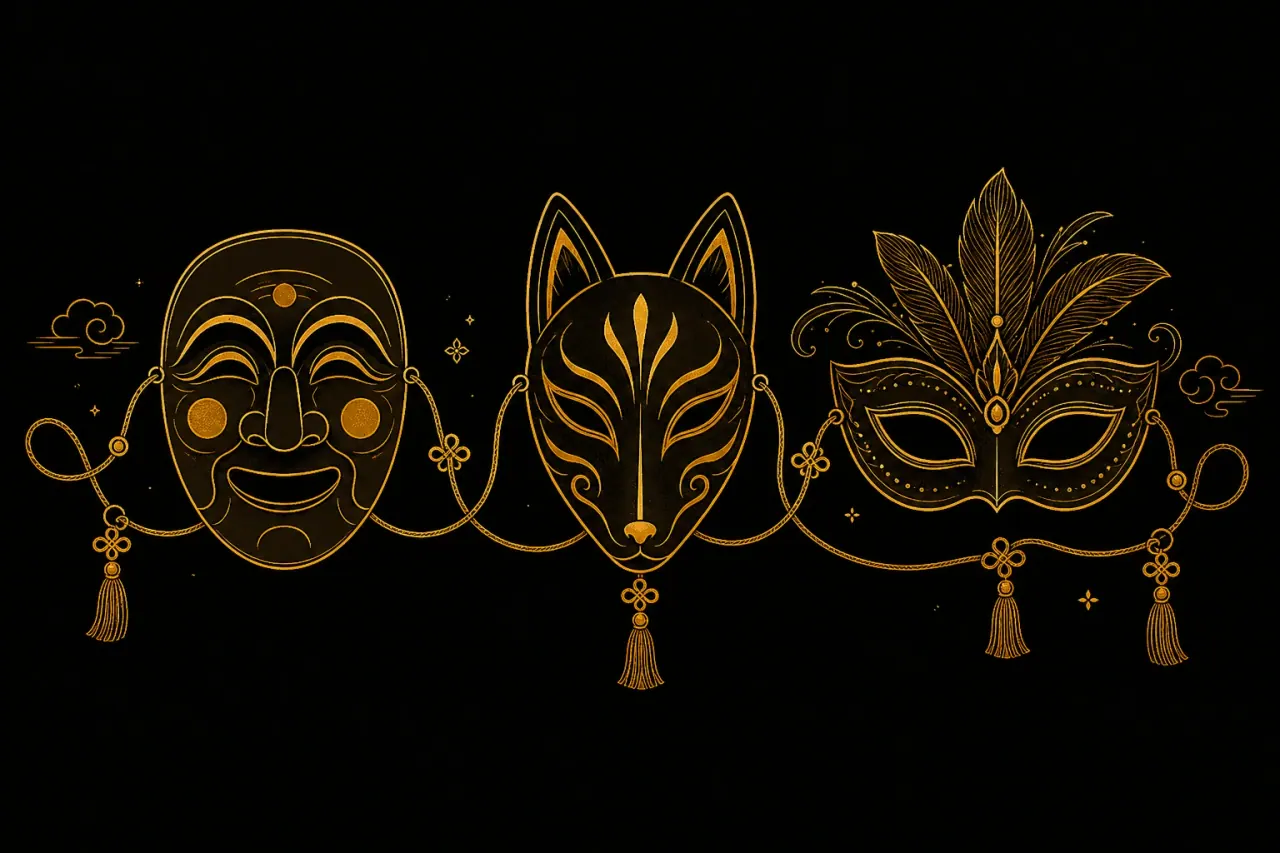
In early summer, Gangneung hosts a mask drama performed entirely without words. On Japanese festival nights, children dash between stalls with fox masks tilted on their heads. And in August, London fills with a parade of feathers, sequins, and painted faces. Three scenes with seemingly nothing in common share one thing: in the heat of summer, changing your face becomes the festival itself.
This article is a cultural stroll through those three scenes. One promise before we set off: this is not a claim that the look of a mask tells you anything about its wearer's character or luck. It is a look at why people everywhere love to put on a different face for a day.
Dano in Gangneung — a mask play that jokes without words
Around Dano — the fifth day of the fifth lunar month, at the doorstep of summer — the city of Gangneung holds the Gangneung Danoje festival. This old celebration of mountain-spirit rites, shaman rituals, swings, and wrestling was proclaimed a UNESCO Masterpiece of the Oral and Intangible Heritage of Humanity in 2005. At its heart is the Gwanno mask drama, said to have been performed by government servants (gwanno) — a rare Korean mask play with no spoken lines at all.
With no dialogue, the whole story flows through gesture and mask. A posturing aristocrat (yangban gwangdae), his young sweetheart (somae gaksi), the mischief-making Sisittakttagi, and the round-bellied Jangjamari tumble through a comedy of love, jealousy, and reconciliation. The sharp aftertaste is that servants shaped their masters' faces into masks and turned their pomp into laughter. The mask is what allowed those at the bottom to tease those at the top, safely, on stage.
This 'put on a mask and flip the order' grammar runs through Korean talchum as a whole. Talchum — the family of mask dance dramas including Hahoe byeolsingut talnori and Bongsan talchum — was inscribed on UNESCO's Representative List of Intangible Cultural Heritage in 2022. It needs no formal stage: any empty yard becomes a theater, and the audience's cheers become part of the play. A long history of changed faces serving as a community's breathing hole.
Japanese summer matsuri — omen worn tilted on the head
In July and August, Japan's shrines and alleys fill with summer festivals. Among the yukata crowds and goldfish-scooping stalls, one shop never misses: the omen (mask) stall. The classics on its crowded wall are fixed — the kitsune (fox), long regarded as the messenger of the deity Inari; Hyottoko, the comic face with puckered lips; and Okame, smiling with full round cheeks. Okame's smile is said to invite good fortune, while Hyottoko's clowning keeps the party's spirits up.
The charming part is how they are worn. Festival omen usually sit tilted on the side or back of the head rather than over the face. The point is not disguise — it is a badge that says 'I am in festival mode.' Some festivals go all in: at the Hyuga Hyottoko Summer Festival in Miyazaki, thousands dance comically in the same mask to pray for good fortune. The old belief that laughter pleases the gods and draws luck lives on, even in a lightweight plastic mask.
August in London — the mas of Notting Hill Carnival
On the last weekend of August, over the bank holiday, London's Notting Hill becomes one of Europe's great street festivals. It began less as a party than as a story of survival. In 1959, the Trinidadian activist Claudia Jones organized an indoor Caribbean carnival for a community wounded by racial violence, and in 1966 a street festival for local children — joined by a steel band that led the crowd Trinidad-style — planted the seed of today's carnival.
First among Notting Hill's five carnival disciplines is mas — masquerade. Feathered headdresses, sequined costumes, and glittering face paint transform the whole body, and the wearer becomes the parade. The roots reach back to Trinidad's carnival: people excluded from the colonial planters' masked balls took to the streets after emancipation with their own masquerade, and that memory of liberation crossed the ocean to color London's summer. Here, masks and paint are not tools for hiding — they are megaphones for saying 'I am here.'
| Festival | When | Masks and makeup | What the mask does |
|---|---|---|---|
| Gwanno mask drama, Gangneung Danoje (Korea) | Around Dano (5th lunar month, early summer) | Yangban gwangdae, Somae gaksi, Sisittakttagi, Jangjamari masks | A wordless comedy of love and reconciliation; class satire |
| Summer matsuri (Japan) | July–August nights | Stall-bought omen — fox, Hyottoko, Okame | A badge of festival mode; laughter and luck-wishing |
| Notting Hill Carnival (UK) | Last weekend of August (bank holiday) | Mas costumes, feathers, face paint | Becoming the parade; a community's pride made visible |
Behind a mask, people come a little bit free
Set the three festivals side by side and you can see three expressions of the mask. In Gangneung it was a license to leap over class walls with laughter; on Japanese summer nights it is a switch that turns off everyday mode; in Notting Hill it is a stage costume that makes one's existence as visible as possible. An odd object — worn to cover, with entirely different results.
The common denominator is a brief freedom from one's everyday face. The face is the business card we hold out to the world, so we manage its expressions and mind its gaze all day. A festival mask lets us hand that card in for a day. We once wrote about research suggesting that covering the eyes with sunglasses loosens the mind a little; a festival mask might be the same looseness, enjoyed by a whole community together, on an appointed day, inside safe rules.
And of course, a mask's face does not tell you what is inside its wearer. Choosing the fox does not make anyone cunning, and choosing Okame does not roll fortune your way. A festival mask is a vessel for the day's mood, not a window for reading a person — keep the same balance we kept with lianpu and kumadori, and these cultures are at their healthiest and most fun.
Frequently asked questions
How is the Gwanno mask drama different from other Korean mask dances?
Its biggest feature is that it is entirely wordless — the whole story flows through gesture and the masks' expressions. Its origin, said to lie with government servants (gwanno), is also distinctive, and it has been passed down as part of the larger Gangneung Danoje festival, giving it a different texture from other regional talchum.
What does the fox mask at a matsuri mean?
The fox has long been regarded as the messenger of Inari, the deity of grain and prosperity, so the fox mask carries both sacredness and mischief at once. Choosing it does not transfer those qualities to the wearer, though — it is best enjoyed as a prop that holds the day's mood.
What is 'mas' at Notting Hill Carnival short for?
Masquerade — the costumed parade. It is a tradition carried over from Trinidad's carnival, in which costumes, headdresses, and face paint transform the whole body for the procession. It is counted first among the carnival's five disciplines: mas, calypso, soca, steelpan, and sound systems.
Can a festival mask's face tell you the wearer's character?
No. A festival mask is an agreed-upon prop that holds a role and a mood for the day; it is not a window into a real person's character or fortune. Like stage makeup, it is best enjoyed for fun as a symbol built up by culture.
Article info & references
Published July 4, 2026 · Last updated July 4, 2026
- UNESCO Intangible Cultural Heritage — Gangneung Danoje festival (proclaimed a Masterpiece in 2005), Talchum, mask dance drama in the Republic of Korea (inscribed 2022) (ich.unesco.org)
- General references on the Gwanno mask drama of Gangneung Danoje — characters and structure of the wordless mask play (Korea Tourism Organization, Gangneung Danoje Committee)
- History of Notting Hill Carnival — Claudia Jones's 1959 indoor carnival and the first 1966 street festival with the mas tradition (nhcarnival.org history pages, London Museum)
- General references on omen mask culture at Japanese summer festivals — fox, Hyottoko, and Okame masks, and the Hyuga Hyottoko Summer Festival (Japan National Tourism Organization)