What That "Somehow It Fits" Feeling Really Is
Listen to talk about physiognomy long enough and a strange moment arrives. Lines like "a broad forehead means an open mind" or "downturned mouth corners mean stubbornness" carry no clear evidence, yet somehow you find yourself nodding. You picture someone you know and think, "Ah, that's exactly them," slapping your knee. The nature of that nod is the subject of this piece.
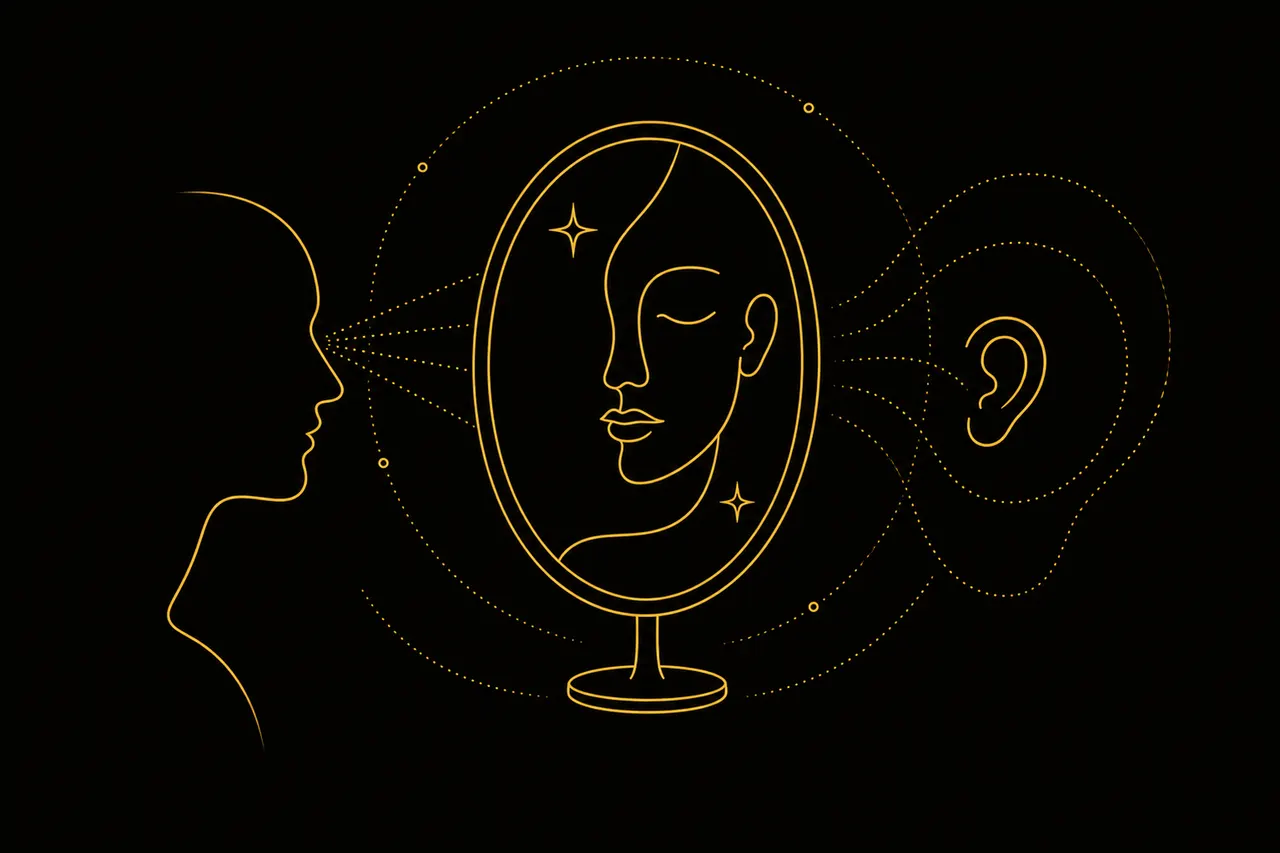
Let me be clear about one thing first. What this article takes up is not proof that physiognomy is 'correct.' Judging a person's personality, ability, health, or destiny from their face is not supported by psychology, and this article does not recommend such judgments. Instead, I flip the question around. Why does a weakly grounded interpretation sound so convincing? That persuasiveness comes not from the face, but from the way our minds work when we look at faces. Physiognomy is less a ruler for measuring people than a mirror reflecting how human cognition turns. Let us look into that mirror through four psychological mechanisms: the halo effect, automatic inference, the Barnum effect, and confirmation bias.
The Halo Effect: One Impression Colors the Whole
The first gear is the halo effect. In his 1920 paper 'A Constant Error in Psychological Ratings,' psychologist Edward Thorndike analyzed data in which military officers evaluated their soldiers. The officers were asked to rate separate, independent items such as physique, intelligence, leadership, and character individually, yet the actual scores leaned excessively in one direction. If a soldier 'looked good,' his physique, his mind, and his character were all rated high across the board.
Thorndike called this a 'constant error'—a systematic illusion that always tilts in a particular direction. One prominent impression, whether liking or dislike, spreads like a halo and colors the judgment of unrelated traits in the same hue. Physiognomic interpretation simply tidies this halo into language. When the likability of 'gentle, kind eyes' flows naturally into the inference 'so the heart must be generous too,' we feel we have gained new information, but in truth we have merely re-confirmed the halo of a first impression. One good impression fills in the remaining blanks all by itself.
Why Personality Is Read 'Automatically' From a Face
The second gear lies in how fast and effortlessly this halo occurs. In 'Social Attributions from Faces,' published in the Annual Review of Psychology in 2015, Alexander Todorov and colleagues summarized that the moment a person sees an unfamiliar face, they generate personality impressions such as trustworthiness, competence, and likability almost instantly. In their experiments, showing a face for just about 0.1 seconds was enough for people to have already made a judgment, and giving them more time did not greatly overturn that first judgment.
Two points are striking. First, these judgments agree considerably across people. Faced with the same face, many respond similarly with "looks trustworthy" or "looks cold." Second, that agreement does not mean accuracy. That many people feel the same way and that the owner of the face is actually that way are entirely different matters. Todorov and colleagues explain this phenomenon as 'overgeneralization.' Our brains excessively extend emotional expressions (a face that appears to smile as warm) or age cues (a baby face as naive), reading them as if they were real personality information.
In short, reading personality from a face is not a judgment we deliberately choose but something closer to a reflexive processing step that fires the moment the eye meets the face. Physiognomy attaches a name tag and a story to this reflex. Since a plausible narrative is laid over an impression we have already 'felt,' the persuasion is half finished before it even begins.
The Barnum Effect: Sentences That Fit Everyone
The third gear is the nature of the interpretive sentence itself. In 1949, psychologist Bertram Forer administered a personality test to students and then handed each of them a result sheet as 'an analysis just for you.' In fact, what everyone received was one identical page, cobbled together from selections out of an astrology book. Even so, the students rated how well their analysis fit them at well above 4 out of 5 on average. That is why the paper is titled 'The Fallacy of Personal Validation.'
The secret was in the sentences. A statement like "You want to be recognized by others, yet you are quite critical of yourself" fits almost everyone at least a little. This tendency to accept such vague, both-sides-covering statements as words tailored precisely to oneself was later named the 'Barnum effect' by scholars. Typical physiognomic phrasings like "You look strong on the outside but are soft inside" or "You are sociable yet absolutely need time alone" follow exactly this structure. Since opposing tendencies are packed in together, it is bound to fit either way, and seeing ourselves caught in that generous net, we marvel, "How uncannily accurate."
Confirmation Bias: A Mind That Remembers Only the Hits
The fourth gear operates after time has passed. In his 1998 paper 'Confirmation Bias: A Ubiquitous Phenomenon in Many Guises,' Raymond Nickerson summarized that people tend to seek information that confirms beliefs they already hold, interpret it favorably, and remember it long, while letting contradicting evidence slip away. He emphasized that this bias is not the flaw of a particular person but a default tendency broadly spread across human thinking in general.
Once you hear "a wide forehead means a smart person," from then on, every time a wide-foreheaded, clever person catches your eye, you engrave it in memory with "See, it's true." Conversely, people with wide foreheads who are not so, or people with narrow foreheads who are sharp, are never linked to the rule and counted in the first place, so they are quietly forgotten. Only the hits pile up neatly while the misses drop off the ledger. On such a one-sidedly tilted sample, any interpretation looks more accurate as time goes on. Physiognomy's hit rate lies not in the face, but in the sample our memory has selectively gathered.
When the Four Gears Mesh — Why Physiognomy Has Survived So Long
These four mechanisms do not run separately; they mesh into one smooth circuit. The moment we see a face, a personality impression arises automatically (Todorov); that impression spreads to unrelated traits (Thorndike); physiognomy's vague sentences dress that feeling in a perfectly fitting outfit (Forer); and later experience remembers only the hits and hardens the conviction (Nickerson). Not a single step requires any supernatural force, yet the result is the powerful experience that "I see the person by looking at the face."
This psychological sturdiness played a part in physiognomy surviving for centuries in East Asia and continuing in the West through the 19th-century vogue for phrenology and physiognomics. Since the human mind is built from the start to read stories from faces, knowledge that systematized those stories easily took root in any culture. But the fact that it has survived long does not guarantee the truth of its content. A story that sells well and a story that is true are matters on different axes. When we read physiognomy as a case study in cultural history and cognitive psychology, we meet not the foolishness of people of the past but a structure of the mind that works just the same in us today.
| Mechanism | Key scholar / study | How it works | Its role in physiognomy |
|---|---|---|---|
| Halo effect | Thorndike (1920) | One impression colors the judgment of unrelated traits | Lets a likable face spread into personality and ability |
| Automatic face inference | Todorov et al. (2015) | A personality impression forms reflexively in about 0.1 seconds | Lets a narrative be laid over an already 'felt' impression |
| Barnum effect | Forer (1949) | Vague statements that fit anyone are taken as being about oneself | Makes both-sides-covering physiognomic sentences sound plausible |
| Confirmation bias | Nickerson (1998) | Only hits are sought and remembered while misses slip away | Makes the hit rate appear to rise as time passes |
So, How Should We Read It?
Knowing this structure does not switch off the halo effect or automatic inference. They are not switches you can turn on and off by will; they are closer to visual processing. What you can add, though, is one layer of metacognition. When you look at someone's face and the thought "they seem somehow cold" arises, you can pause a beat and recall that this may be a reflex of your brain rather than information about the person. Especially in settings like hiring, interviews, or blind dates, where first impressions sway real decisions, this one beat becomes a small safeguard against unfair misjudgment.
So physiognomy is most honest when kept not as a yardstick for judging people, but as a cultural and psychological story enjoyed for fun. A face alone cannot pin down someone's personality or destiny. But when you ask back, "Why did I get this impression from this face?", physiognomy turns from a tool for sizing up others into a lens for observing your own cognition. Viewed through that lens, face reading becomes not superstition but an intriguing bit of insight into the mind.
Frequently asked questions
Physiognomy seems to fit well, so does that mean it's actually correct?
'Feeling like it fits' and 'actually being correct' are different matters. Vague sentences that fit anyone (the Barnum effect) and the habit of remembering only the hits (confirmation bias) make the hit rate look high, but this is the way our minds work rather than the accuracy of the face. Enjoy it as a story for fun, but do not use it as grounds for pinning down a specific person's personality, ability, or destiny.
How do the halo effect and the Barnum effect differ?
The halo effect is the phenomenon where one impression (e.g., a likable face) colors the judgment of unrelated traits such as intelligence or conscientiousness, while the Barnum effect is accepting a vague description that fits anyone as words tailored precisely to oneself. In physiognomy, the former produces the 'spread of the impression,' and the latter produces the 'plausibility of the interpretive sentence.'
Even if the impression forms automatically, does a face accurately reveal personality? (It does not.)
According to Todorov and colleagues, people generate personality impressions from a face in a span of about 0.1 seconds, and those judgments agree fairly well with one another. But 'many people feeling the same way' and 'actually being that way' are separate things: a face does not reliably reveal what a person is truly like, and the accuracy of inferring personality from a face is generally low. It is important not to mistake an automatically arising impression for a fact.
If I know these biases, can I avoid being fooled by physiognomy?
Knowing does not switch off the automatic reaction itself. But you can cultivate the metacognition of pausing a beat to recall, "This may be a reaction of my brain rather than information about the person." Especially in situations like interviews or blind dates, where first impressions sway decisions, this one beat reduces unfair misjudgment.
Does this mean I should not believe in physiognomy at all?
It is less a matter of believing or not than of 'how you handle it.' Used as a tool to judge people by their faces, it reinforces bias; but treated as cultural and psychological insight into why we read stories from faces, it becomes an intriguing lens for understanding your own cognition.
Article info & references
Published July 4, 2026 · Last updated July 4, 2026
- Edward L. Thorndike, A Constant Error in Psychological Ratings (1920)
- Bertram R. Forer, The Fallacy of Personal Validation: A Classroom Demonstration of Gullibility (1949)
- Raymond S. Nickerson, Confirmation Bias: A Ubiquitous Phenomenon in Many Guises (1998)
- Alexander Todorov, Christopher Y. Olivola, Ron Dotsch & Peter Mende-Siedlecki, Social Attributions from Faces: Determinants, Consequences, Accuracy, and Functional Significance (2015) — a review of face-perception research