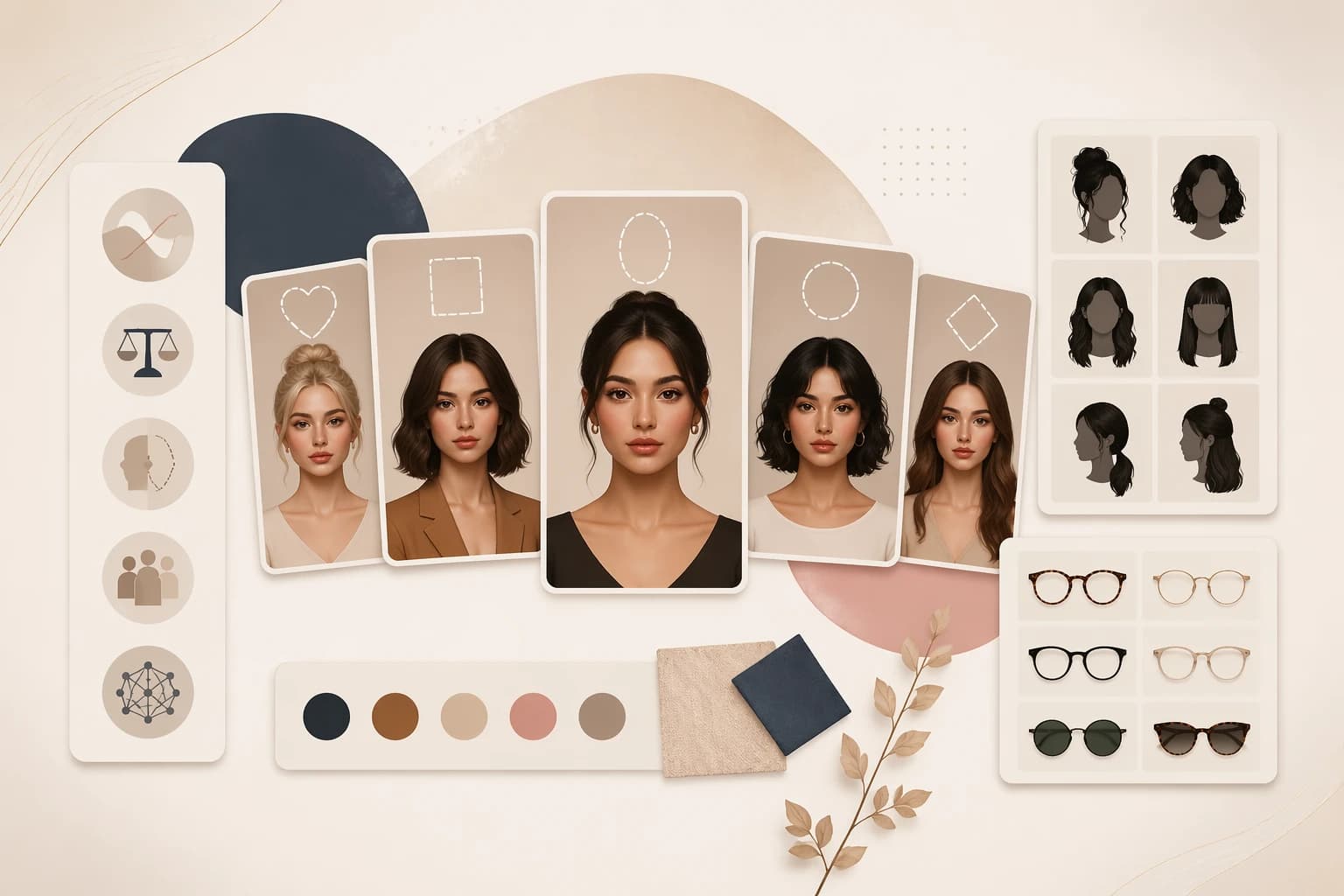
Read enough styling content and a few sentences keep coming back: "oval is the prettiest," "square jaws are masculine," and so on. This article takes five of those recurring myths and explains why each is a heavy oversimplification.
Myth 1. "Oval is the most attractive"
A common magazine claim that shifts with era and culture. 1950s Hollywood idolized heart and round; 2010s K-pop briefly worshipped a V-line closer to diamond. "The prettiest face shape" is a cultural moment, not biology.
Myth 2. "Your face shape is fixed for life"
Faces shift slightly into the late 20s and continue to move with weight, exercise, and expression habits. Hair, makeup, and weight change apparent shape all the time. Treat your face shape as "closest to X right now," not a lifetime label.
Myth 3. "Square = masculine, round = feminine"
Gender stereotyping dressed up as face analysis. Real faces show every shape across every gender, and the same face reads entirely differently under different expressions. Styling also works better when driven by "what look do I want" rather than gender prescriptions.
Myth 4. "Change your face shape and life changes"
A staple of cosmetic advertising. Appearance changes can affect self-confidence, but the claim that looks determine life outcomes is not well supported. Research shows a modest first-impression advantage; long-term relationships, performance, and happiness don't track with face shape. Styling, makeup, and photography reach most of the plausible benefit.
Myth 5. "AI can score your real facial attractiveness"
Attractiveness-scoring AIs exist, but their scores are almost entirely a reflection of who labeled the training data. A model trained on Western preferences and one trained on Korean or Japanese preferences will score the same face differently. Scores also swing by ten points on a different lighting or angle. That is why FaceOracle does not surface attractiveness scores by default.
A balanced view of attractiveness
Research repeatedly highlights attractiveness signals far more human than face shape:
- Expression: a warm look boosts ratings substantially.
- Eye contact: direct gaze reads as trustworthy.
- Posture: natural upright posture raises likability.
- Clothing fit and context fit: bigger driver than facial features.
- Voice and speech rhythm: decisive in real-life encounters.
Recap
- "Most attractive shape" is culture, not biology.
- Face shape drifts; styling changes how it reads.
- Gender-coded shape labels are custom, not science.
- Surgical shape changes do not reshape life outcomes.
- AI attractiveness scores inherit labeler bias — handle with care.