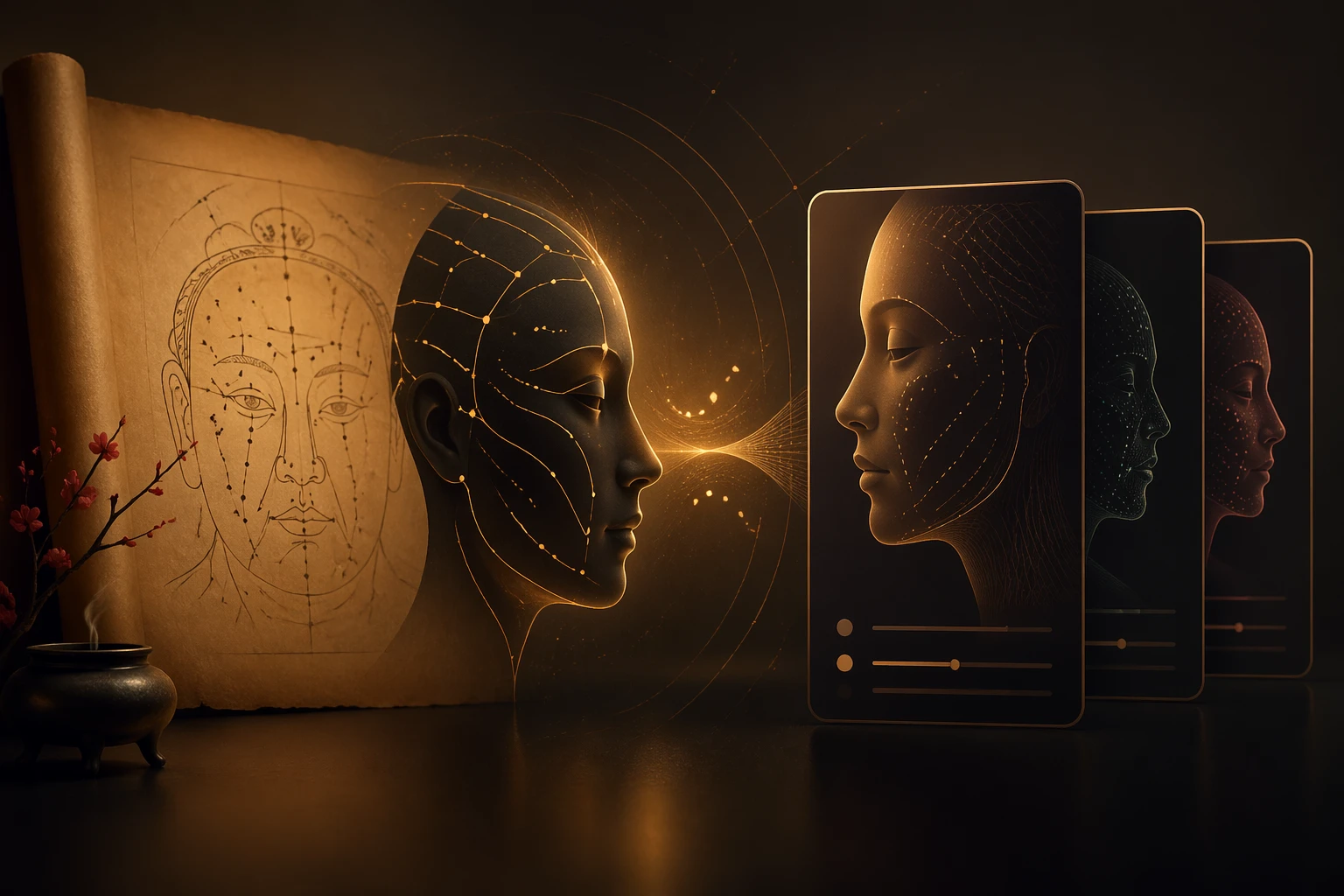
Face reading is one of the oldest methods of character assessment in human history. Developed over thousands of years in both Eastern and Western traditions, it is now being reborn through AI technology in an entirely new form.
Thousands of Years of Eastern Face Reading
The roots of face reading trace back to China's Spring and Autumn Period (770-221 BC). Guiguzi established the foundations of physiognomy, and later during the Song Dynasty, the Ma Yi Xiang Fa compiled by Ma Yi Dao Zhe became known as the bible of Eastern face reading. The Three Courts system — dividing the face into forehead (Heaven Court), nose (Middle Court), and chin (Earth Court) — originates from this classic text.
In Korea, face reading was transmitted through the Three Kingdoms, Goryeo, and Joseon periods, gaining unique local interpretations. During Joseon, there are records of civil exam officials referencing candidates' facial features — showing how deeply it was embedded in daily life.
Western Face Reading — Physiognomy
In the West, Aristotle authored Physiognomonica in ancient Greece. In the 18th century, Swiss theologian Johann Lavater systematized physiognomy, making it fashionable across Europe. However, the misuse of phrenology in the 19th century and racially biased interpretations led the scientific community to distance itself from the practice.
When Face Reading Meets AI — Entertainment Reborn
In the 21st century, face reading has been reappraised not as science but as cultural content and entertainment. Advances in AI technology now enable precise analysis of facial features, spawning services that automate face reading interpretations and deliver them in engaging ways.
Crucially, these services do not claim to "predict destiny." The right approach is to enjoy them as entertainment content that lets you experience fascinating traditional cultural interpretations through modern technology.
The FaceOracle Approach
FaceOracle combines playful interpretations of traditional face reading with AI image analysis. It delivers traditional face-reading impressions, first-impression keywords, and similar-vibe celebrity mood references as entertainment. Fun and cultural context come first — we make no scientific claims and no identity or face-recognition claims.